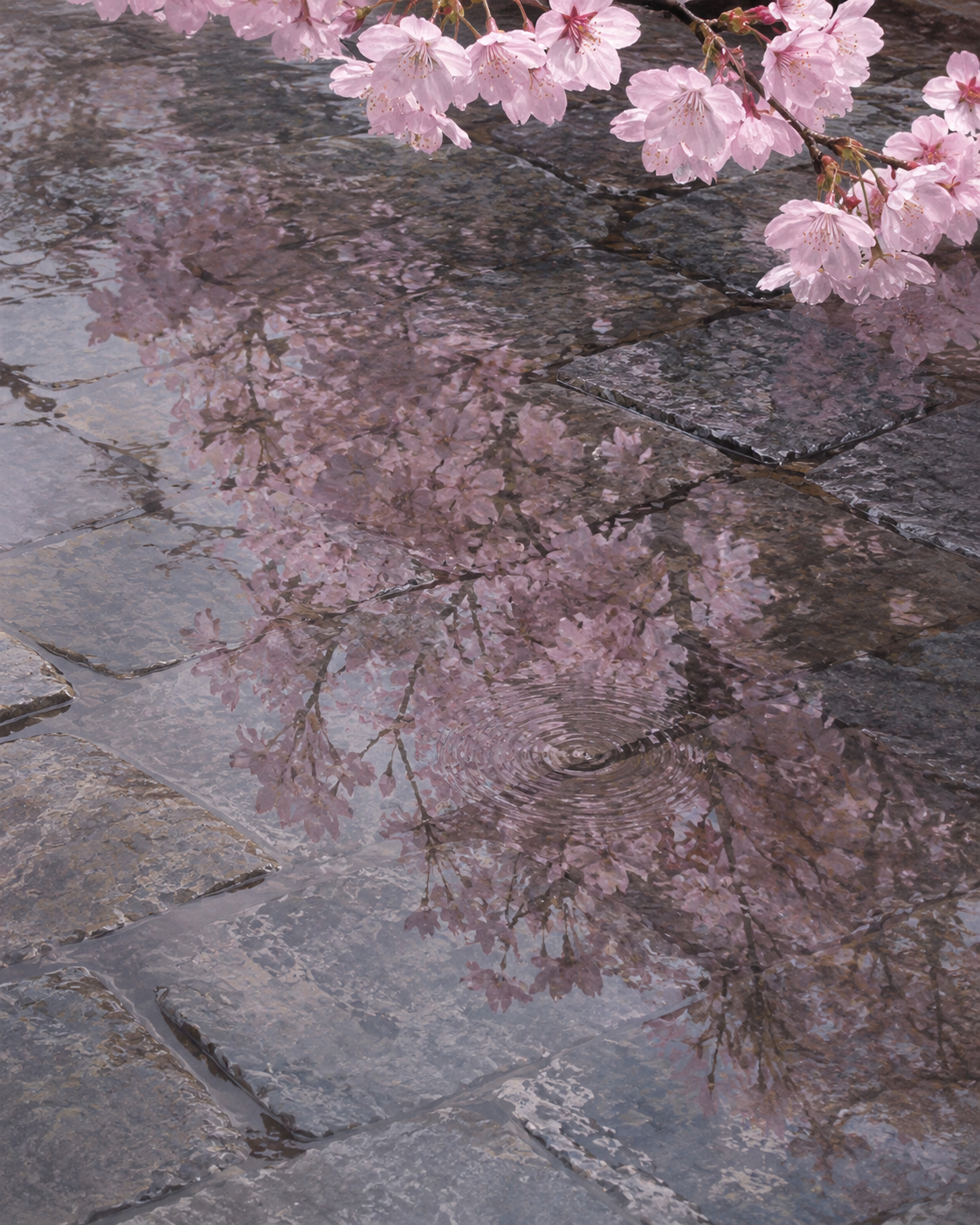
Cherry Raindrops in the Stone Mirror
Critique
Introduction This painting makes rain-darkened pavement the main field for viewing cherry blossoms. Flowers fringe the upper edge; most of the tree appears indirectly in shallow water. Description Irregular gray paving slabs fill the vertical format, their joints running in broken diagonals. A flowering branch hangs from the top right, with pink petals and droplets clearly visible. Across the center, pooled rainwater reflects a large canopy in muted mauve. Near the lower middle, a circular ripple interrupts the mirrored branches and sends fine rings across the surface. Analysis The work reverses an expected hierarchy: solid stone becomes a fluid picture plane, while the blossoms themselves are reduced to a framing accent. Rough, angular slabs contrast with soft flower masses and concentric water rings. Cool charcoal and blue-gray dominate, making the limited pink appear luminous without strong sunlight. The ripple acts as a second focal point beneath the hanging branch, and its circles counter the pavement’s hard diagonals. Small beads of water unify stone, petal, and reflection through a shared wet sheen. Interpretation and Evaluation The disturbed reflection presents beauty as something visible but never fully fixed. Careful drawing makes the paving weighty, while sensitive tonal transitions keep the reflected canopy recognizable within its broken surface. The composition is notably original in directing attention downward rather than upward. Its restrained color, convincing textures, and precise placement of the ripple transform a minor weather event into the central expressive device. Conclusion At first the image depicts wet paving beneath a flowering tree, but attention reveals water as the scene’s mediator. Through inversion, texture contrast, and disturbance, the painting finds renewal in an image changing as it is seen.
Same Subcategory
Similar Artworks
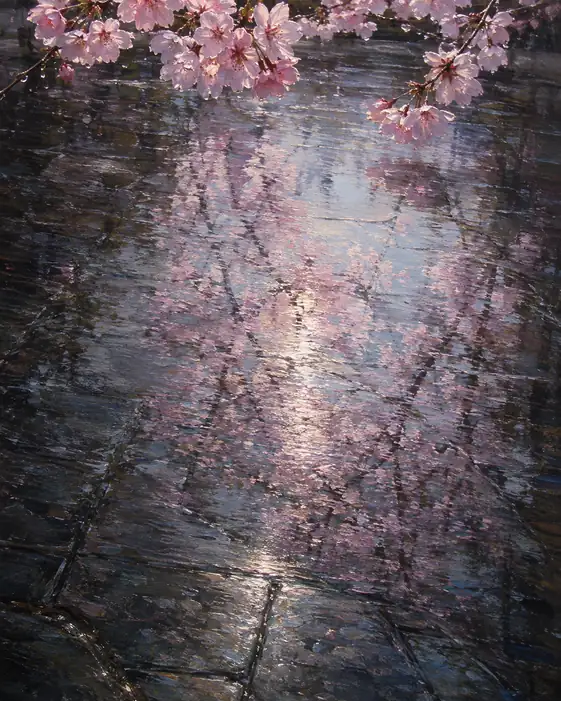 Reflection of the Canopy in Rain-Soaked Stone
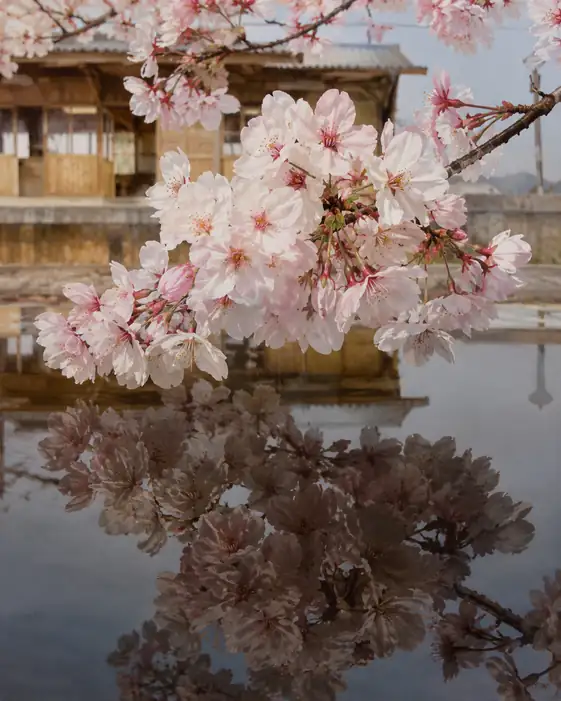 Symmetrical Reverie Above the Pool
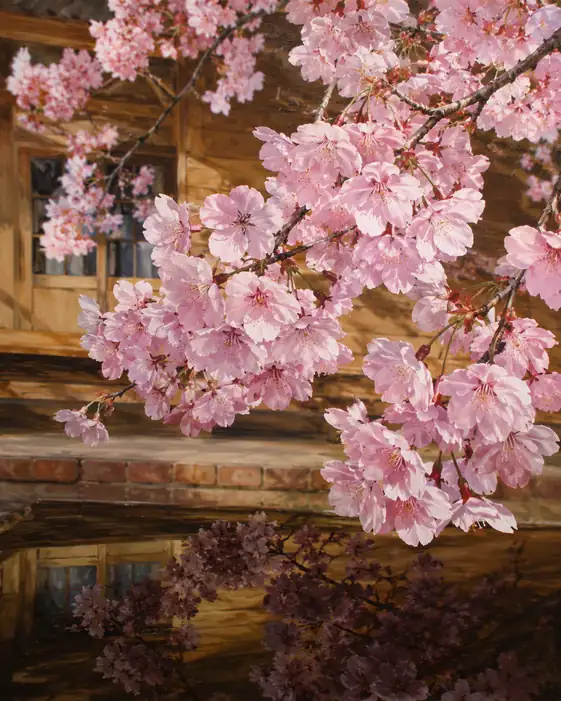 Spring Reflected on Still Water and Timber
 Layered Canopies in the Midnight Blue
 Distant Moon Halo Above the Midnight Blooms
 Blossoms Mirrored on Wet Earth and Timber
 Wisteria Reflected in the Quiet Pool
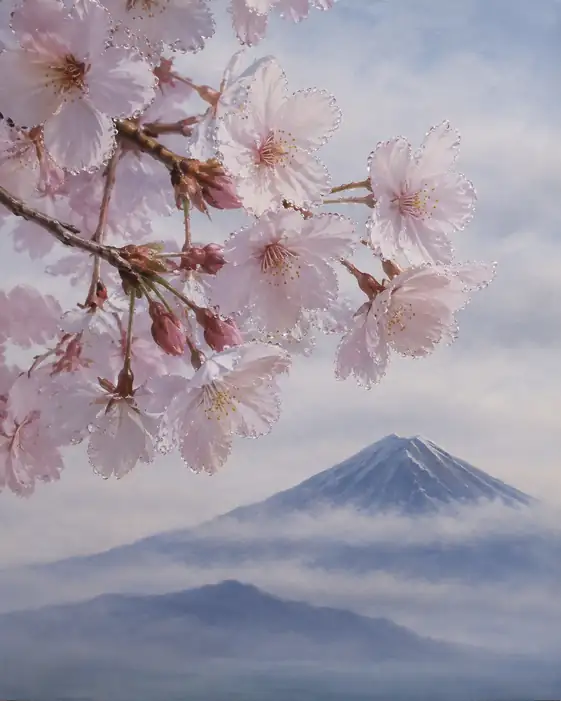 Dew-Beaded Petals and the Distant Summit
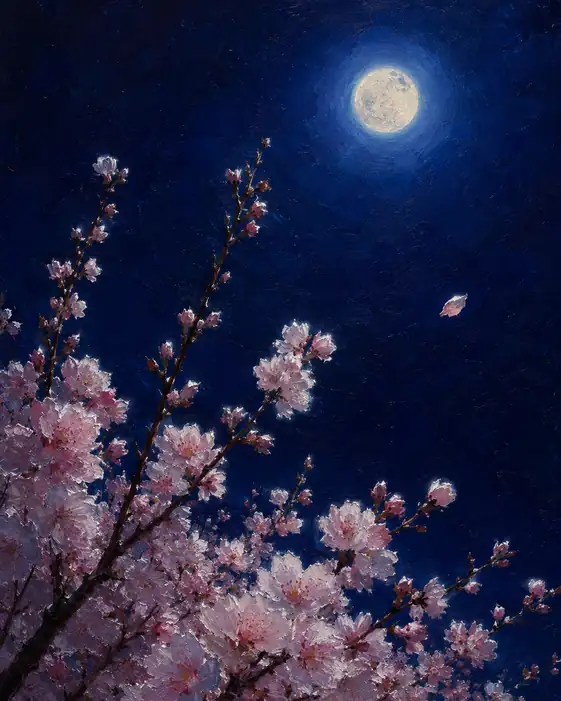 Full Moon in the High Azure Night
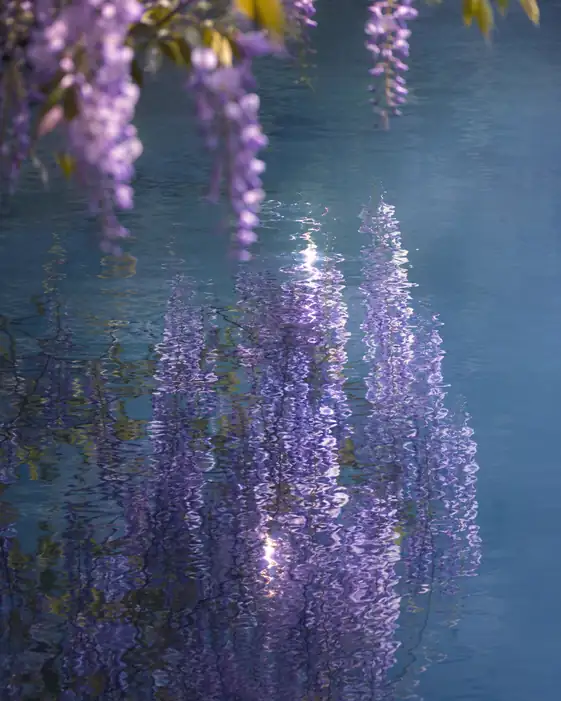 Ripples of Violet Across the Water