
Windmill Hill, Where the Breeze Crosses a Blue Spring
Critique
Introduction This warm-toned landscape gives a nemophila field broad horizontal reach beneath a pale late-afternoon sky. The windmill sits relatively small at upper right, leaving flowers and open distance to dominate. Compared with more saturated versions, the scene favors calm integration over monumentality. Description Blue-and-white blossoms spread from large foreground cups into fine bands across the slope. A rope fence runs near the upper third, dividing the field from a line of green trees. The dark wooden windmill rises right of center with four pale sails. A solitary tree stands beyond it. Soft cream clouds scatter through light blue sky, warmed near the horizon. Small lamp posts appear along the distant edge. Analysis The low horizon grants the flower field greater weight while preserving generous sky. The mill is offset and compact, balancing the darker tree mass at left. Horizontal flower bands and fence lines produce calm recession; diagonal sails provide limited counterenergy. Cooler blues are softened by yellow-green foliage and cream light. Foreground petals remain readable but less oversized, allowing a continuous transition into distance. Broad, broken strokes unify the surface. Interpretation and Evaluation The gentler light shifts emphasis from spectacle toward duration. The field appears as a maintained seasonal environment rather than a miraculous eruption. Windmill, fence, lamps, and flowers share space without one claiming authority. This social landscape is idealized, yet its visible infrastructure acknowledges stewardship. The smaller landmark encourages attention to collective ground rather than singular icon. Conclusion The work succeeds through balance and restraint. Its windmill offers orientation, but the horizontal flower field carries the emotional breadth. Beauty is presented as something sustained across a place, not concentrated in one object.
Same Subcategory
 Breeze through the Crimson Canopy
Similar Artworks
 Rising Through the Blue Slope to the Mill
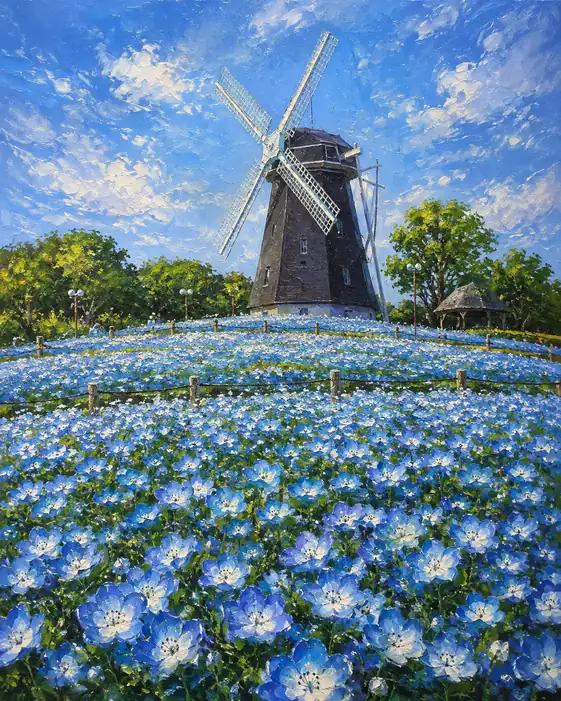 Stepped Horizons of Nemophila and Sky
 Azure Sea of Blossoms Beneath the Windmill
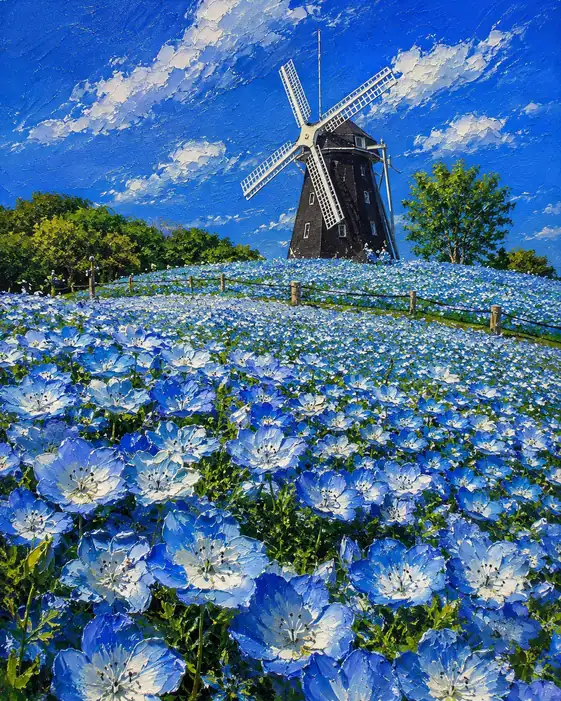 Azure Hillside Under the Turning Sails
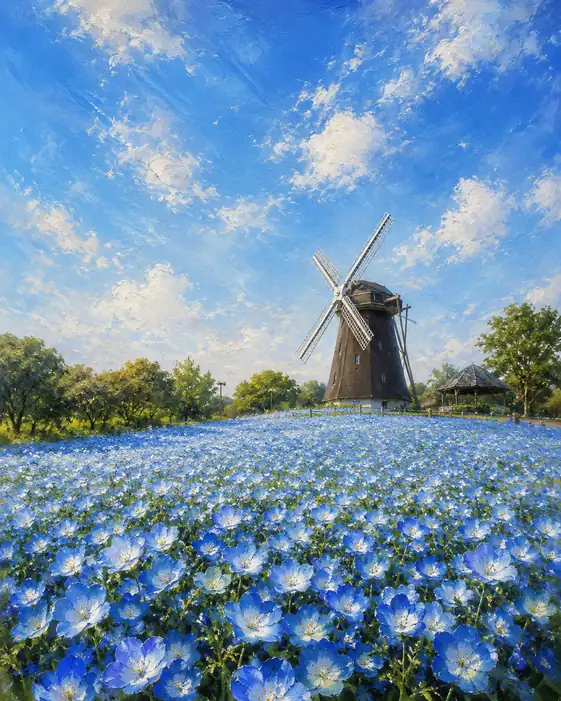 Breath of Blue Under the Summer Clouds
 Sky and Petal Meeting the Wind
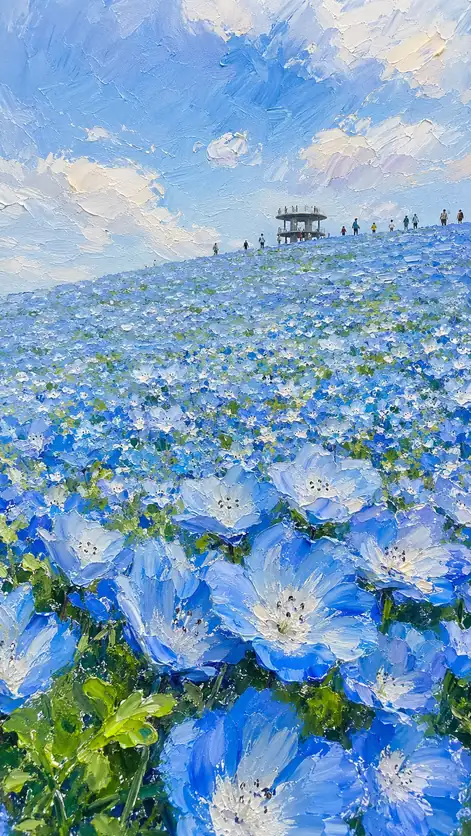 A Blue Hill into the Sky
 Morning Church in Field of Nemophila
 Where Morning Dew Blooms into Sky
 Cosmos Meadow Beneath Autumn Arc