
Azure Hillside Under the Turning Sails
Critique
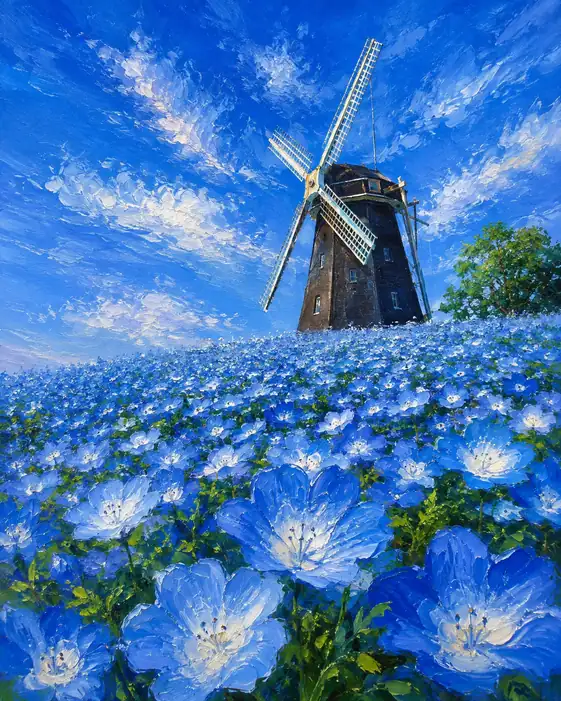
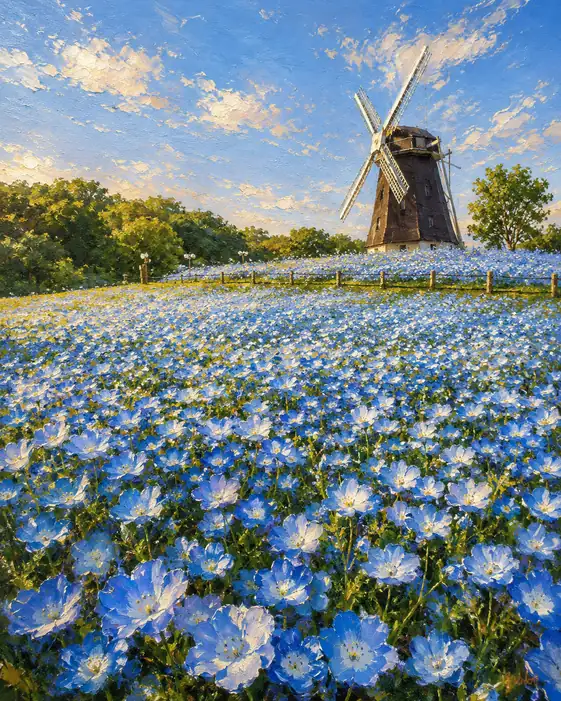
Introduction This low-angle landscape brings nemophila close while a windmill rises above the crest. Compared with a panoramic view, the composition compresses sky and structure into intensity. Flower field and machine confront one another across a taut horizon. Description Large blue flowers with white centers fill the lower two thirds, densely interwoven with green leaves. Their scale decreases toward a rope fence crossing the slope. A tall black-brown windmill stands near upper center, its white lattice sails extending dramatically against cobalt sky. Green trees flank it, especially a bright solitary tree at right. Bold white clouds stream diagonally behind the sails. No gazebo or visible visitors interrupt the field. Analysis The low viewpoint magnifies foreground blossoms and makes the windmill appear monumental. A steep diagonal slope lifts left to right, reinforced by fence rails. The mill’s near-black body anchors an extremely saturated blue-green palette. White flower centers, sails, and clouds establish a repeated luminous network. Thick strokes give petals and sky similar material force. The compact sky intensifies contact between sails and clouds, suggesting motion even though the blades remain fixed. Interpretation and Evaluation The flowers form a crowd of distinct faces directed upward, while the windmill gathers invisible air above them. This anthropomorphic reading is invited but not required; formally, both field and structure are radial systems responding to sun and wind. The absence of visitors makes the encounter feel elemental. High saturation risks artificiality, yet strong tonal structure and dark timber prevent visual collapse. Conclusion The work succeeds through concentrated scale and contrast. It presents abundance not as gentle distance but as immediate physical presence. Windmill and flowers become complementary instruments through which the hill registers weather.
Same Subcategory
Similar Artworks
 Sky and Petal Meeting the Wind
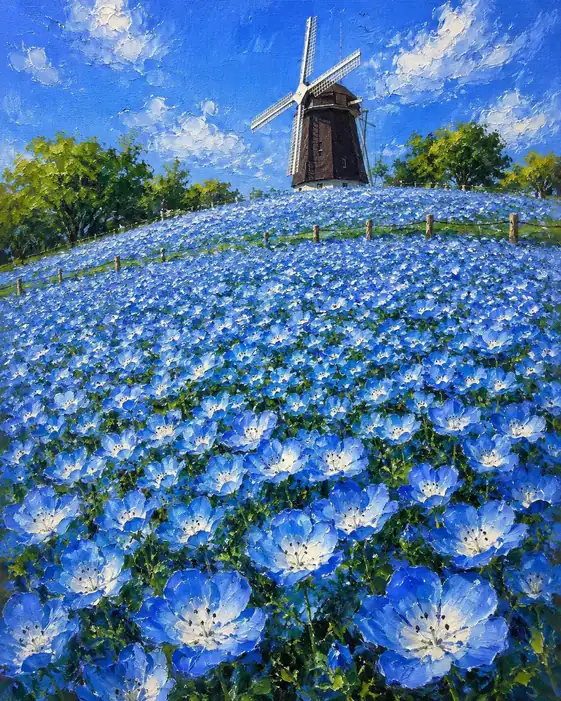 Azure Sea of Blossoms Beneath the Windmill
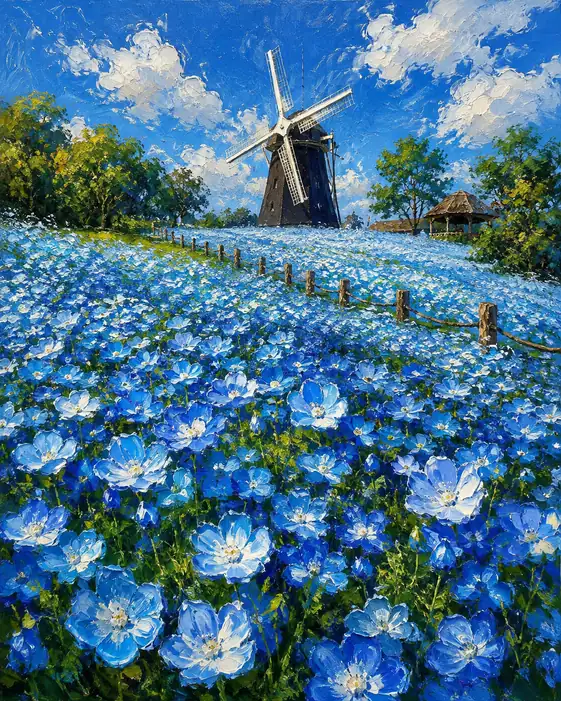 Rising Through the Blue Slope to the Mill
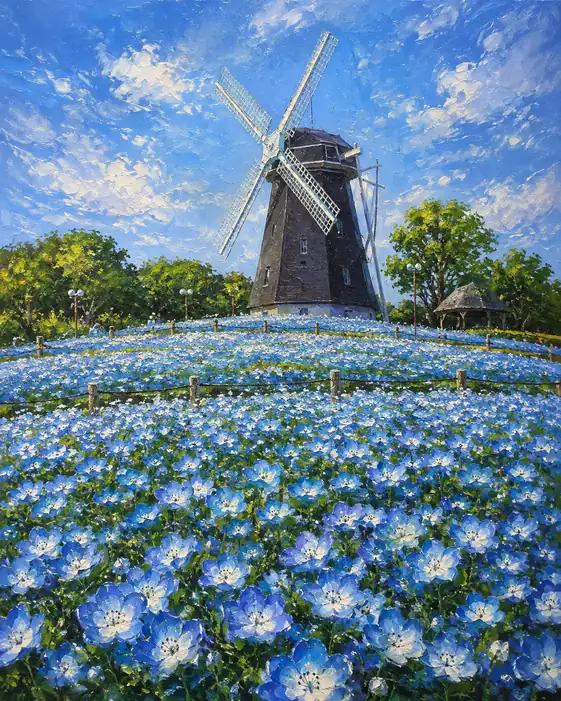 Stepped Horizons of Nemophila and Sky
 Windmill Hill, Where the Breeze Crosses a Blue Spring
 Breath of Blue Under the Summer Clouds
 A Blue Hill into the Sky
 Where Morning Dew Blooms into Sky
 Pink Whispers to the Eternal Peak
 Golden Waves Running Across the Hills