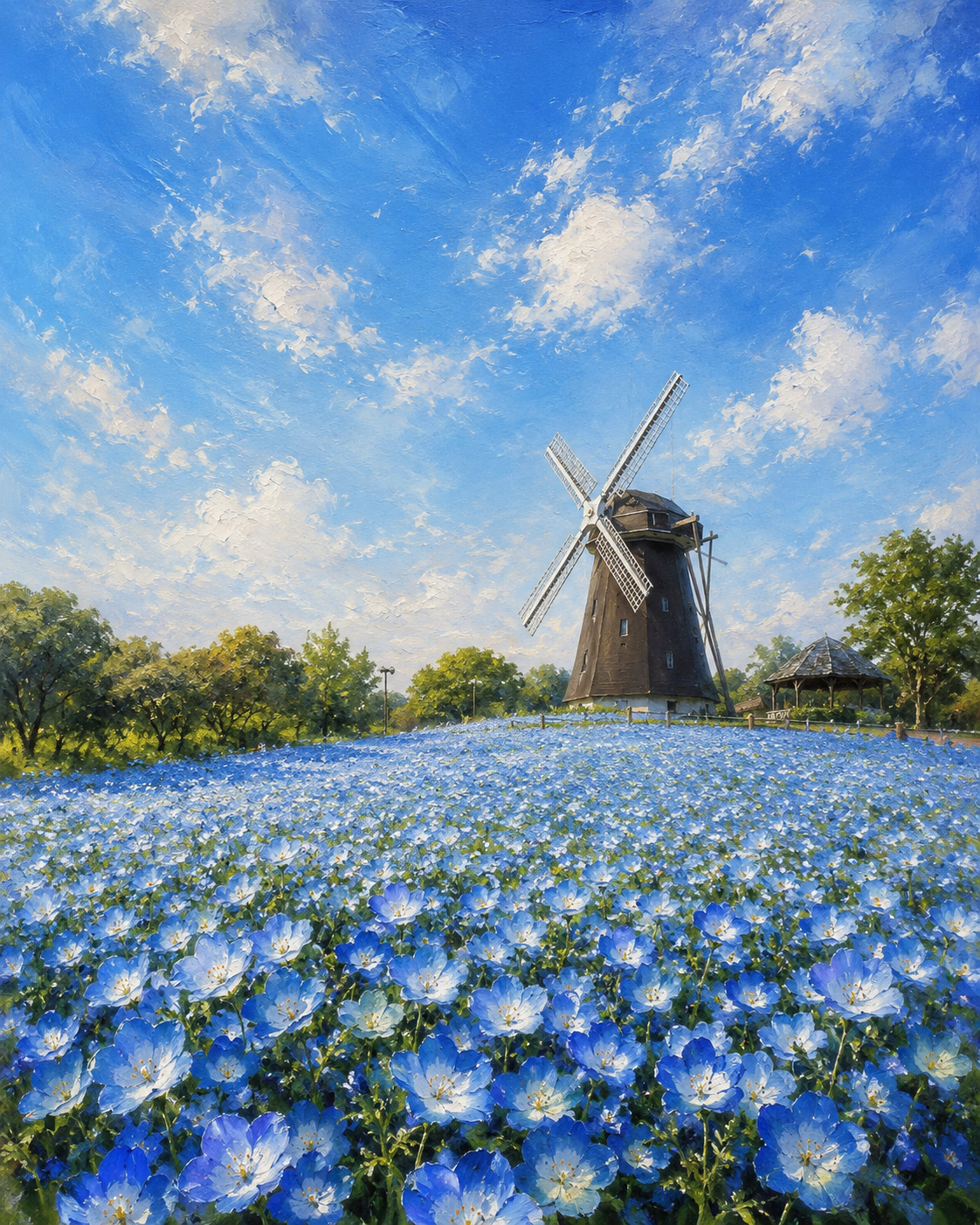
Breath of Blue Under the Summer Clouds
Critique
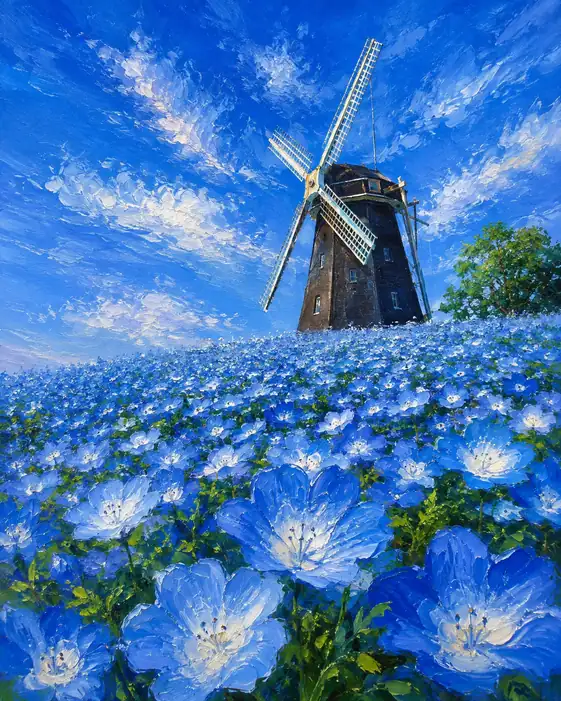
Introduction This painting balances a windmill and flower field beneath a large summer sky. Unlike a close botanical study, it grants clouds and open air nearly half the composition. The landscape emphasizes spaciousness, leisure, and the coexistence of cultivation with weather. Description Blue nemophila cover the foreground and middle slope, with larger cups visible along the lower edge and a fine blue carpet near the crest. A dark wooden windmill stands right of center, its four white lattice sails angled across the sky. Trees border the field, and an open-sided gazebo appears at far right. Small fence posts and distant visitors mark the horizon. White clouds drift through a pale-to-deep blue sky. Analysis The low curved horizon separates two broad blue fields: flowers below and atmosphere above. The windmill bridges them vertically and acts as the main dark accent. Its diagonal sails energize the otherwise horizontal panorama. Foreground flowers establish depth through scale, while distant trees provide a green hinge. White repeats in flower centers, sails, and clouds, visually connecting ground and sky. Generous negative space prevents floral abundance from becoming oppressive. Interpretation and Evaluation The gazebo and tiny visitors frame the site as a shared public landscape rather than untouched wilderness. Windmill, fence, and cultivated field show human ordering, yet the enormous sky relativizes that control. The scene celebrates accessible beauty and communal rest. Its clarity risks postcard idealization, but the disproportionate sky gives genuine breathing room and shifts attention from landmark ownership toward environmental scale. Conclusion The work succeeds through proportion. Flowers provide intimacy, the windmill orientation, and the sky freedom. Together they create a landscape where designed pleasure remains open to forces larger than its planners.
Same Subcategory
Similar Artworks
 Rising Through the Blue Slope to the Mill
 Stepped Horizons of Nemophila and Sky
 Azure Sea of Blossoms Beneath the Windmill
 Sky and Petal Meeting the Wind
 Windmill Hill, Where the Breeze Crosses a Blue Spring
 Azure Hillside Under the Turning Sails
 The Canola Flowers Remember the Way
 Sea Breeze upon the Azure Coast
 A Blue Hill into the Sky
 Cosmos Meadow Beneath Autumn Arc