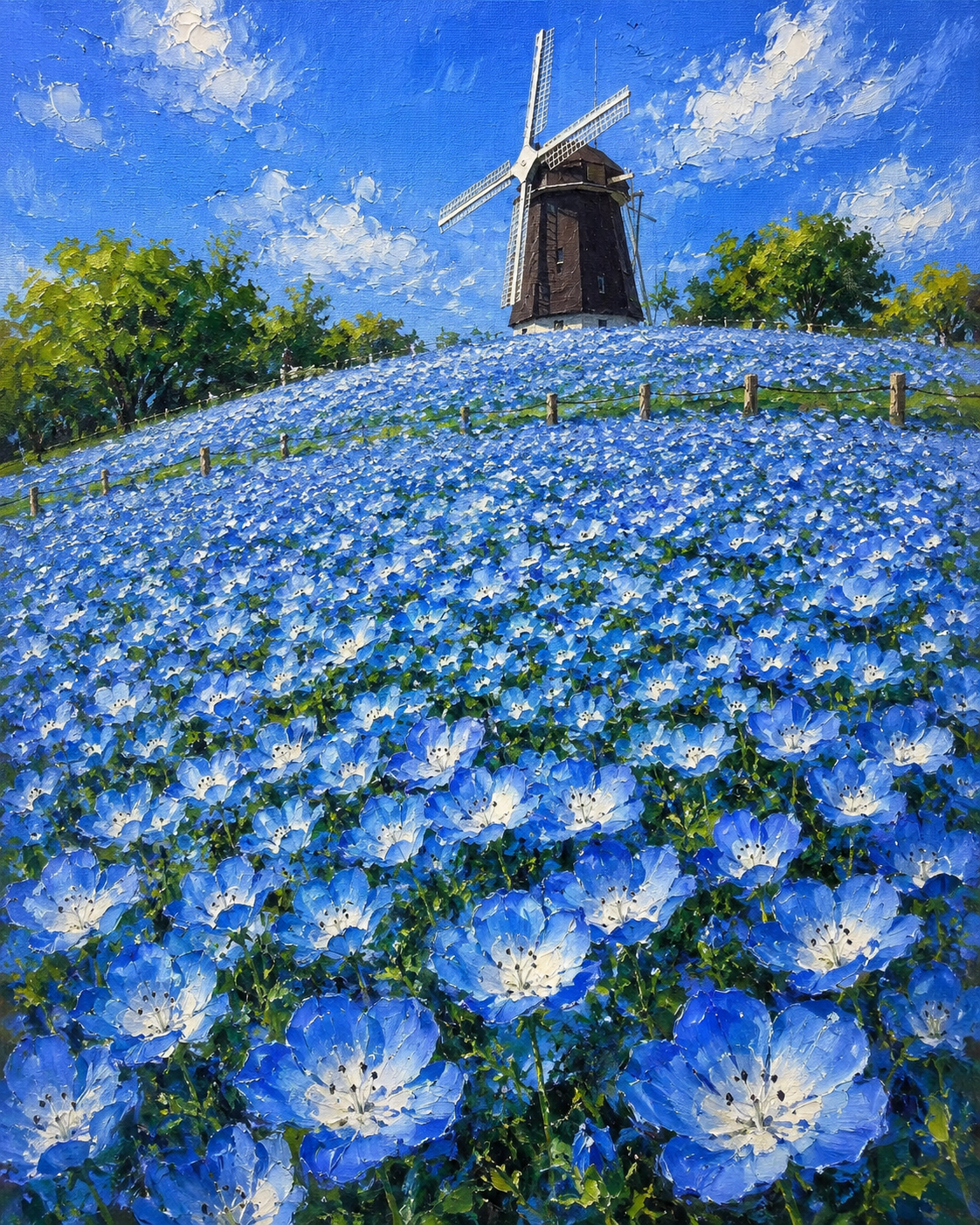
Azure Sea of Blossoms Beneath the Windmill
Critique
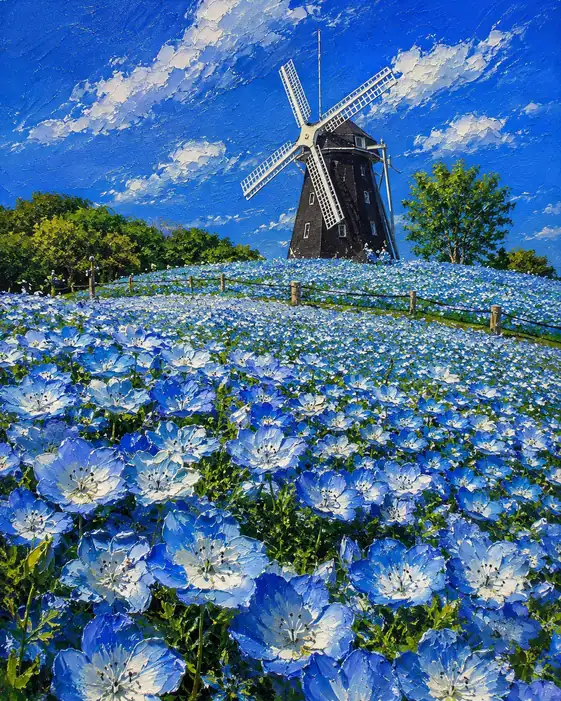
Introduction This landscape places a windmill above a slope of blue nemophila. The flowers dominate the view, enlarging from a fine distant band into distinct foreground cups. Repetition turns the hillside into a second sky beneath the machine. Description Blue-and-white blossoms fill roughly three quarters of the frame. The nearest flowers reveal pale centers, dark stamens, green leaves, and thick individual petals. A rope fence curves horizontally across the upper slope. At the crest stands a brown wooden windmill with four white lattice sails, flanked by green trees. A saturated cobalt sky holds scattered white clouds. The low viewpoint hides the horizon behind flowers. Analysis The field rises as a broad diagonal plane, while the windmill provides a compact vertical crown. Flower size decreases rapidly uphill, producing strong depth through repetition. Blue unifies petals and sky, interrupted by green foliage, white centers, and the dark mill. The sails echo petals in their radial arrangement. Thick strokes give foreground blooms tactile individuality, then merge into a textured band. The curved fence supplies scale and prevents the field from becoming limitless abstraction. Interpretation and Evaluation The windmill traditionally converts invisible wind into useful motion; flowers register the same air through implied swaying. Machine and field therefore appear responsive rather than opposed. The overwhelming bloom suggests collective abundance: no single flower controls the image, though each remains legible nearby. Saturation risks artificiality, but the dark timber, uneven fence, and green interruptions stabilize the idealized scene. Conclusion The work succeeds by joining one landmark with countless small lives. Windmill and blossoms repeat radial forms at radically different scales. The hill becomes a communal blue expanse that supports, rather than merely decorates, the structure above.
Same Subcategory
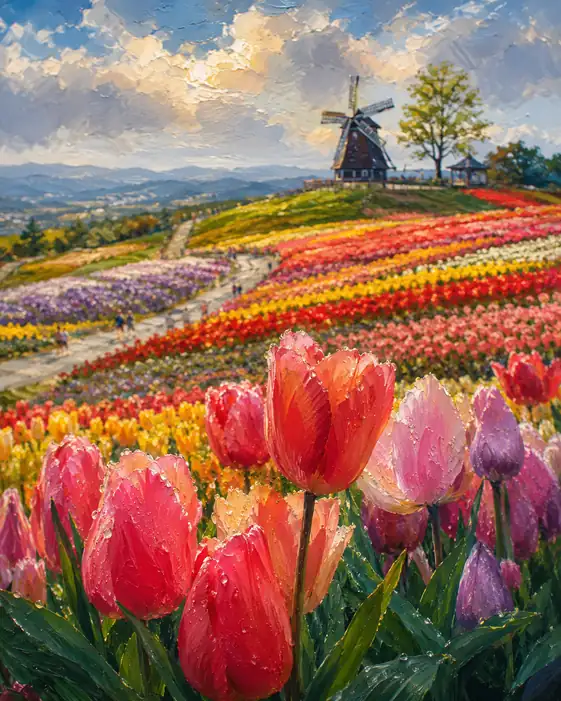 Tulips Turn the Hill into a Rainbow
Similar Artworks
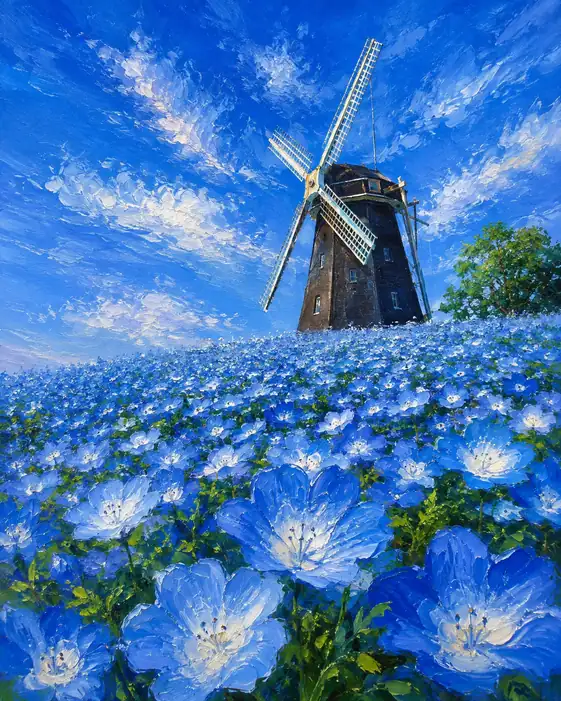 Sky and Petal Meeting the Wind
 Rising Through the Blue Slope to the Mill
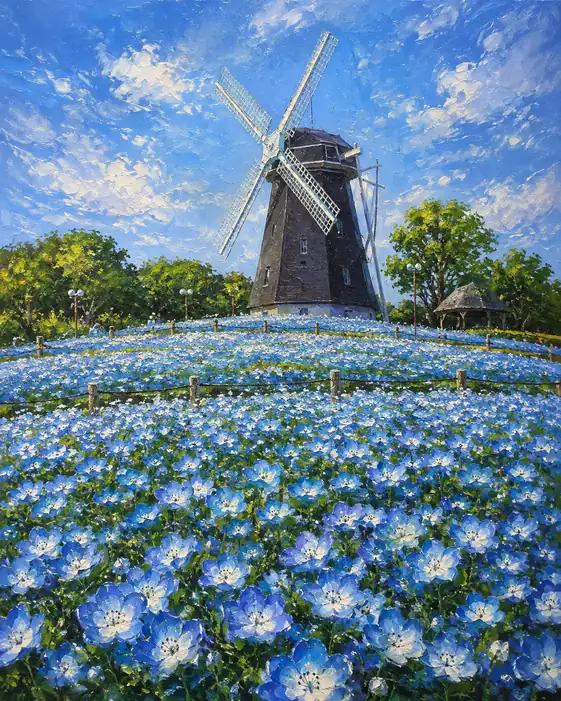 Stepped Horizons of Nemophila and Sky
 Azure Hillside Under the Turning Sails
 Breath of Blue Under the Summer Clouds
 Windmill Hill, Where the Breeze Crosses a Blue Spring
 A Blue Hill into the Sky
 Where Morning Dew Blooms into Sky
 Vibrant Path to the Silent Peaks
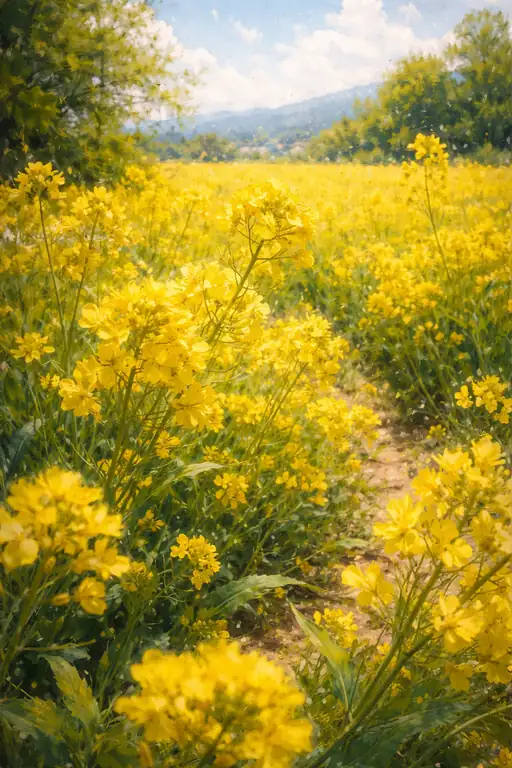 The Canola Flowers Remember the Way