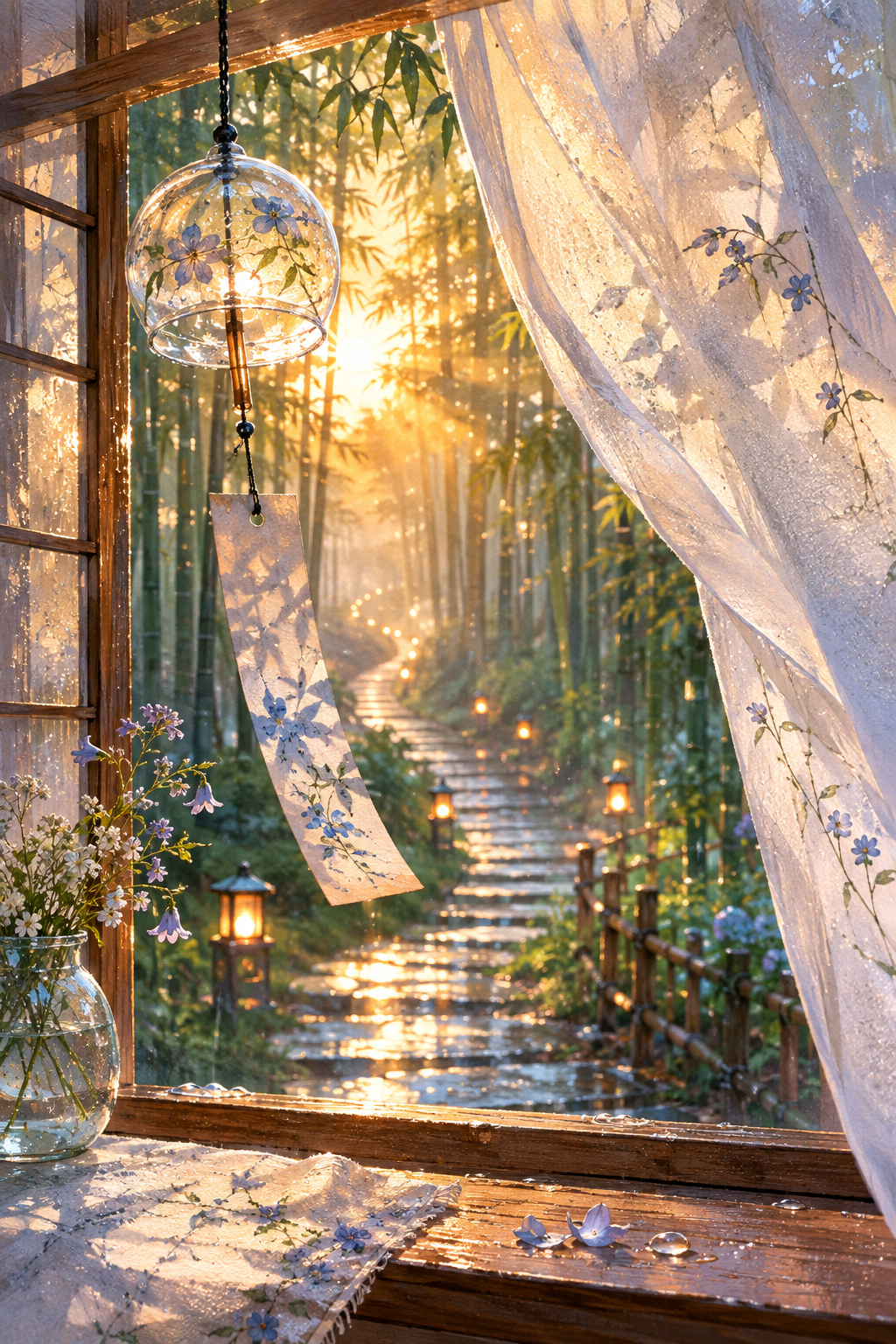
Morning Breeze Between Chime and Bamboo
Critique
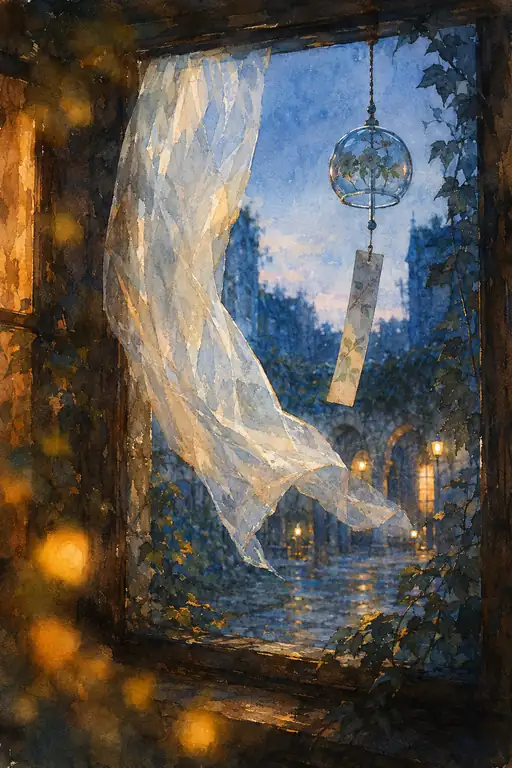
Introduction This watercolor looks from a window onto bamboo. A wind chime and curtain occupy the threshold, while wet steps lead outward. Breeze, light, and sound make the window an exchange between shelter and forest. Description A transparent chime hangs at upper left, painted with blue flowers and fitted with a flowered paper strip. At right, a sheer curtain lifts in broad folds. A jar of wildflowers stands on the sill beside fallen petals, cloth, and raindrops. Beyond, bamboo frames a stairway marked by lanterns and railings. Low sun turns mist and puddles gold. Analysis The window frame establishes a stable rectangle, crossed by the chime’s vertical strip and the curtain’s sweeping diagonal. These moving forms animate the boundary. Repeated blue flowers connect glass, paper, fabric, bouquet, and fallen petals. Warm backlight passes through translucent surfaces, revealing water, weave, and scratches. The path’s central recession counters the near flatness of the window. Small lanterns rhythmically carry interior warmth into depth. Interpretation and Evaluation The chime makes an unseen breeze imaginable through anticipated sound; the curtain makes the same air visible. Interior decoration and living forest therefore respond to one force. The long paper strip resembles a message, yet its floral marks replace readable language with sensation. Rain has entered as droplets and petals, further weakening the division between inside and outside. Although highly idealized, worn wood and scattered fragments keep the threshold convincingly inhabited. Conclusion The work succeeds by presenting openness as reciprocal rather than passive. The room frames the forest, but light, air, water, and sound return through the frame. The viewer is invited not simply to admire the path, but to feel the moment before stepping onto it.
Same Subcategory
Similar Artworks
 Whispering Curtain and Morning Breeze
 Twilight Breeze and the Clear Wind Chime
 Morning Glory Wind Chime at Dusk
 Where the Sea Wind Whispers to the Glass
 Morning Repose Along the Bamboo Grove
 Summer Wind Chime Whispering by the Cloister
 Forest Stairs Woven in Sunlight and Bloom
 Offering of Wildflowers to the Forest Path
 Evening Air Carried on Chimes
 Petals Drifting on a Forest Mirror