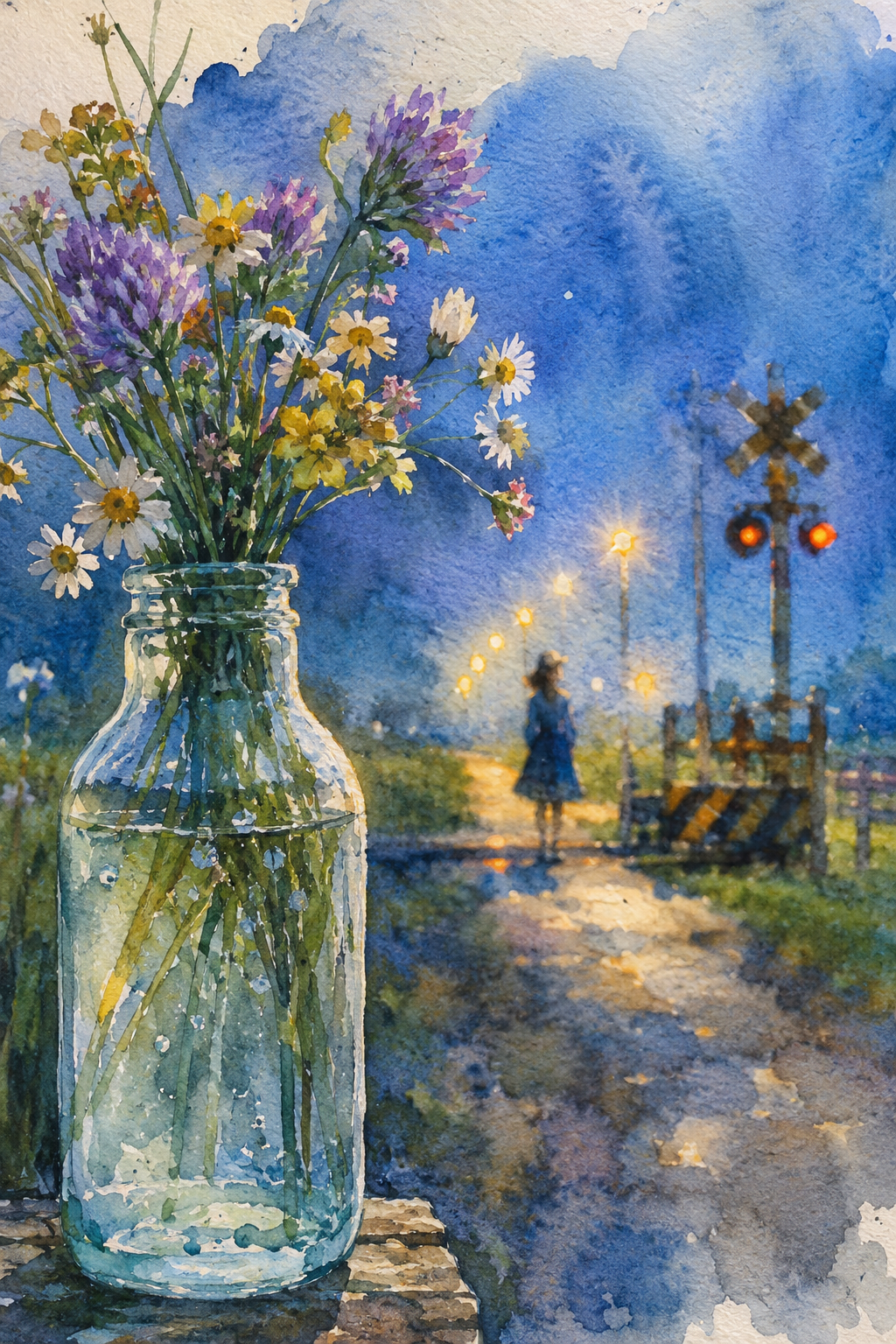
Wildflower Bouquet in the Twilight Lane
Critique
Introduction This watercolor joins still life and railway landscape in a quiet narrative. A glass jar of field flowers dominates the foreground while a distant figure and crossing signal occupy the blue evening. Ordinary objects become persuasive markers of waiting, departure, and remembered summer. Description The tall jar rises from a rough ledge, its transparent body crowded with green stems. White daisies, yellow blossoms, and purple clusters spread across the upper left. A pale path curves toward a small blue-clad figure. Streetlights recede as warm dots, and the blurred crossing signal glows red beneath a clouded cobalt sky. Analysis Scale and focus establish a clear hierarchy: crisp flowers and glass command attention, while softened tracks, figure, and signal resemble recollection. The jar’s vertical contour is echoed by stems, lamp posts, and signal mast, tying the intimate foreground to public infrastructure. Cool ultramarine washes make yellow lights and flower centers luminous. Granulation, blooms, and reserved paper whites suggest atmosphere and reflected glass. Interpretation and Evaluation The bouquet reads as a temporary offering beside a route of movement. Its fragile abundance contrasts with the rigid crossing, while the solitary figure introduces an unresolved destination. The scene may describe farewell, anticipation, or an evening walk. Although the strong foreground risks overwhelming the narrative background, loose transitions and repeated lights preserve unity. The ambiguity allows personal memory to enter without requiring a fixed story. Conclusion The work succeeds through poetic control of distance, temperature, and focus. Familiar rural motifs become a meditation on what remains still while someone moves away. The jar is more than decoration: it becomes the visual memory against which the entire twilight journey is measured.
Same Subcategory
Similar Artworks
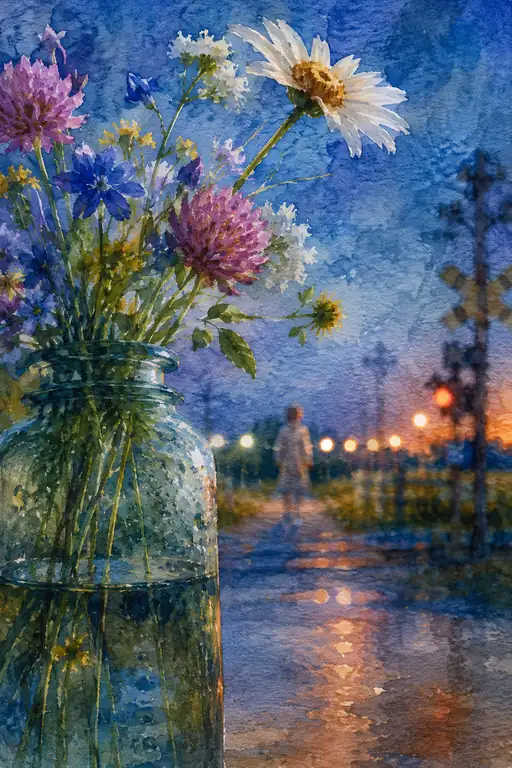 Wildflower Glass and Departing Steps in the Dusk
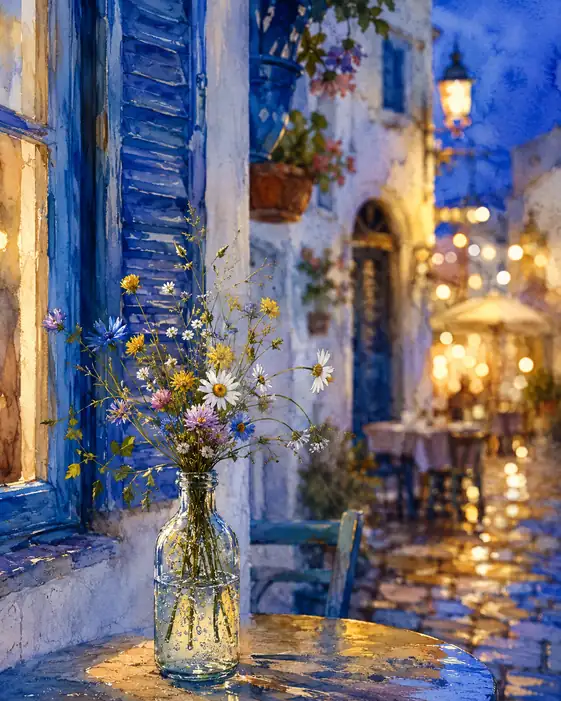 Wild Petals in the Blue Hour
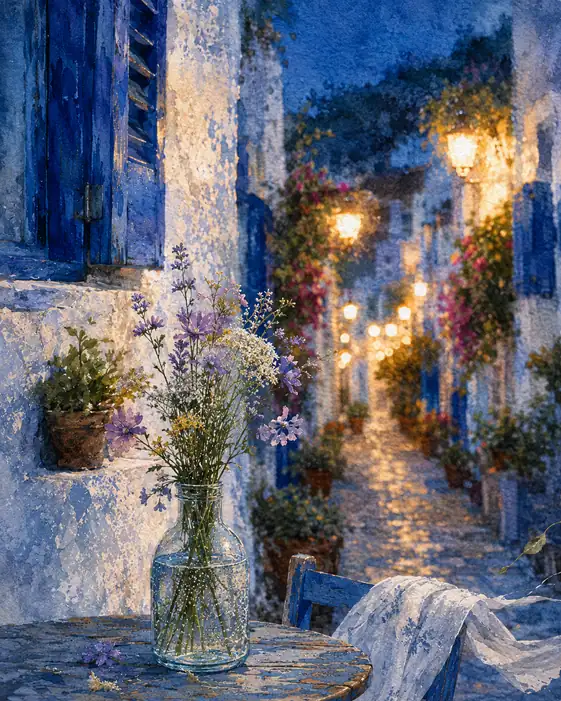 Evening Terrace with Wildflowers and Glowing Lamps
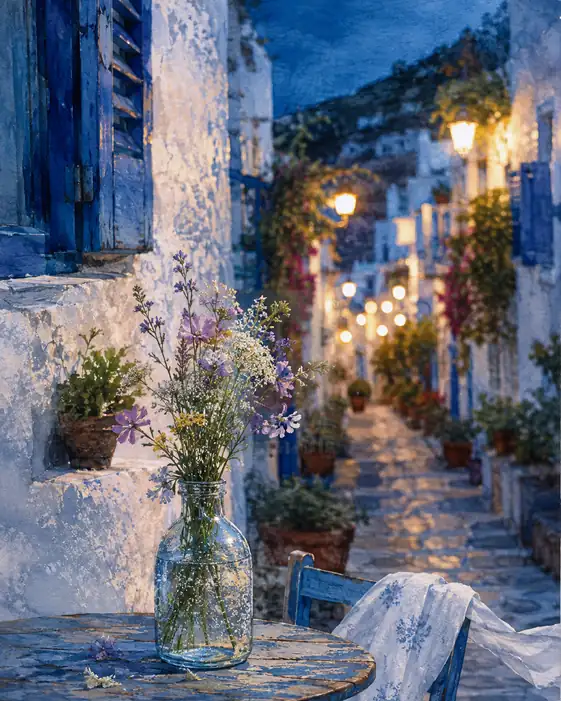 Mediterranean Evening Whispers on the Table
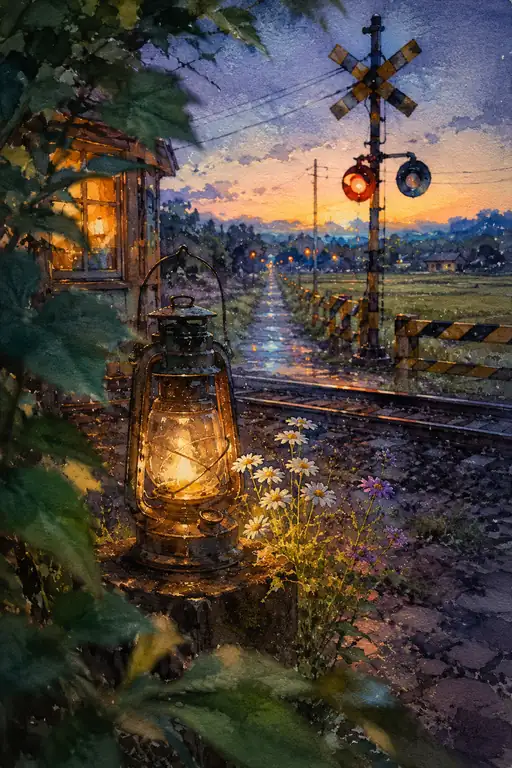 Wild Daisies by the Twilight Crossing
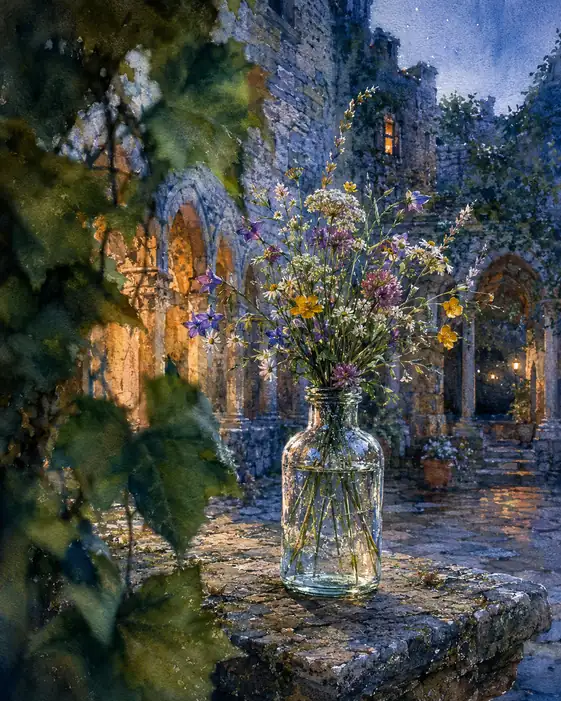 Meadow Blooms in the Abbey Light
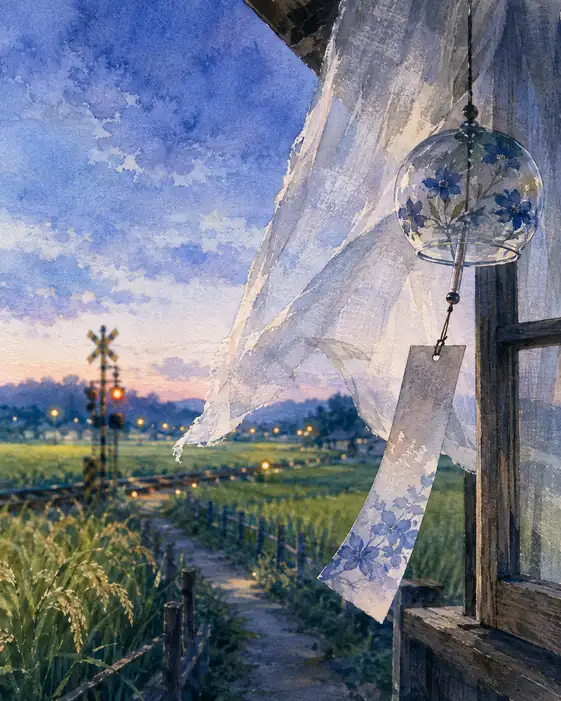 Twilight Breeze and the Clear Wind Chime
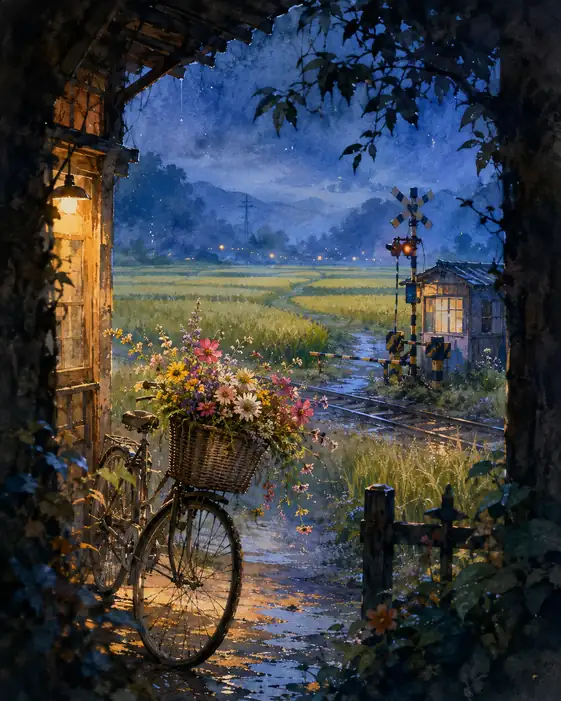 Nocturne Delivery Basket by the Station
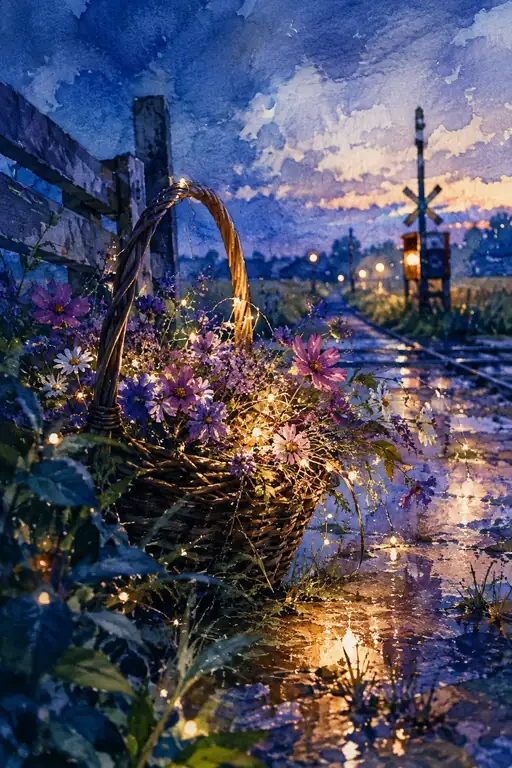 Twinkling Cosmos by the Railroad Track
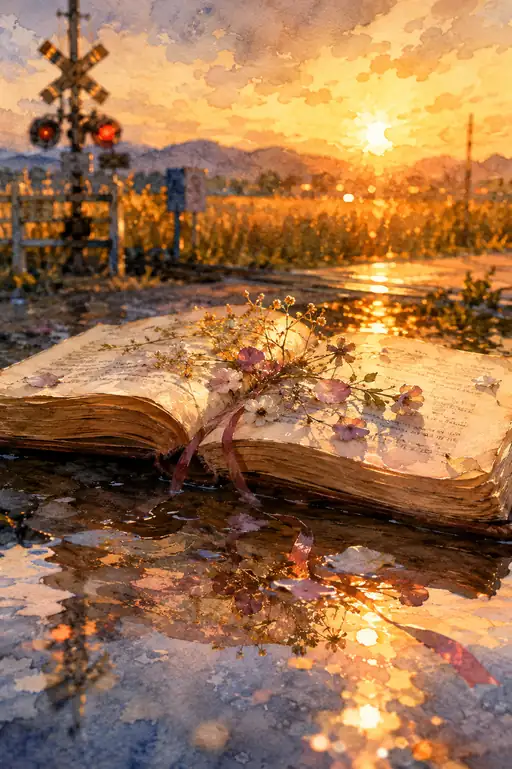 Forgotten Verses on the Sunlit Railway Water