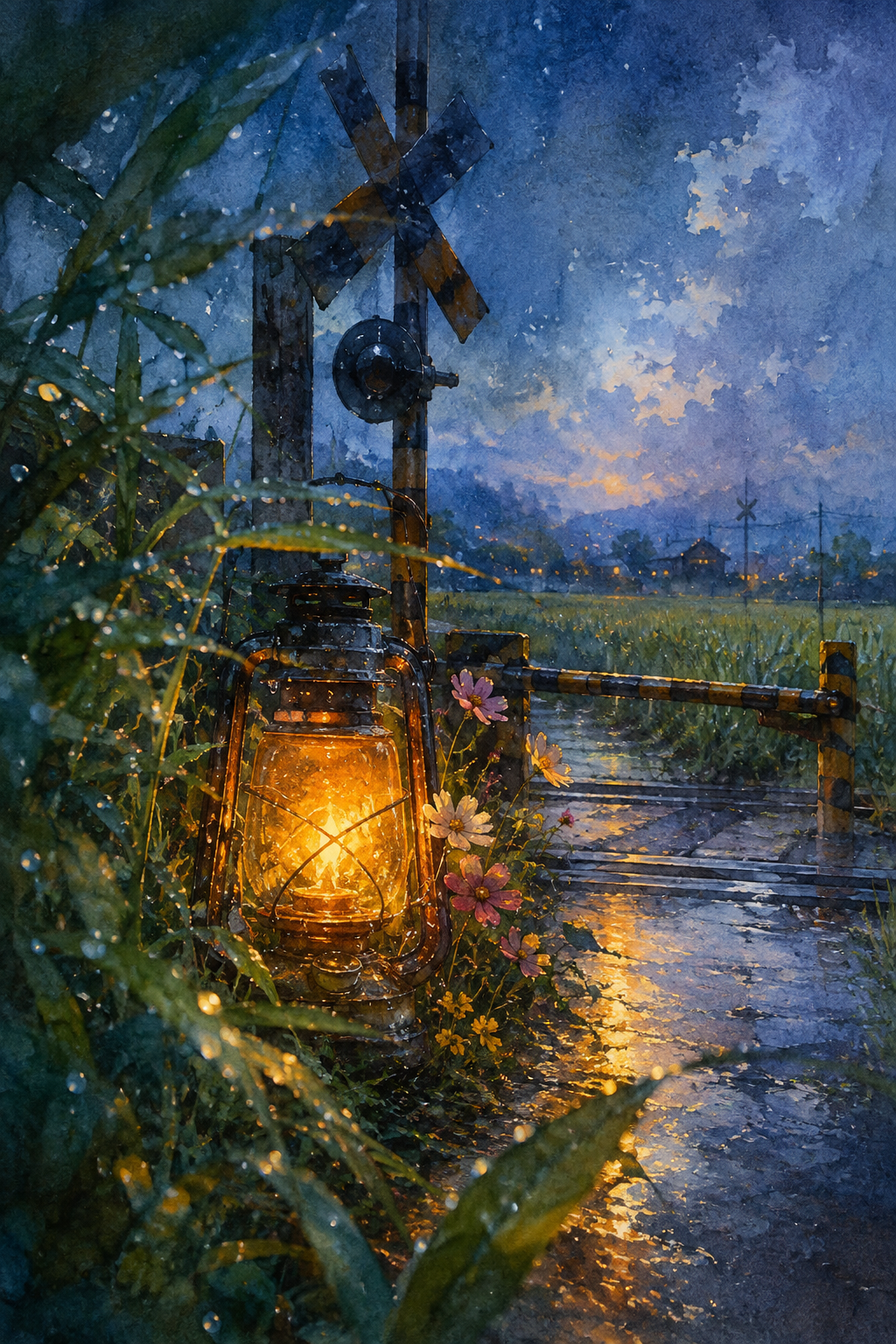
Raindrop Lamp by the Evening Railway
Critique
Introduction A kerosene lantern burns among rain-heavy grasses before a closed rural crossing at blue hour. The painting makes practical light feel protective, while wet vegetation and mechanical barriers establish a credible atmosphere of delay. Description The lantern occupies the lower left center, its black frame and wired glass beaded with moisture. Pink, white, and yellow wildflowers rise beside it. Broad grasses enter from the left and bottom, each blade carrying bright droplets. A striped barrier stretches horizontally across the wet path beneath a tall crossbuck and round signal. Fields, houses, poles, and small orange lights recede under blue-violet clouds touched with peach. Analysis The barrier’s horizontal line stops the path’s central recession, while the lantern’s vertical frame and signal mast counter it. Curving grasses interrupt this engineered grid and create layered depth. Amber radiates from the nearest flame onto leaves and puddles, then diminishes through distant village lights. Blue governs sky, metal, path, and rain. Crisp droplets and glass edges contrast with softened horizon, making damp proximity almost tactile. Interpretation and Evaluation The closed crossing transforms guidance into patient waiting. Unlike the signal, which regulates passage, the lantern simply sustains visibility and warmth during the pause. Flowers suggest that care persists at an infrastructural margin. Romantic glow is moderated by the barrier’s blunt obstruction, dark machinery, saturated soil, and wind-bent plants. Conclusion The image succeeds through a subtle distinction between command and comfort. Signal and barrier determine when movement is possible; the small lantern makes immobility bearable. Rain turns every surface into a participant, carrying one flame outward across an otherwise cold landscape.
Same Subcategory
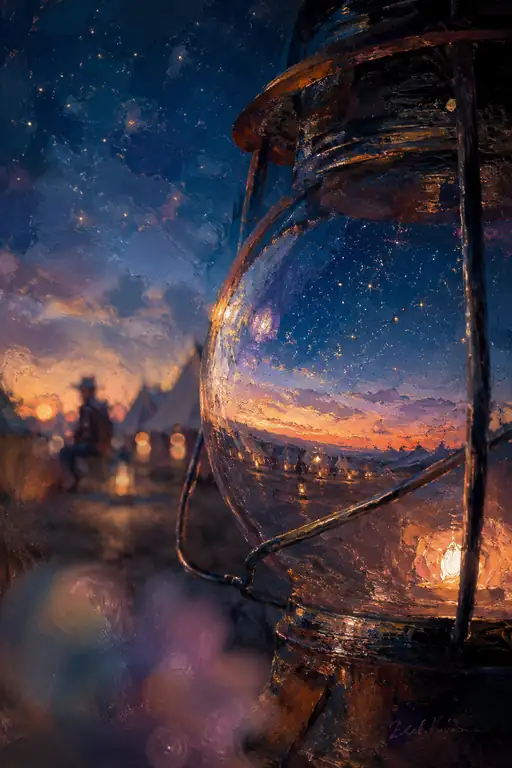 Sunset Horizon Sealed in the Traveler's Lantern
Similar Artworks
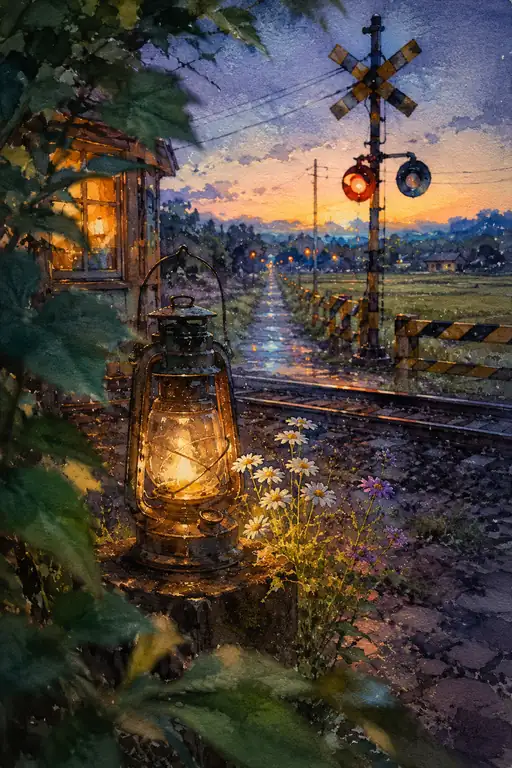 Wild Daisies by the Twilight Crossing
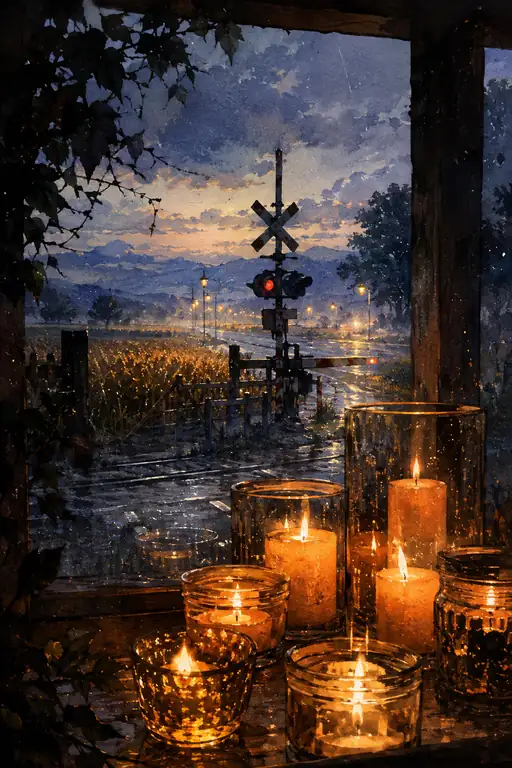 Candles by the Window Overlooking the Track
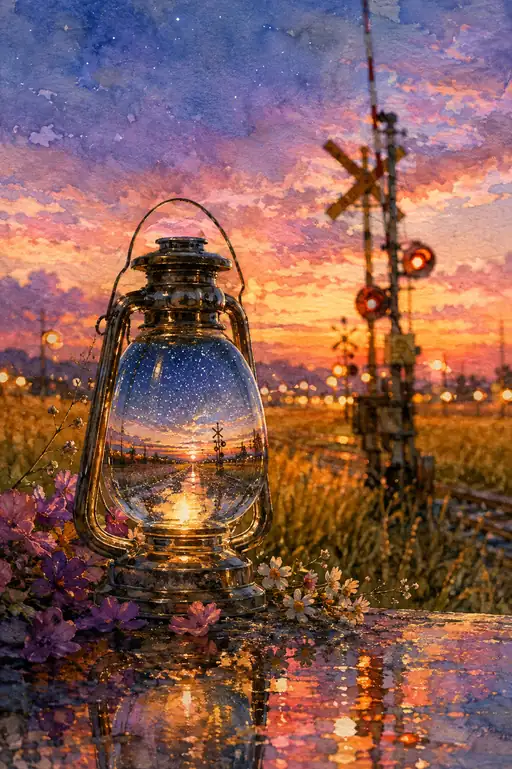 Sunset Train Path Captured in Glass
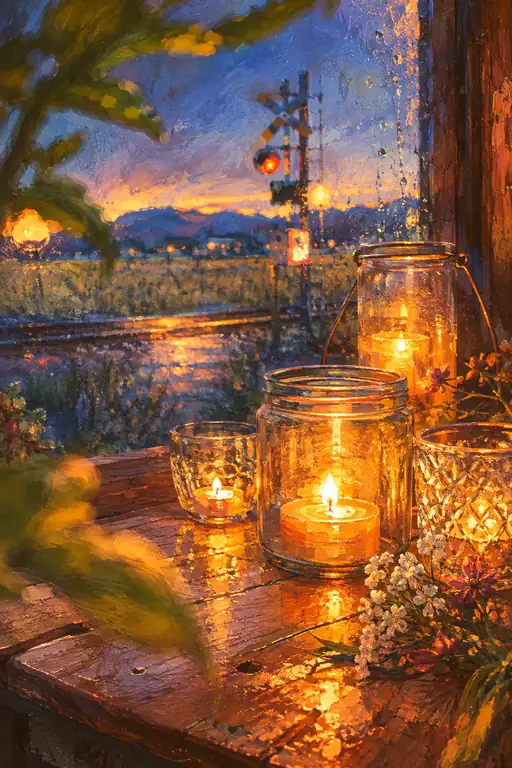 Twilight Candles on the Country Station Sill
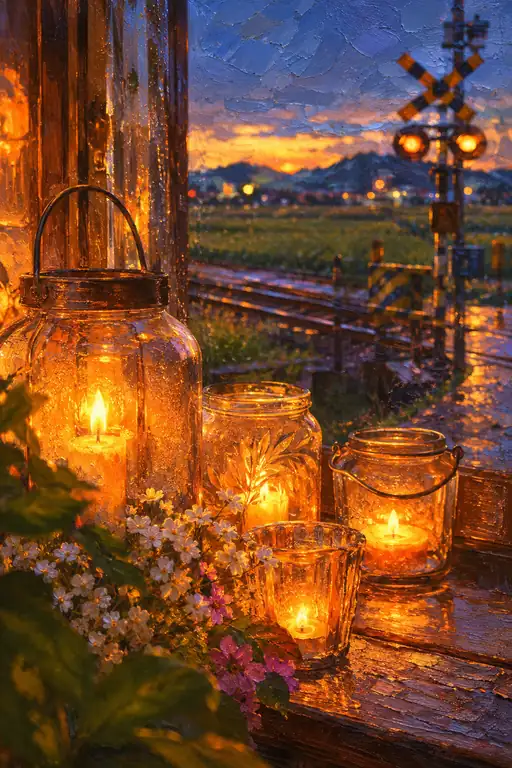 Warm Glow by the Rain-Drenched Crossing
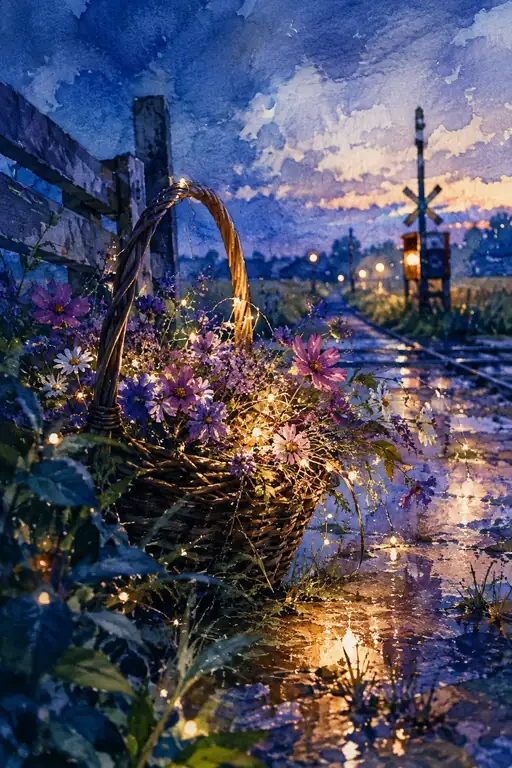 Twinkling Cosmos by the Railroad Track
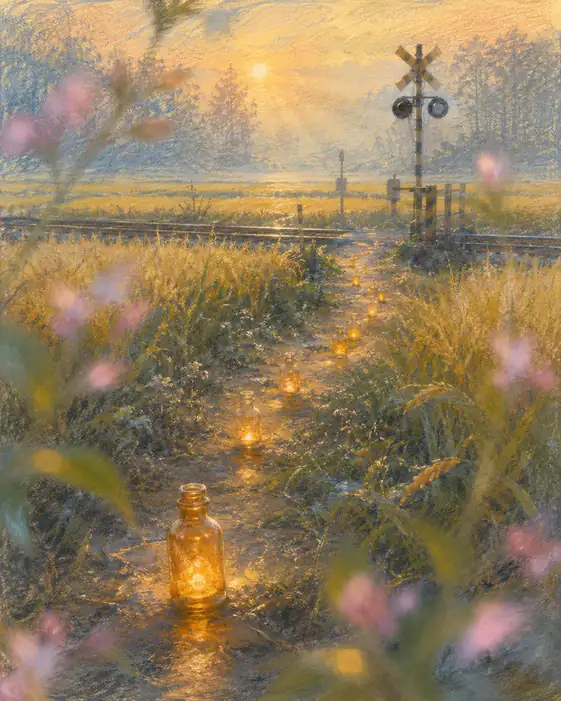 Path of Morning Glow Bottles Across the Field
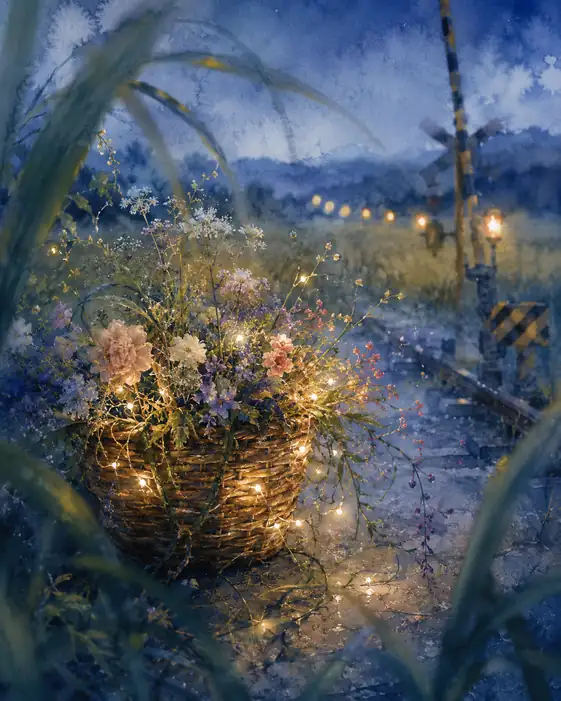 Fairy Lights in the Twilight Grass
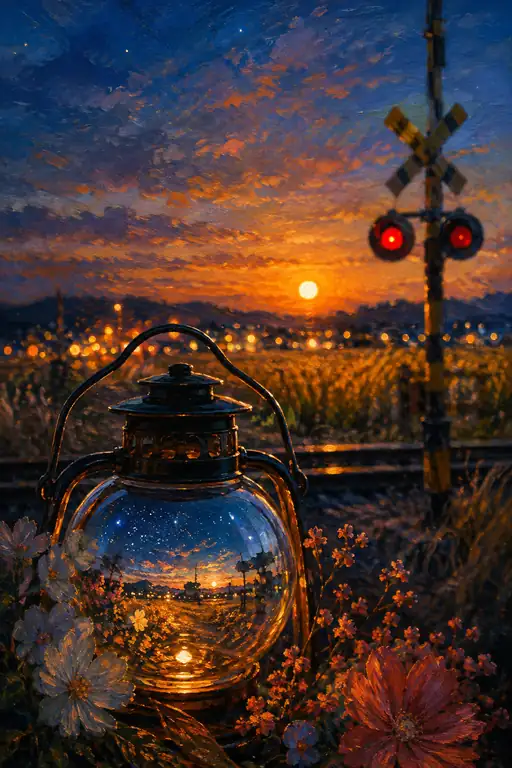 Sunset Cosmos Reflected in the Railroad Lantern
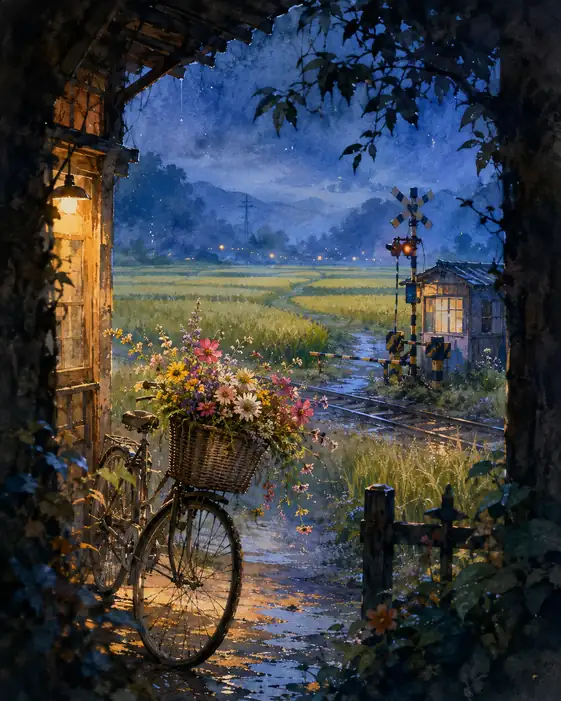 Nocturne Delivery Basket by the Station