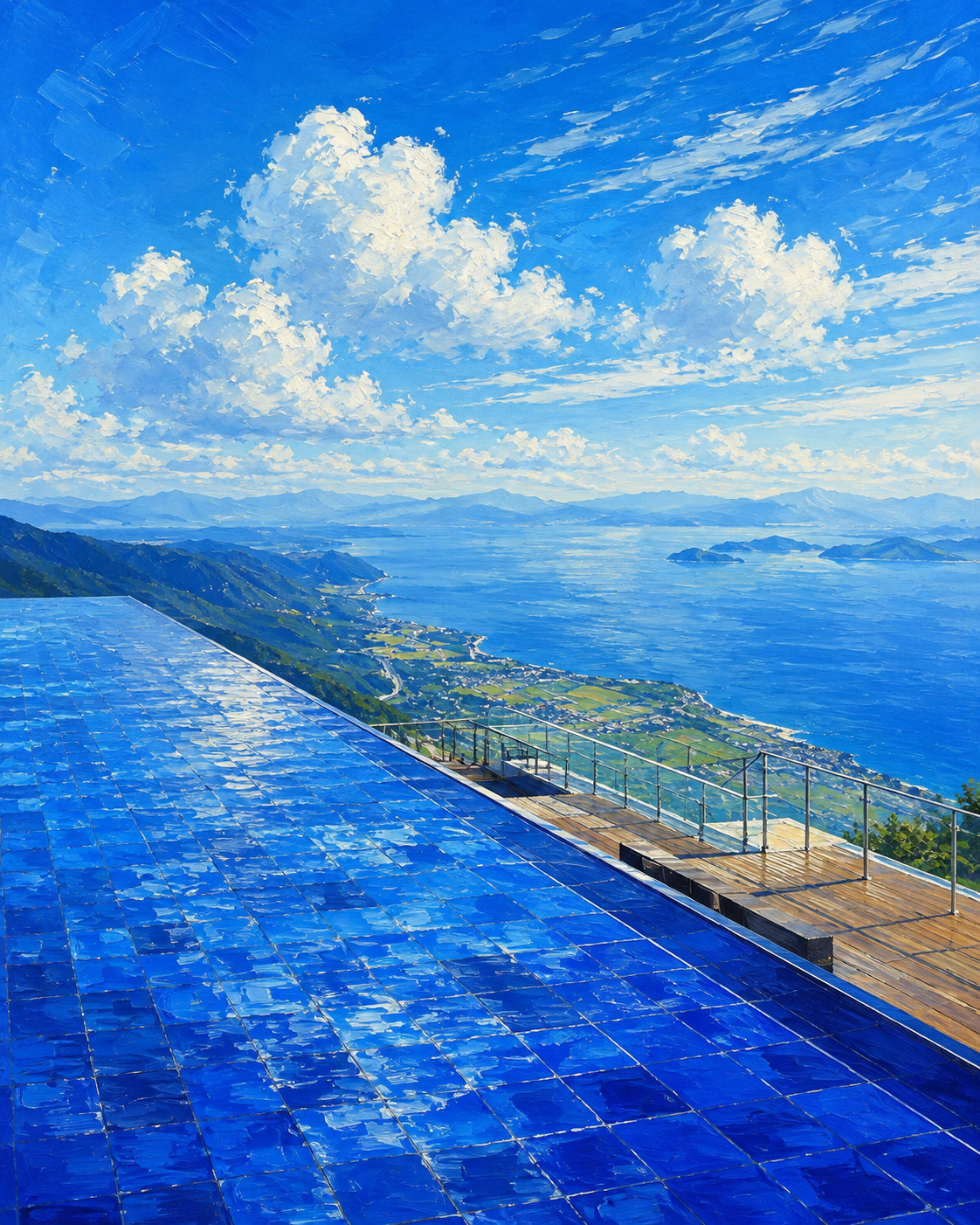
Summer Infinity Above the Cobalt Sea
Critique
Introduction An immense cobalt infinity pool occupies the foreground before opening onto a coastal plain, island sea, and cloud-filled sky. By minimizing furniture and architecture, the painting makes blue itself—tiled, liquid, atmospheric, and distant—the principal subject. Description The pool fills the lower left and center, its gridded tiles visible beneath rippling highlights. A narrow wooden walkway with metal railing runs along the right edge and ends near the vanishing pool lip. Beyond are green fields, roads, shoreline settlements, mountains, and scattered islands. White cumulus towers across a saturated sky, with finer streak clouds sweeping rightward. Analysis The pool’s diagonal rim creates a forceful transition from near geometric grid to broad natural horizon. Tile lines establish tangible depth, then disappear beneath reflected light. A thin warm-brown walkway mediates between cobalt water and green coast. Blue shifts from dense ultramarine foreground to lighter sea and cyan sky, preventing monochrome flatness. Thick white strokes give clouds volume; shorter angular marks agitate the pool. Sparse railings supply human scale without dominating. Interpretation and Evaluation The near merger of pool and sea offers a fantasy of continuity, but visible tiles and railings acknowledge its engineered construction. This tension makes the view more interesting than pure escapism: boundlessness is carefully staged. The empty deck removes social narrative and directs attention toward perception itself. Intense blue could become synthetic, yet distant farmland and mountain layering provide credible geographic depth. Conclusion The painting turns a designed water surface into a threshold between body and panorama. Its disciplined reduction gives sky, pool, and sea distinct kinds of blue while allowing them to resonate. The result is spacious, lucid, and almost physically cooling.
Same Subcategory
Similar Artworks
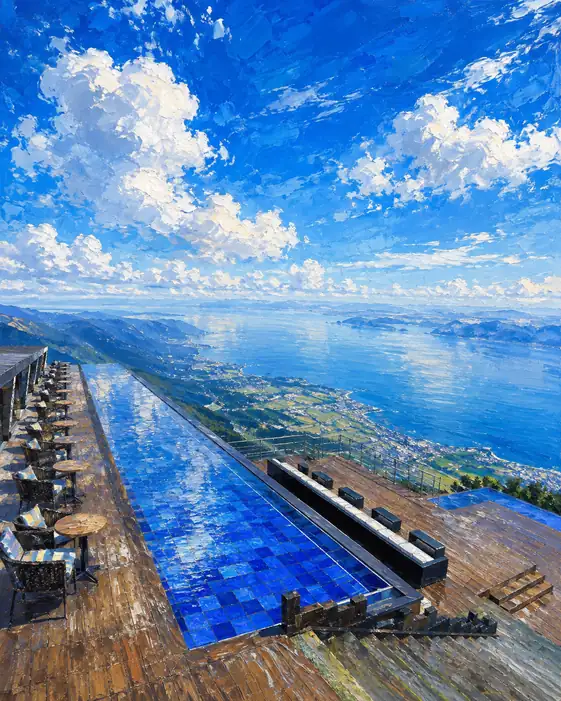 Floating Clouds Over the Distant Basin
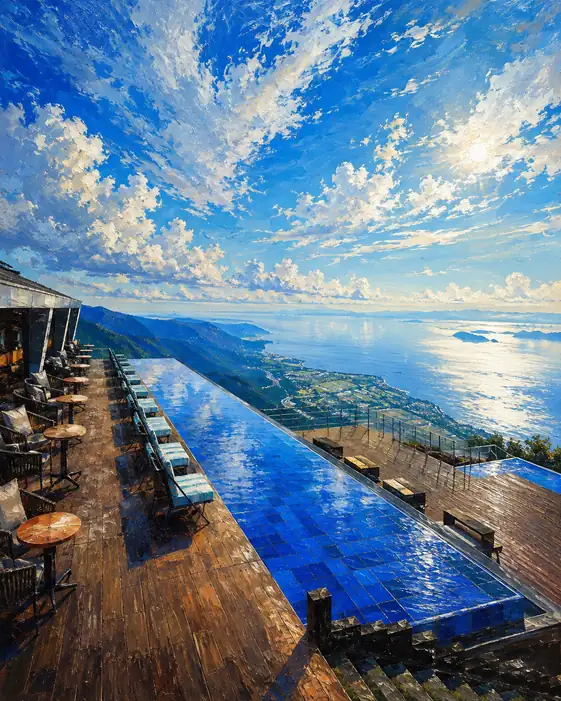 A Premier Seat in the Blue, Open to the Heavens
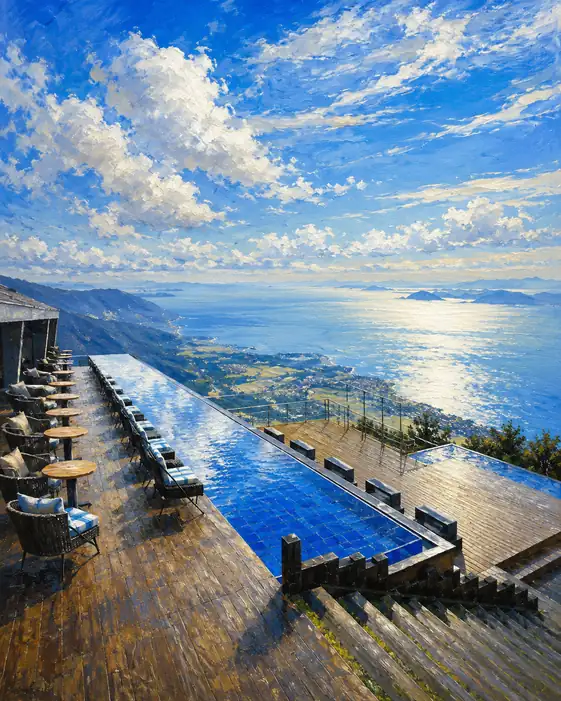 Horizon Terrace Where Azure Meets the Sky
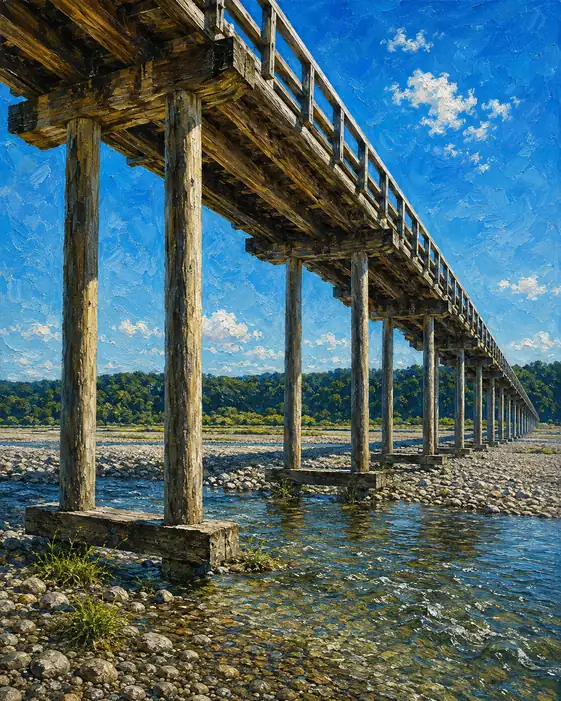 Shadows of Timber Framing and the Flowing Clear Stream
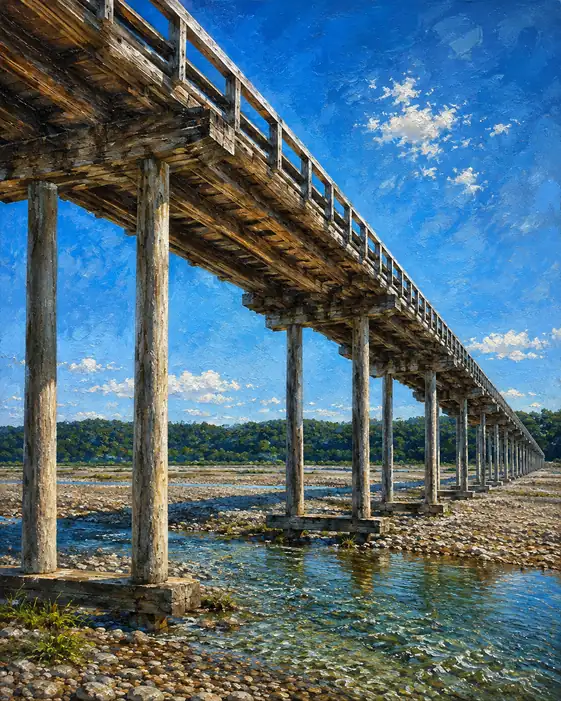 A Single Wooden Way Spanning the Dry Riverbed
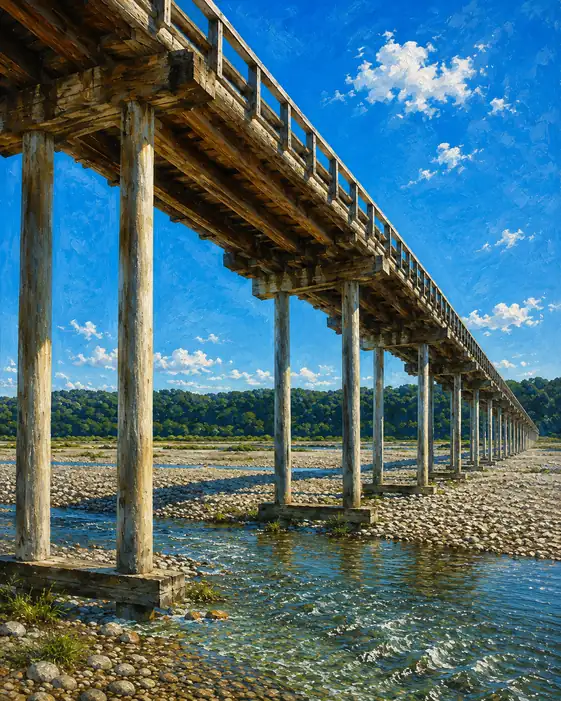 Gate of Summer Sky Carved by Log Piers
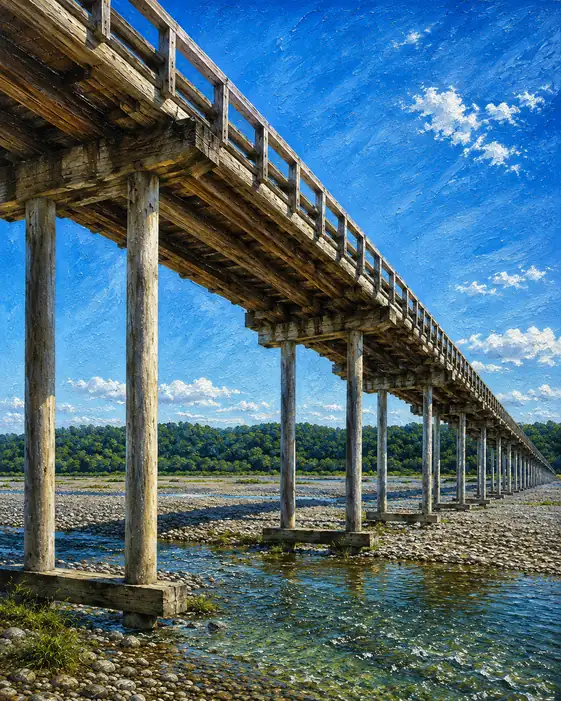 Perspective of the Wooden Bridge Crossing the Stony Bed Beneath Azure Sky
 The Golden Road That Lights the Wind's Memory
 Where the Forest Whispers to the Sun
 Luminous Whispers along the Coastal Arcade