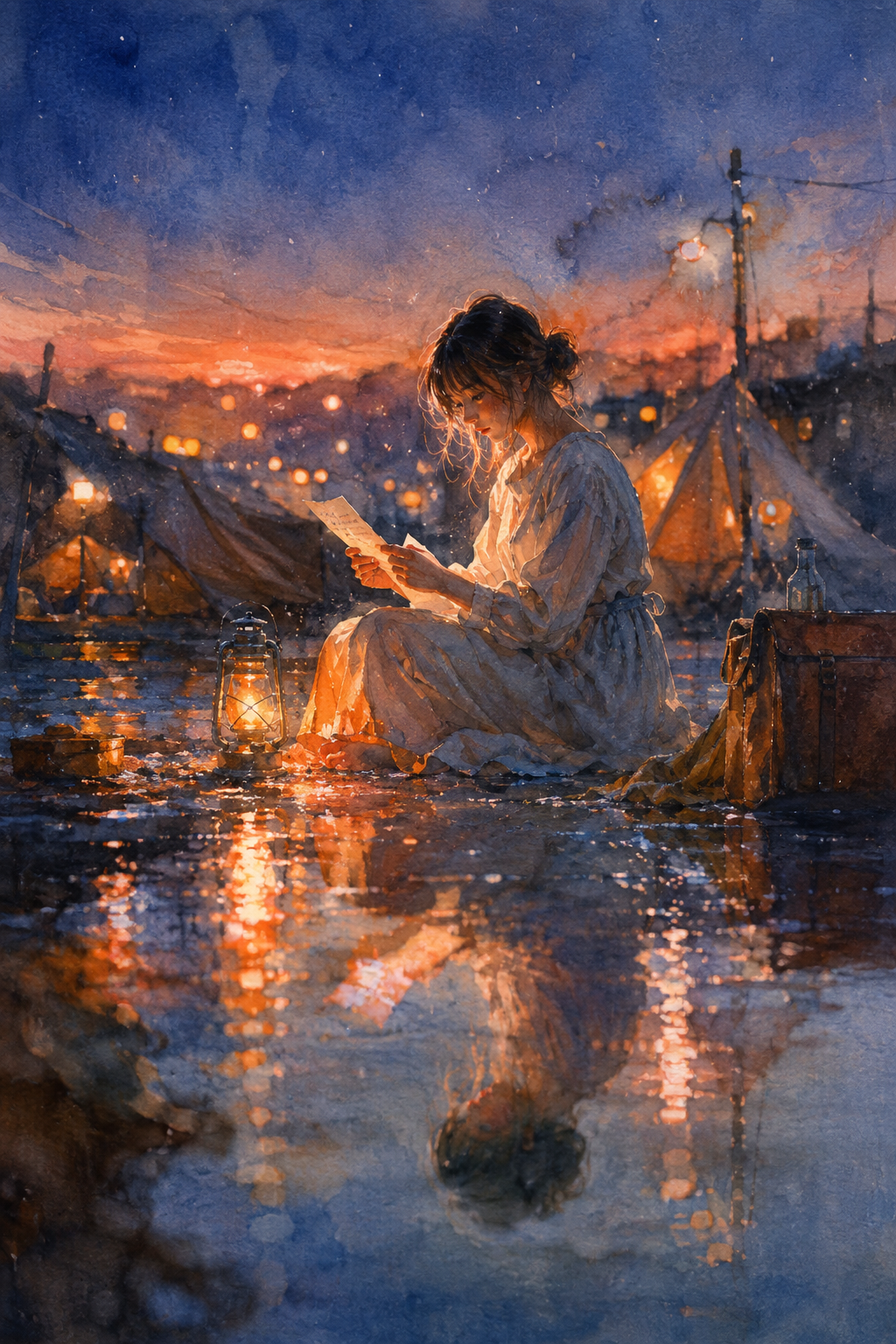
Midnight Letter Under the Canopy of Stars
Critique
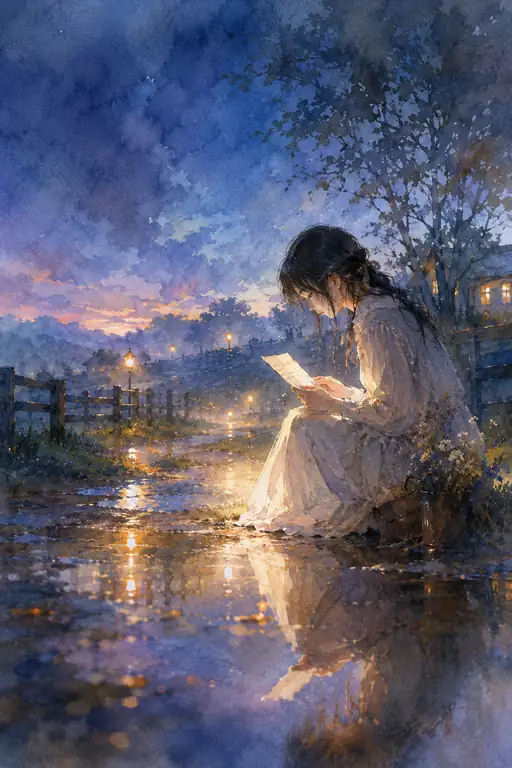
Introduction A woman reads a letter while seated on rain-soaked ground in a twilight encampment. The painting places private concentration amid communal shelter, using lamplight and reflection to make written words feel momentous without revealing them. Description The woman sits near center in a pale, long-sleeved dress tied with a blue sash. Her dark hair is loosely gathered, and both hands hold a small folded sheet. A kerosene lantern glows beside her feet. At right stand a worn case, draped cloth, and empty bottle. Canvas tents, poles, and many distant lamps spread behind her beneath a blue and coral sky. Puddles mirror her figure and the lights. Analysis Her bowed head, forearms, and letter form a compact triangle of attention. The lantern establishes a second, lower triangle with her knees and hands, visually linking illumination to reading. Cool blue-gray unifies dress, mud, and sky; orange outlines hair, face, paper, and fabric folds. Vertical reflections lengthen the small lamps across the foreground. Softened camp details surround the more carefully modeled face and fingers, isolating concentration without removing context. Interpretation and Evaluation Because the text remains illegible, news, reassurance, grief, and longing all remain possible. The public camp becomes private through her absorbed posture. The case suggests travel and the empty bottle ordinary material need, grounding the scene’s romance. Her clean dress amid mud may seem idealized, but wet hems, loose hair, and the unstable reflected body introduce vulnerability. Conclusion The work convincingly portrays reading as a temporary shelter within temporary shelter. Its lights lead not toward spectacle but inward, to paper and response. The doubled figure in water expands a quiet personal moment into the emotional center of the entire camp.
Same Subcategory
Similar Artworks
 Reading Letters in the Drizzle-Kissed Cafe
 Letters Read in the Bamboo Shade
 Letters Read in the Evening Breeze
 Whispering Letters from the Stone Balcony
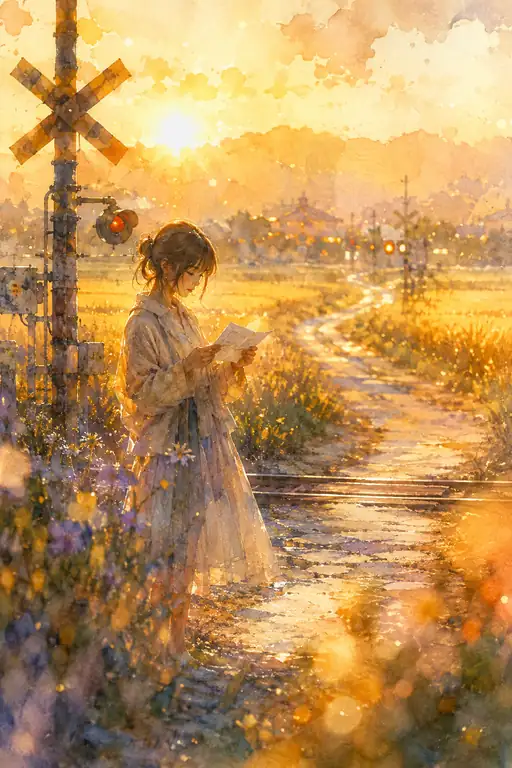 Reading Letters at the Golden Crossing
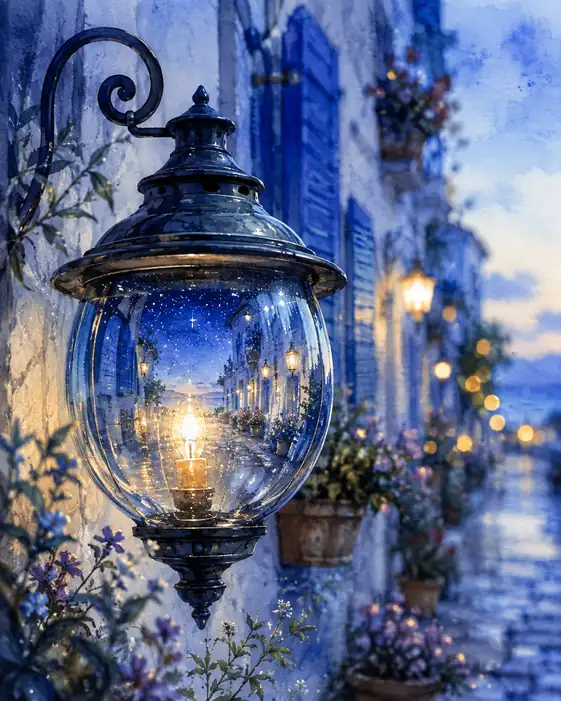 Sanctuary of Starlight in Glass
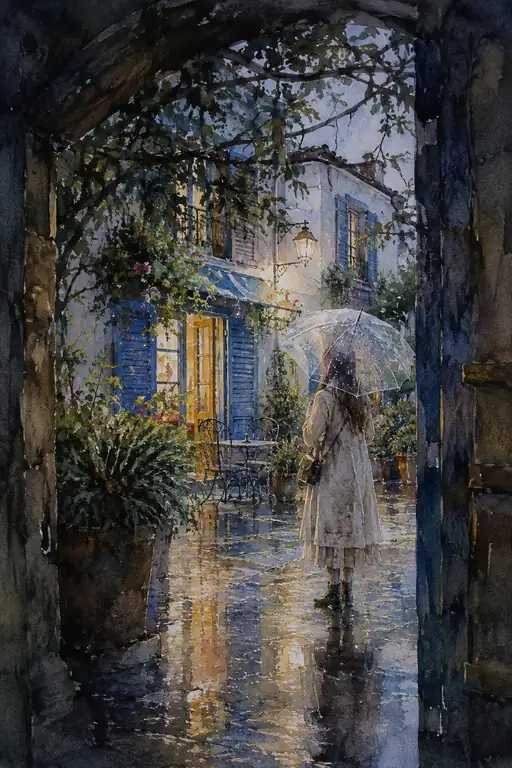 Clear Umbrella Stroll in the Evening Rain
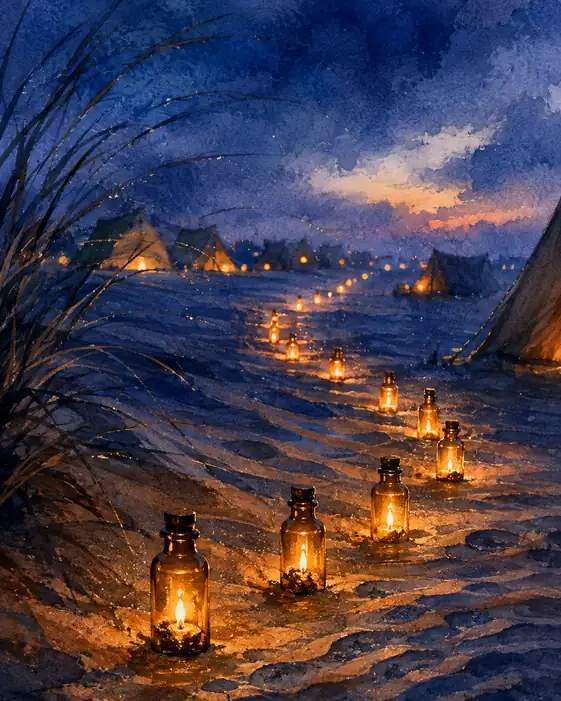 Trail of Amber Candles Along the Sandy Shore
 Twilight Traveler Resting by the Dunes
 Her Letter Shines After the Rain