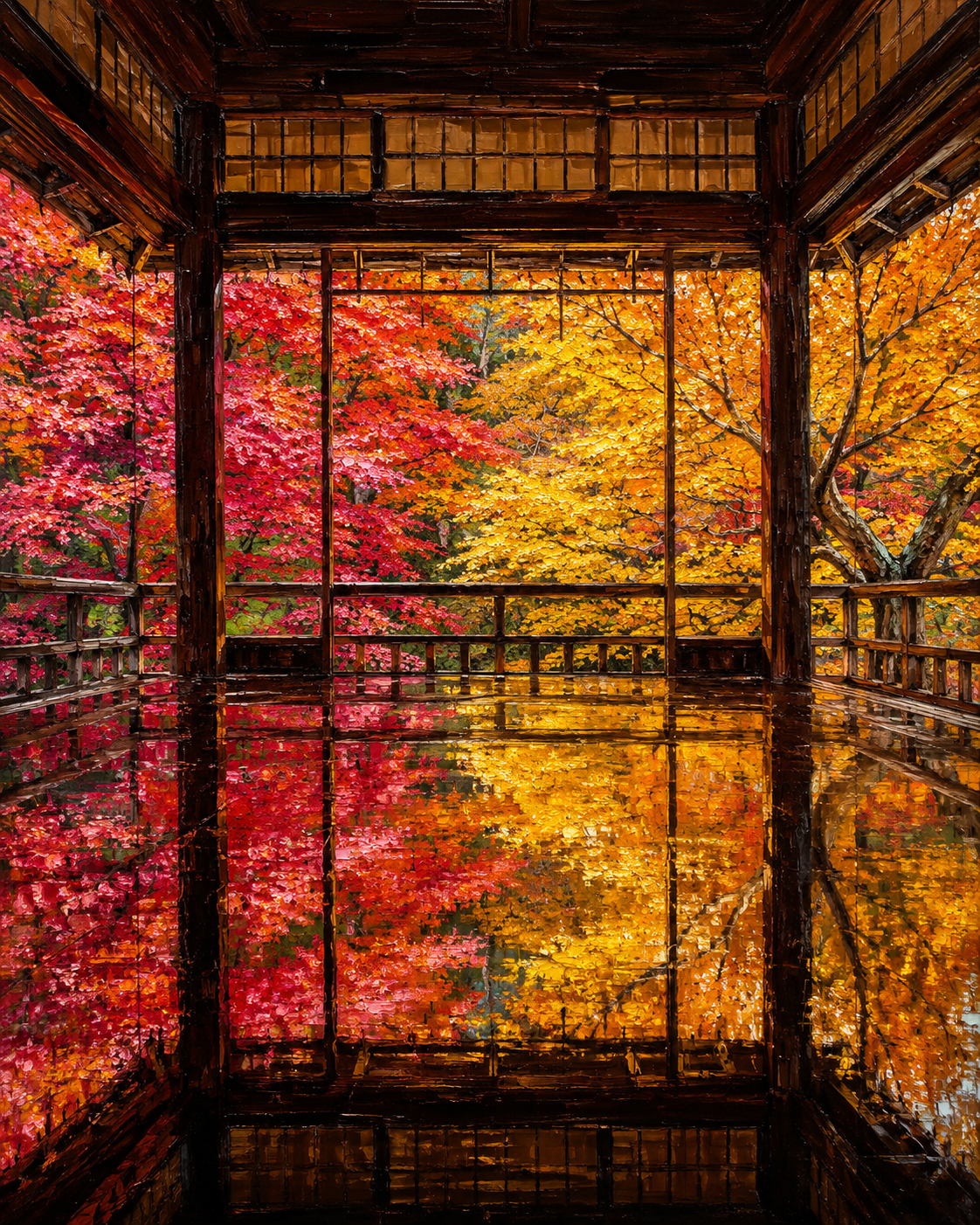
Crimson and Gold Merging into Lacquered Floors
Critique
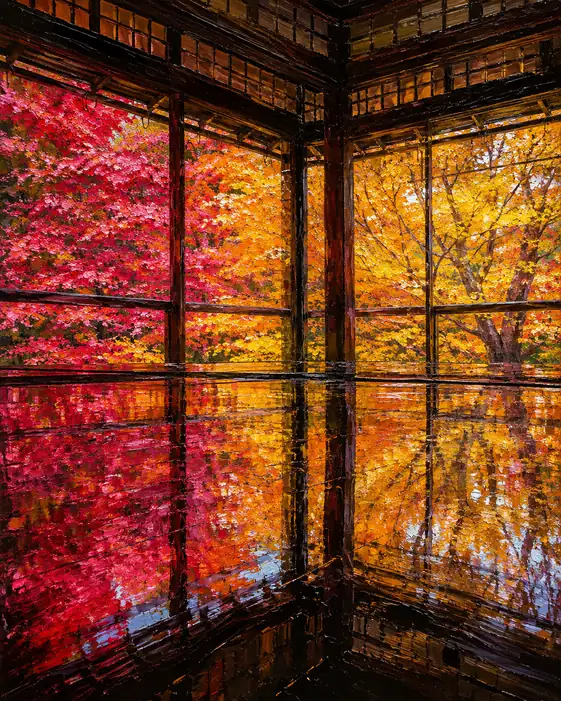
Introduction This frontal view of an empty wooden pavilion turns autumn foliage and its floor reflection into a nearly abstract field of red and gold. Severe architectural symmetry gives the seasonal spectacle clarity, stillness, and contemplative distance. Description Dark beams, posts, transom windows, and railings frame three broad openings. Crimson leaves fill the left, yellow-orange foliage occupies center and right, and a branching trunk enters at the far right. The highly polished floor mirrors the entire view across the lower half, including posts and roof structure. No furniture or figure interrupts the room. Analysis The central post and roof apex establish a stable vertical axis, while horizontal rails divide the composition into stacked bands. Reflection creates an approximate bilateral division across the floor edge, though rippled brushwork prevents perfect duplication. Black-brown timber separates saturated color into panels and supplies visual rest. Leaf marks are thick and irregular; architectural edges remain straighter but share the same material paint handling. The central gold functions as a luminous hinge between red zones. Interpretation and Evaluation Emptiness makes the pavilion an instrument for seeing rather than a setting for action. The floor receives the garden without possessing it, suggesting perception or memory as a darkened second image. Strong symmetry could feel static, yet uneven foliage, the right-hand trunk, and broken reflections preserve movement. With no human-scale object, the viewer’s own position becomes the implied occupant. Conclusion The painting succeeds by making architecture both boundary and optical device. It edits nature into panels, doubles it below, and leaves a calm interior from which abundance can be faced. Seasonal color becomes immersive without losing structural discipline.
Same Subcategory
Similar Artworks
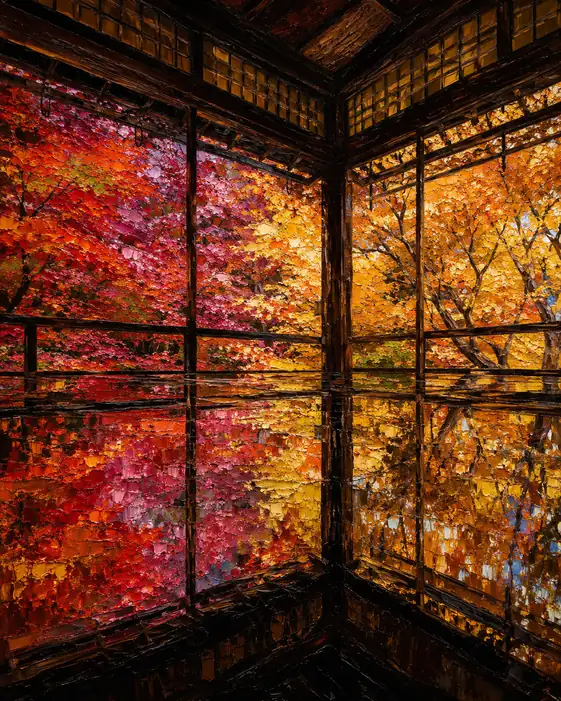 Autumn Splendor Mirrored on the Chamber Floor
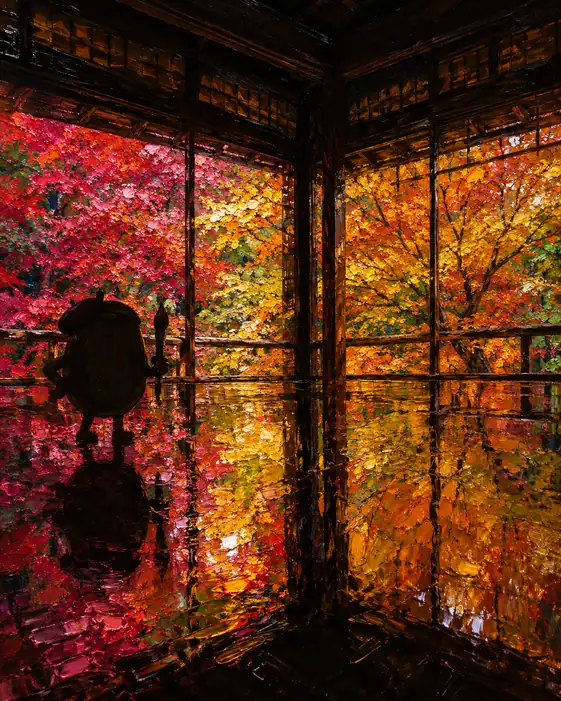 Autumn Returns in the Lapis Pure Land
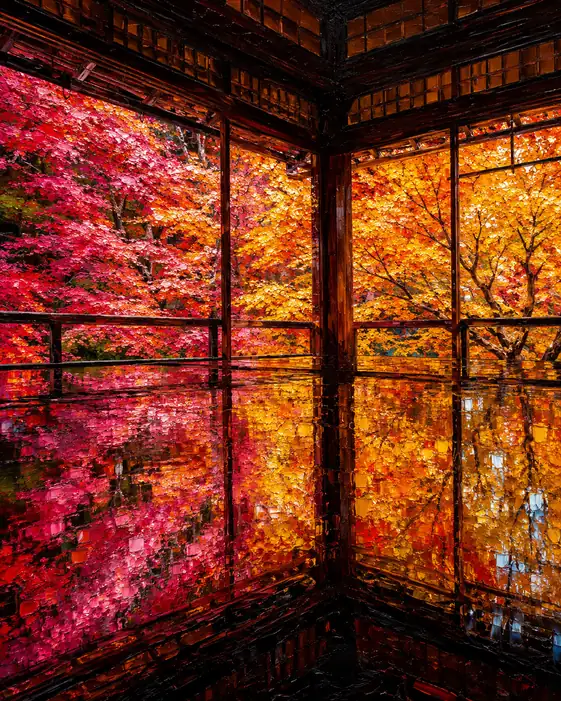 Crimson Harmony on the Polished Floor
 Vermilion and Gold Reflected in the Temple Chamber
 The Golden Road That Lights the Wind's Memory
 Silent Prayers Floating Past the Sacred Gate
 Dreams of Goldfish Lights on the Lake
 Clear Stream Lanterns and Sky Splendor
 Silent Night Journey Guided by Lotus Lanterns
 Whispering Prayers Reflected on Night Waters