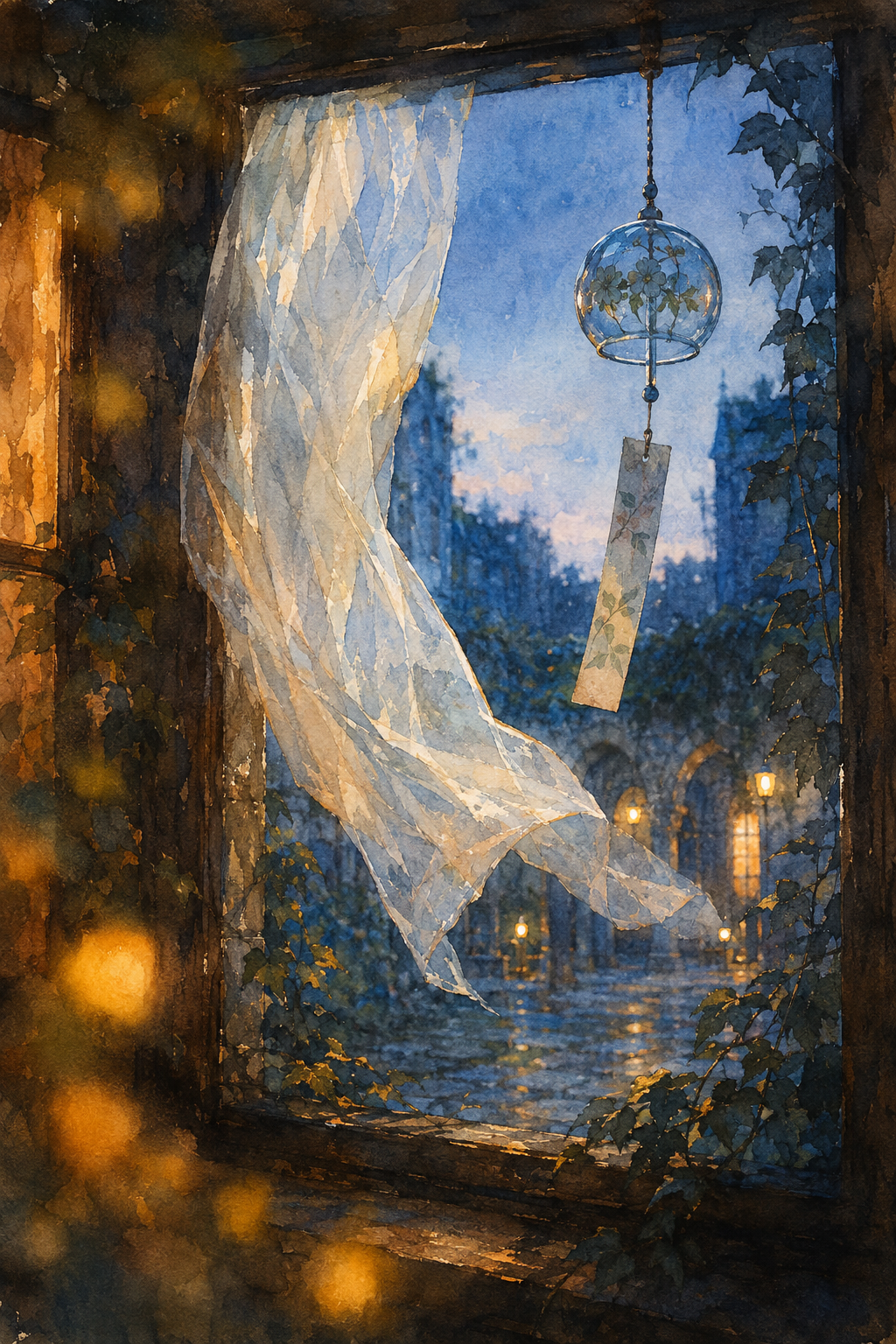
Summer Wind Chime Whispering by the Cloister
Critique
Introduction An open, ivy-framed window holds a billowing white curtain and a glass wind chime against blue evening. The painting treats air—normally invisible—as its central subject, revealed through fabric, leaves, and suspended objects. Description The dark wooden opening fills nearly the entire frame. A translucent curtain enters from upper left and sweeps downward toward the sill. At upper right hangs a round glass bell enclosing small leaves, with a painted paper strip below. Ivy climbs both sides. Beyond lie a wet courtyard, arches, towers, and scattered amber lamps beneath a pale blue sky. Analysis The curtain’s broad S-curve supplies movement against the window’s rigid rectangle. The chime forms a clear vertical counterweight, its circular glass and narrow strip echoing distant lamps and windows. Cool blues dominate exterior and cloth shadows; amber pools along the interior wall and far lights. Broken angular strokes make the curtain appear faceted and translucent. Dark framing intensifies the open center, while softened architecture produces convincing depth. Interpretation and Evaluation The threshold joins protected interior and damp exterior without choosing between them. Wind carries the curtain outward and presumably sounds the bell, making the unseen perceptible. The floral strip and leaves suggest a wish or seasonal message, but remain unreadable enough to preserve openness. Large golden bokeh at left could overwhelm the subtle subject; instead, it conveys nearby light and deepens the sense of looking from within. Conclusion The work makes a fleeting draft feel momentous. Through the tension of rectangle, curve, and hanging vertical, it gives structure to passing air. Its quiet achievement is transforming a window view into an experience of movement, sound, and anticipation.
Same Subcategory
 The Stage Still Dreams of Applause
Similar Artworks
 Twilight Breeze and the Clear Wind Chime
 Morning Glory Wind Chime at Dusk
 Evening Air Carried on Chimes
 Whispering Curtain and Morning Breeze
 Where the Sea Wind Whispers to the Glass
 Morning Breeze Between Chime and Bamboo
 Echoes of a Summer Sunset
 Twilight's Soft Lullaby
 Morning Sunlight on the Castle Ledge
 Candles by the Window Overlooking the Track