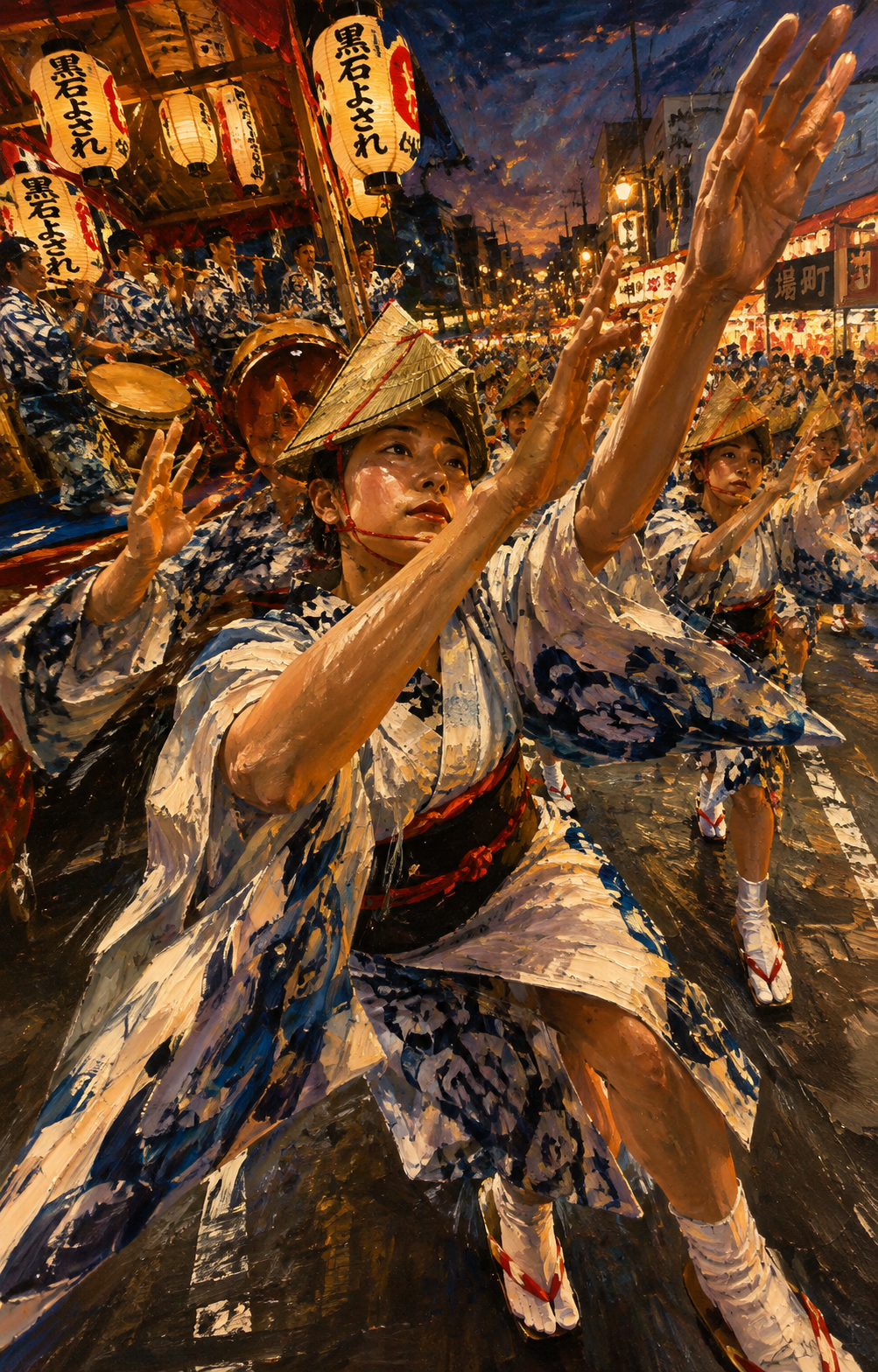
Fingertips Offered to Heaven and the Kuroishi Yosare Procession
Critique
Introduction This work captures a night procession through a close body and a deep street. Arms cross the viewer’s sight, making the experience less like observation than immersion. Description At center, a woman in a woven hat and blue-white robe stretches both arms upward on opposing diagonals. A black sash edged in red anchors her torso. Rows of similarly dressed dancers follow behind, while musicians with flutes and drums occupy a raised structure at left. Large inscribed lanterns glow above them, and shop lights recede toward a sunset-darkened vanishing point. Analysis The sharp V made by the dancer’s arms intersects the one-point perspective of the road, joining upward gesture to forward movement. Black wet pavement, white cloth, ultramarine shadows, and yellow lanterns form a clear tonal architecture. Relatively controlled modeling in the face contrasts with broken strokes across garments and crowds, separating inward concentration from external speed. The dramatically cropped hands compress distance and make the viewer physically aware of the choreography. Interpretation and Evaluation The central expression suggests discipline more than abandon. Festival dance appears as a communal language refined through repetition. Including the musicians gives the visible movement a concrete acoustic source and makes performance an exchange rather than a spectacle detached from labor. Contemporary signs and streetlamps also matter: they prevent tradition from becoming timeless fantasy and locate it within an inhabited commercial street. Conclusion The painting successfully binds precise bodily form to the heat of a crowd. Overlapping arms, repeated lanterns, and reflected light establish an insistent rhythm, yet the composition never loses its emotional center in one attentive face. It is a forceful image of collective motion made convincing through spatial daring.
Same Subcategory
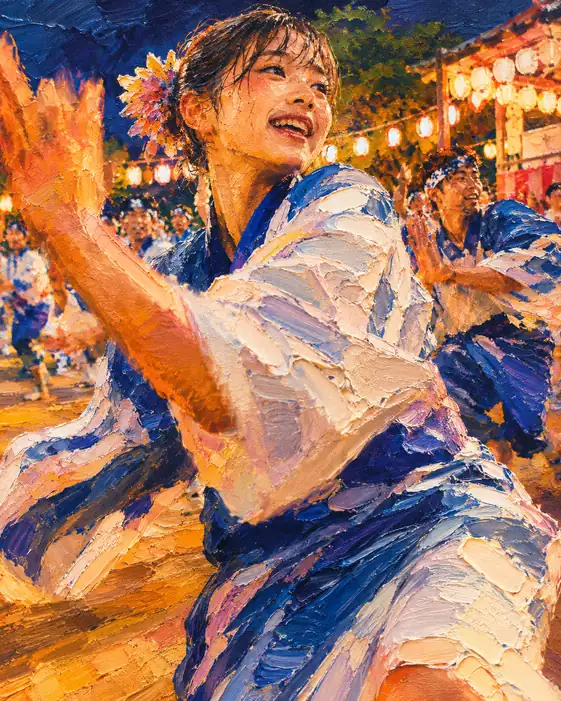 Bursting Smile and Indigo-White Sleeves in the Heat of Lanterns
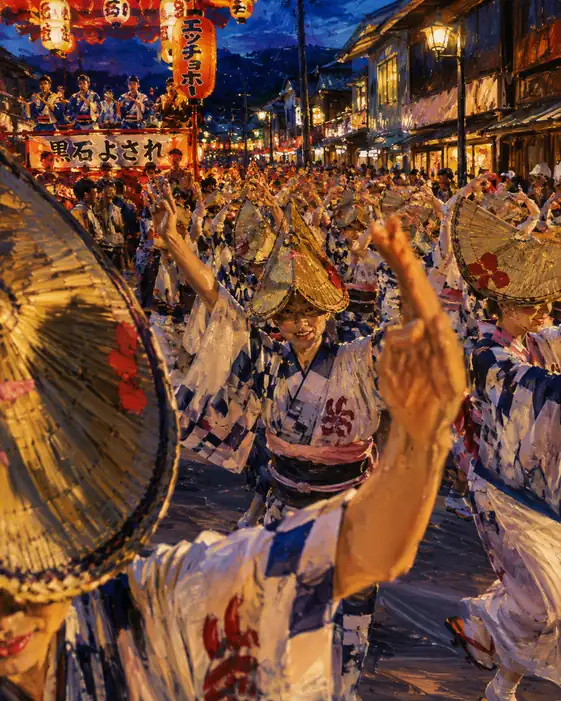 Ecchaho Festival Chants and Woven Hats Filling the Town Street
Similar Artworks
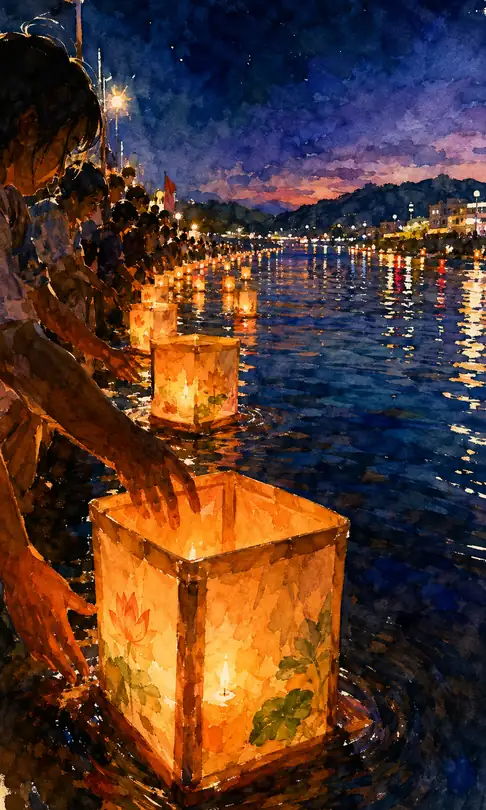 Lotus Lantern of Prayer Entrusted to the Waters and Twilight River Waves
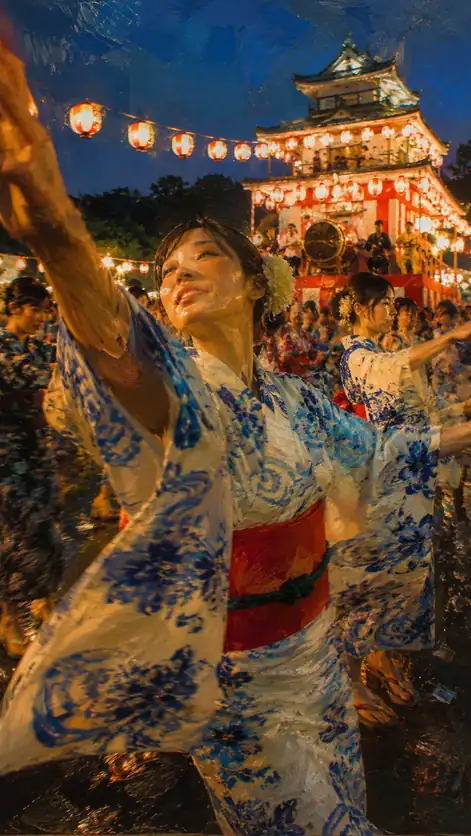 Dancing in Indigo-White Florals Beneath the Lanterns of the Castle Yagura
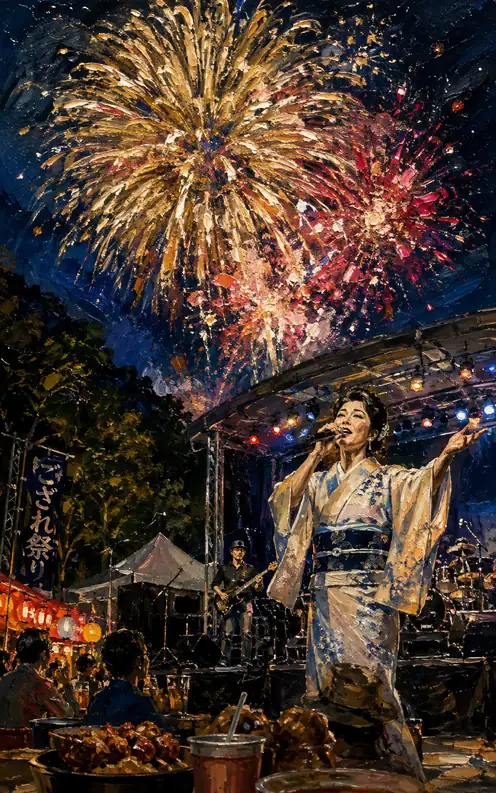 Singing Voice Echoing in the Gozare Festival Night Sky and Golden Blooms
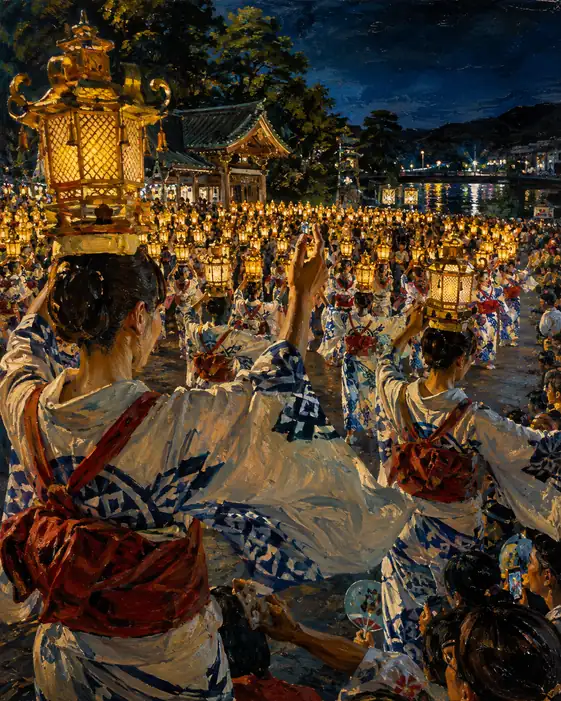 A Thousand Waves of Light Dancing Before the Night Shrine Bearing Golden Lanterns
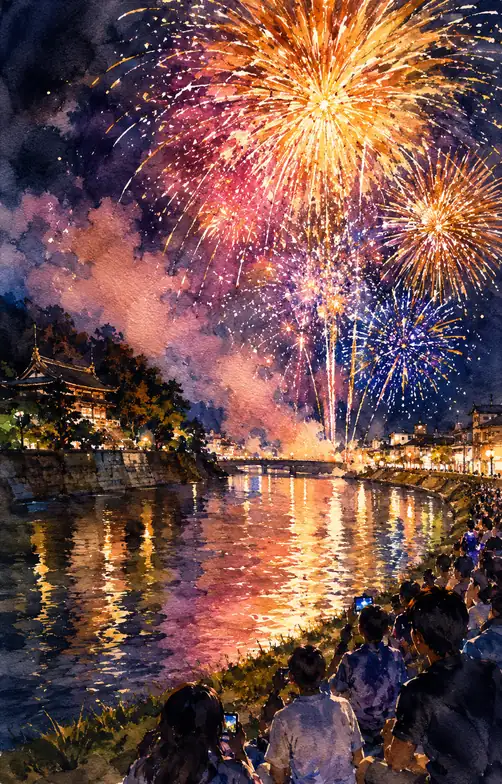 River Waves Illuminating Castle Stone Walls and Great Blooms in the Night Sky
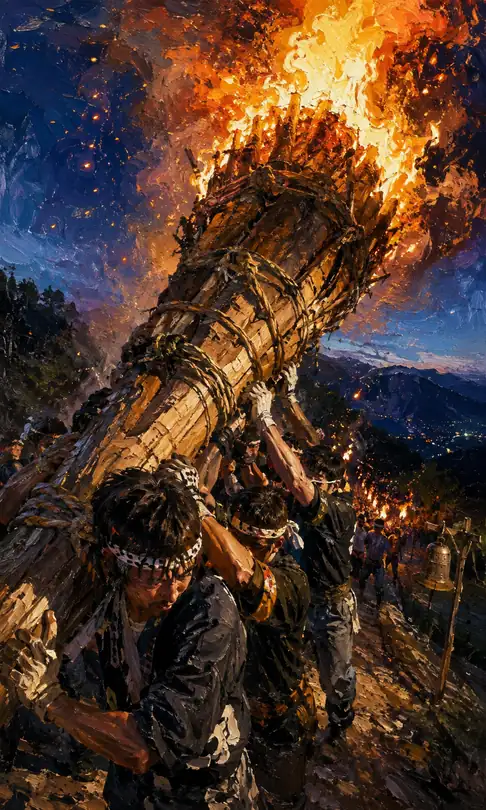 Great Torches Carried Up the Mountain Path and Roaring Flames Scorching the Night Sky
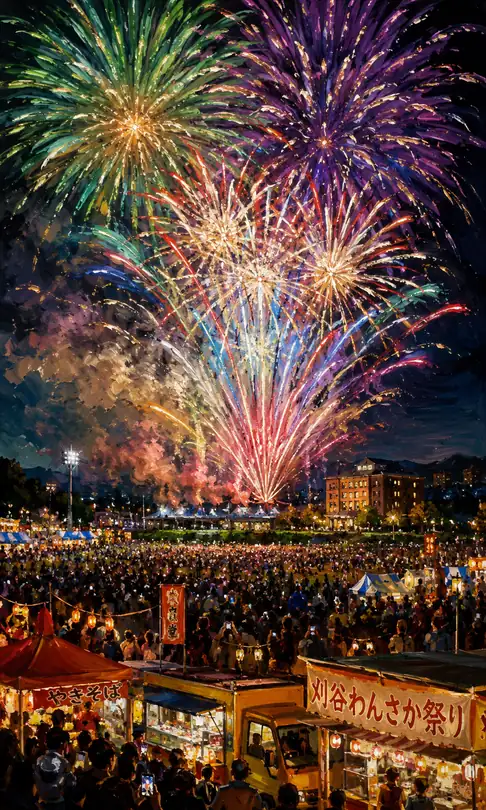 Bustle of Kariya Wansaka and Emerald and Purple Blooms in the Night Sky
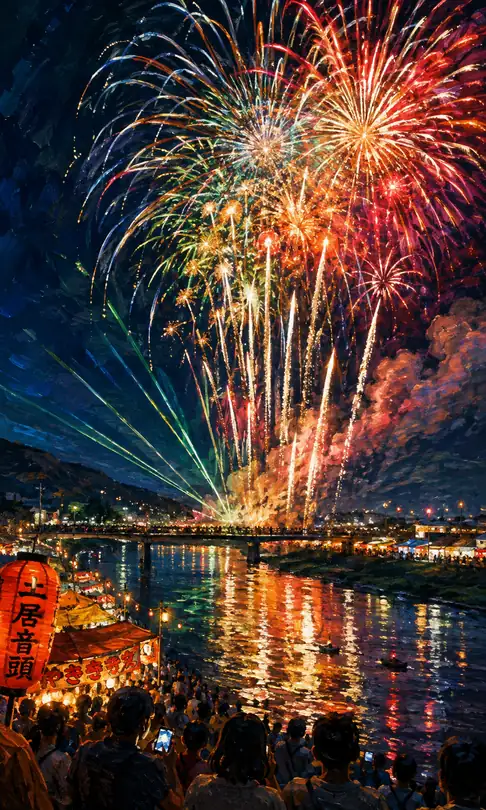 Red Lanterns of Doi Ondo and Blooms of Light Reflecting on the River
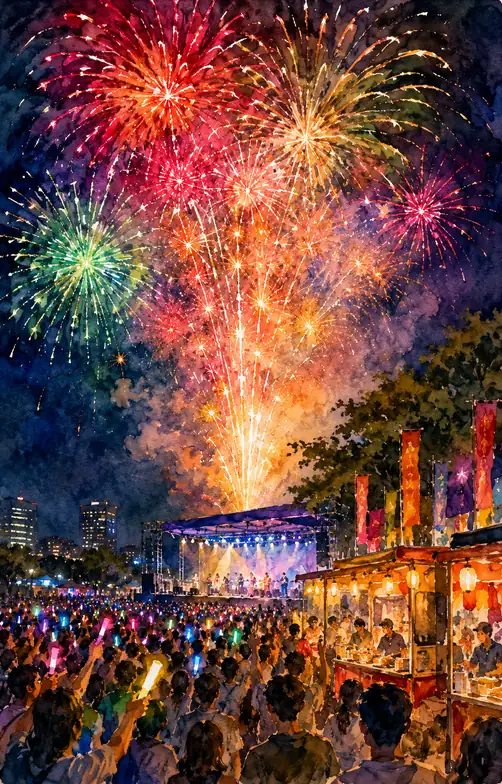 Rays of Light Raised to the Outdoor Stage and Great Blooms in the Night Sky
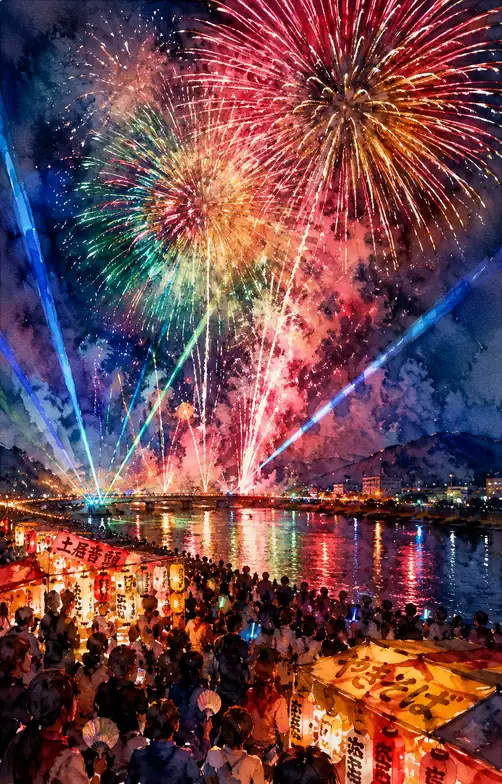 Stall Lights of Doi Ondo and the Great Cascade of Blooms Reflecting on the River