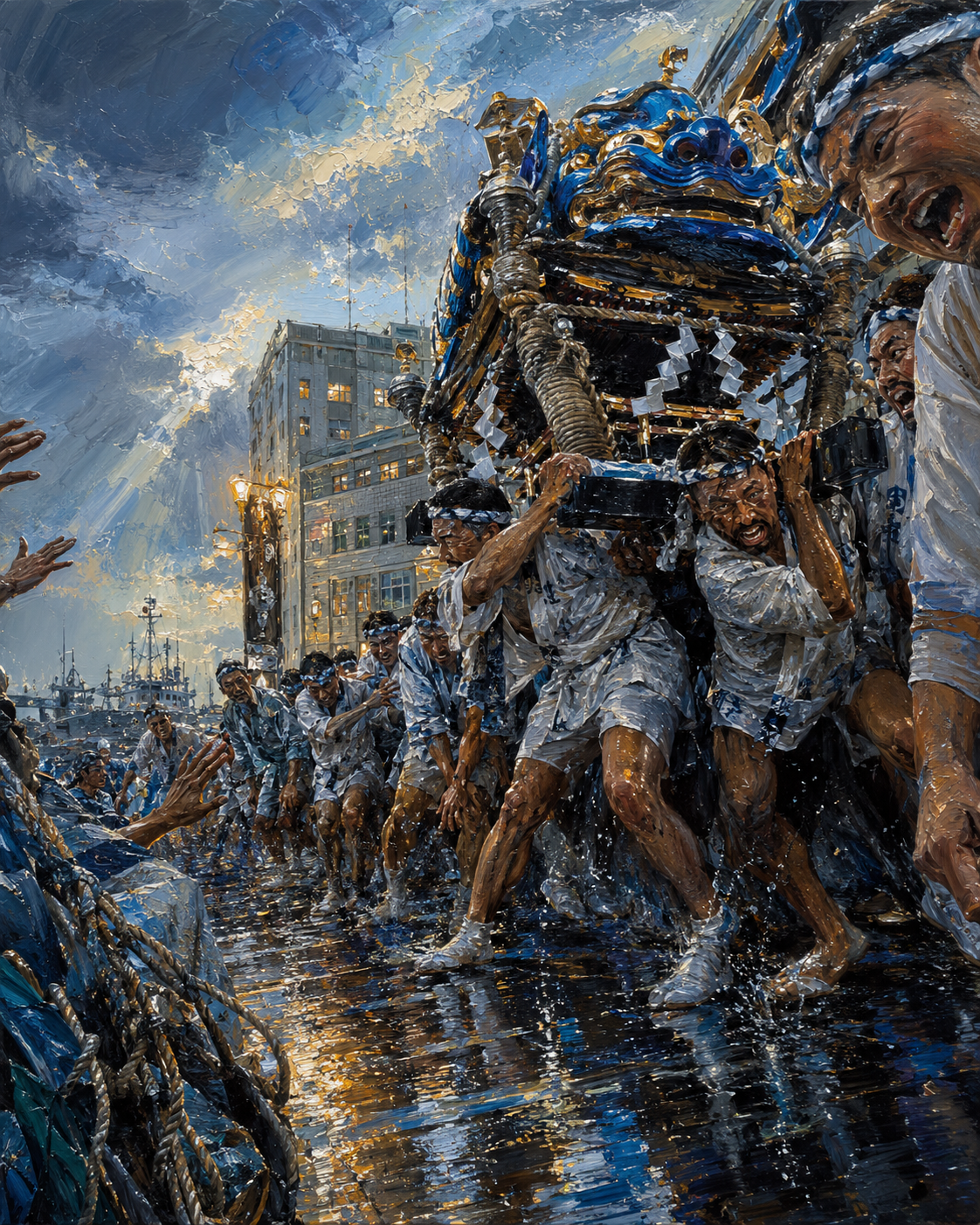
Roar of Men and Blue Lion Shrine Shaking the Port Town
Critique
Introduction This painting depicts men carrying an ornate blue festival shrine through a rain-soaked harbor street. The low, close viewpoint emphasizes physical strain, collective coordination, and the collision of sacred pageantry with modern waterfront architecture. Description The shrine rises at upper right, crowned by a blue-and-gold creature mask and supported by thick ropes and dark beams. Bearers in wet white garments brace the load on their shoulders; faces grimace or shout, and bare legs splash through shallow water. More participants recede along the left. Harbor vessels, rigging, stone buildings, and glowing streetlamps occupy the background beneath a broken gray sky. Analysis The shrine's heavy diagonal descends toward the central bearers, concentrating weight over bent knees and angled torsos. Repeated arms and legs extend this force backward through the procession. Cobalt accents bind shrine, clothing marks, puddles, and harbor, while amber lights interrupt the cool field. Thick impasto describes wet rope, carved ornament, skin, and reflections; sharp highlights make rainwater and exertion tactile. Interpretation and Evaluation The image presents tradition as labor enacted together rather than as distant display. Strained expressions preserve individual effort within a coordinated body. Its dramatic cropping and low perspective are compositionally bold, and the blue, white, and ochre palette remains coherent. Convincing differences among carved surfaces, soaked fabric, rope, flesh, and water demonstrate powerful descriptive technique. Conclusion At first the shrine commands attention as a spectacular object, but closer viewing shifts emphasis toward the people who sustain its movement. The work turns physical burden into a persuasive image of communal commitment.
Same Subcategory
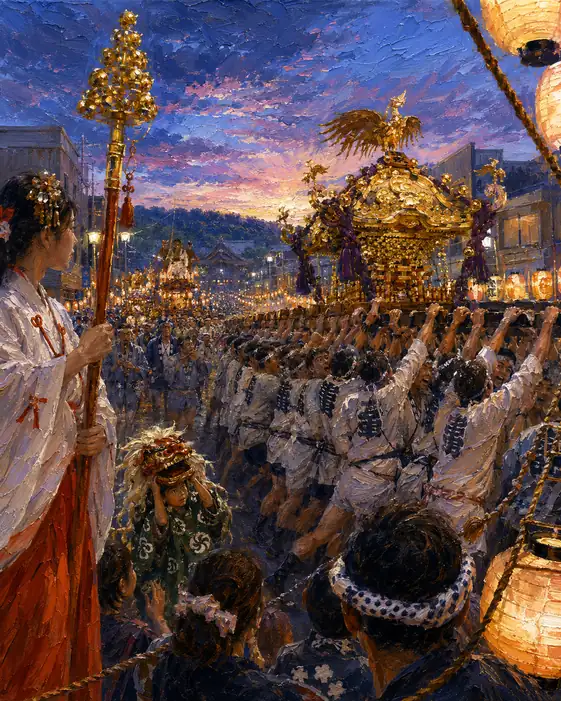 Golden Shrine Procession Under Twilight and Heated Shoulders
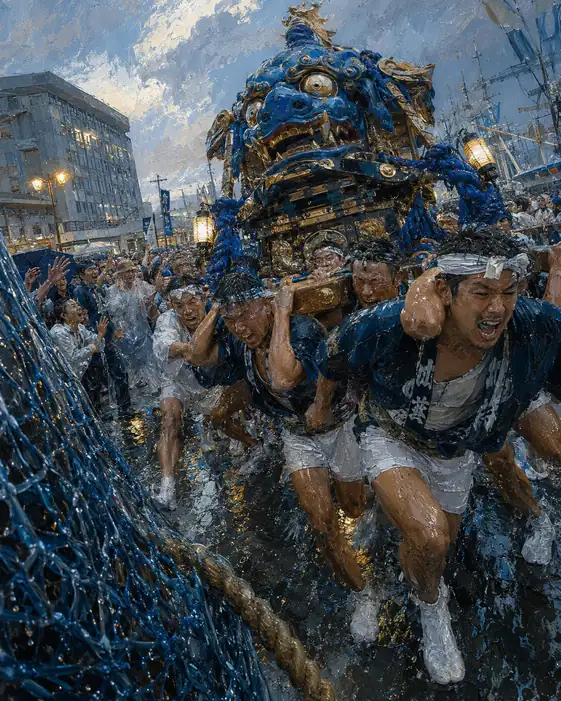 Heavy Rain and Men Carrying the Blue Lion Shrine
Similar Artworks
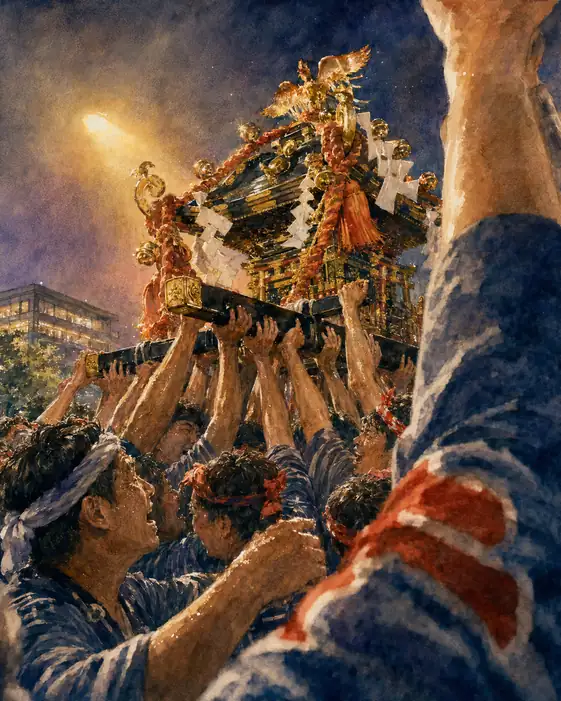 Pinnacle of Passion: Lifting the Sacred Shrine
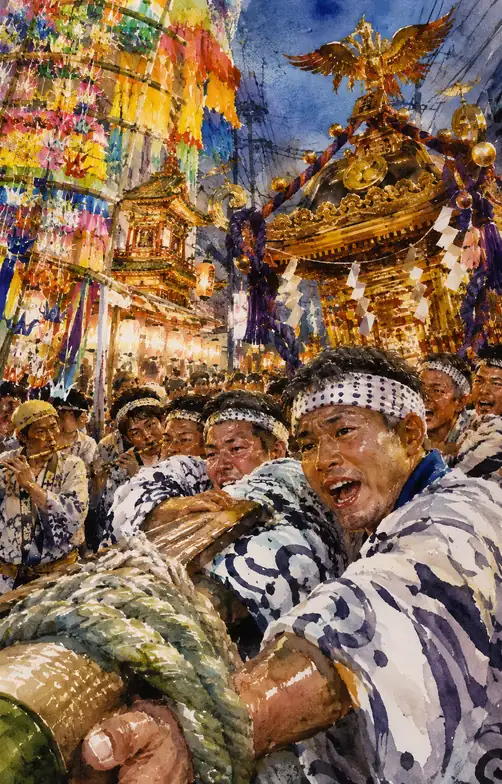 Golden Phoenix Shrine and Men's Cries Resonating in Tanabata Streamers
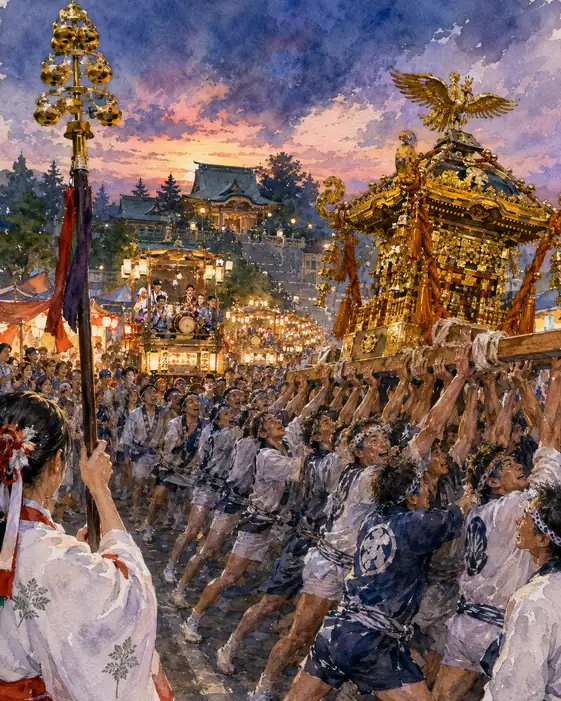 Golden Phoenix Shrine Raised High with Maiden's Bell
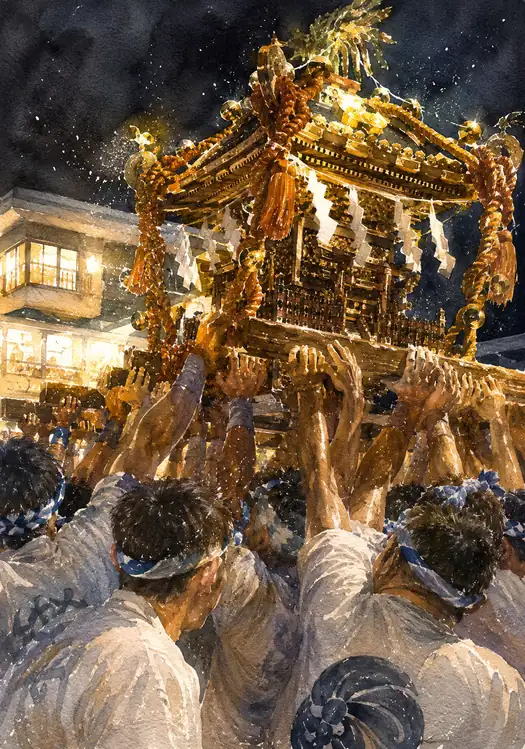 Raising the Golden Shrine Against the Night Sky
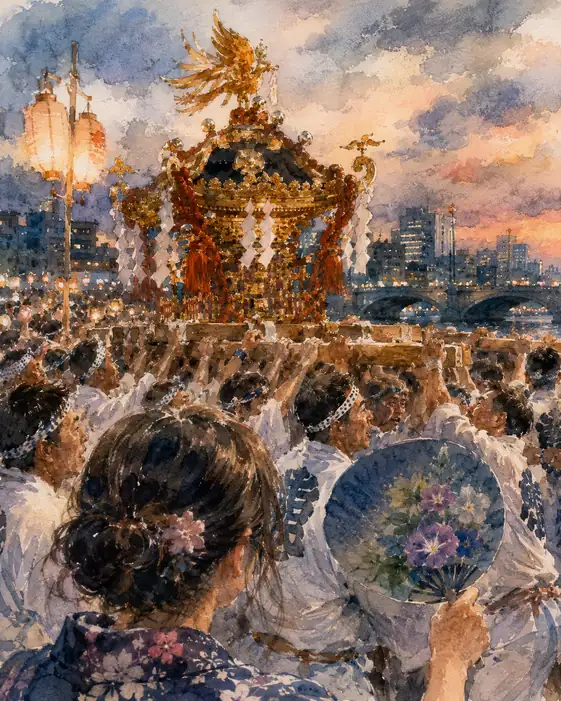 Flash of Sacred Shoulders in Dusk (No. 57)
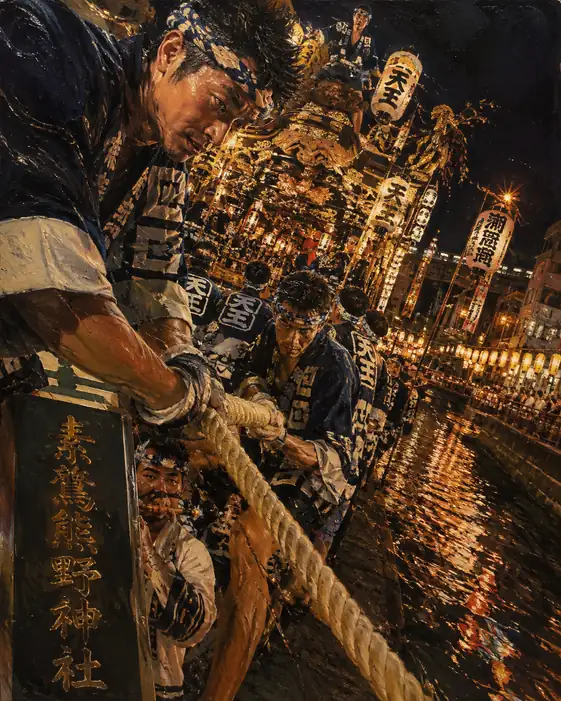 Men's Sweat and Ropes at Susanoo Shrine Tenno Festival
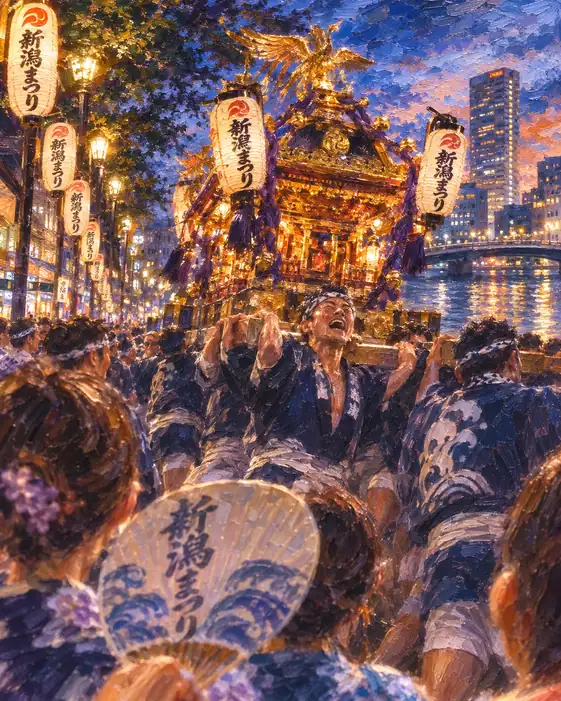 Flash of Sacred Shoulders in Dusk (No. 52)
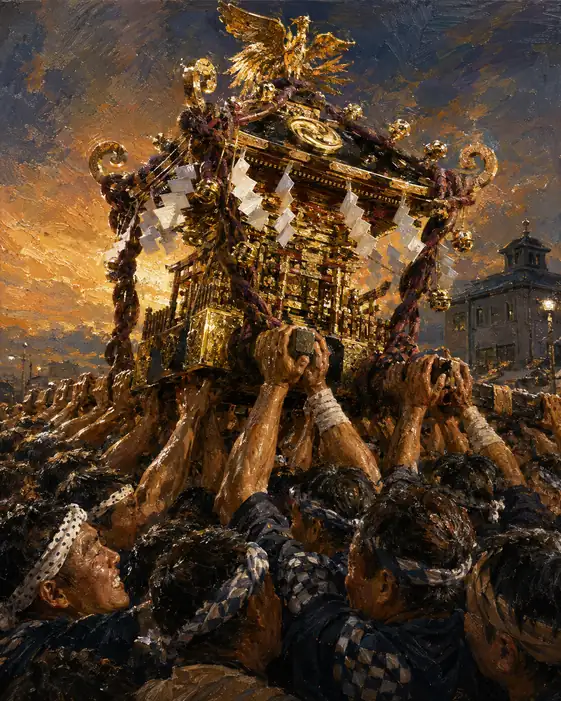 Flash of Sacred Shoulders in Dusk (No. 15)
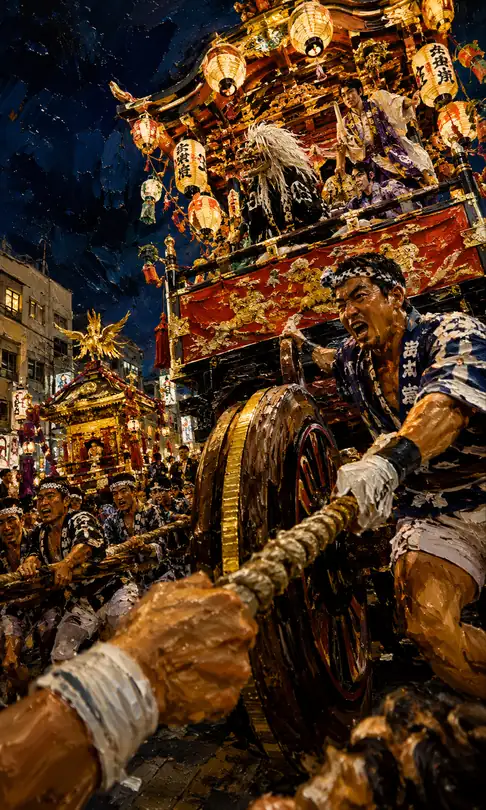 Passionate Cries of Men Pulling the Vermilion and Gold Float
 An Instant Eternity Scorching the Sky (No. 54)