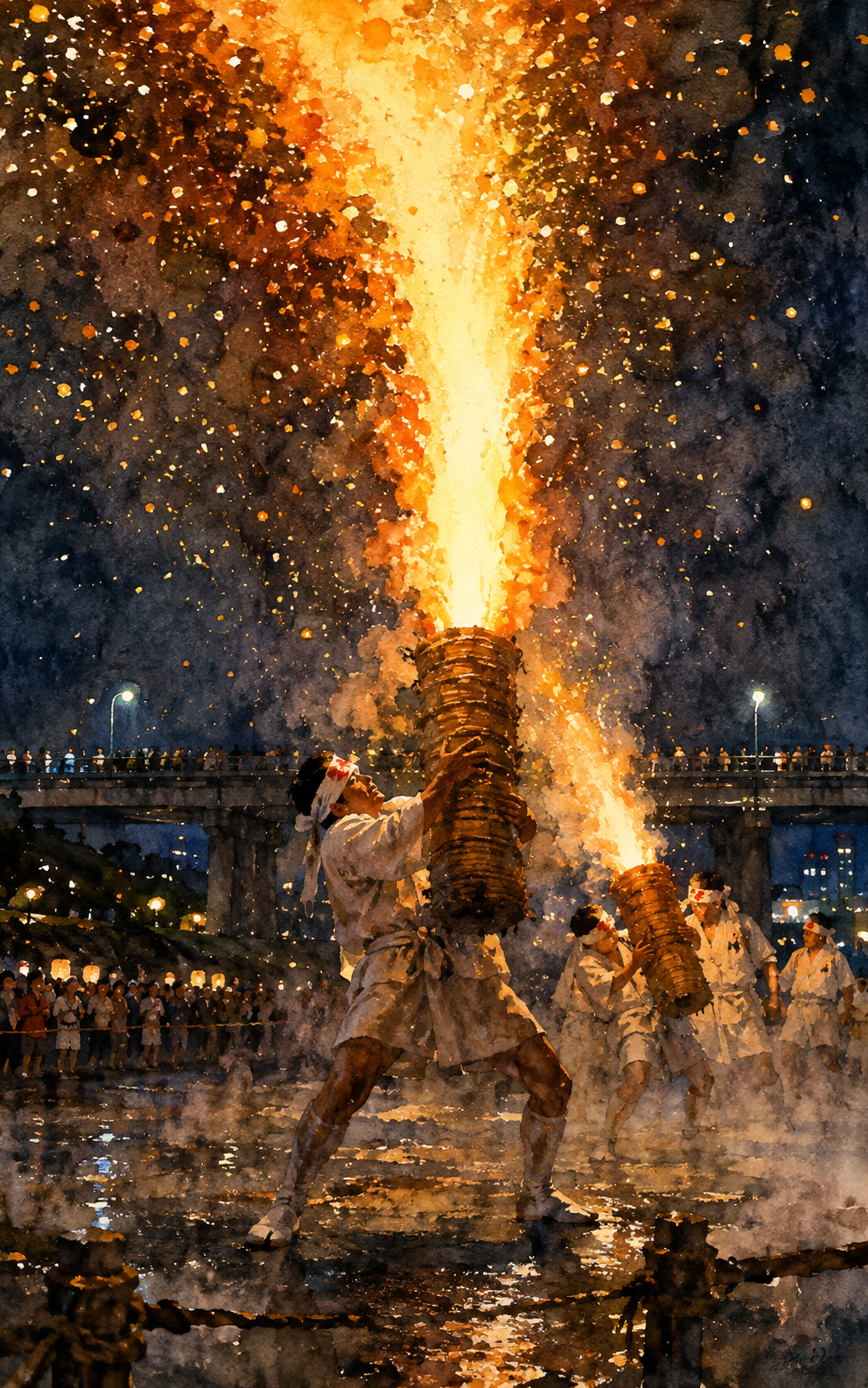
Pillars of Fire and White-Clad Braves Below the Bridge
Critique
Introduction This work depicts men carrying blazing cylindrical torches through a night festival ground. The towering central flame, braced body, wet pavement, bridge spectators, and surrounding smoke transform strenuous ritual labor into a monumental image of heat and endurance. Description The principal bearer stands wide-legged at the lower center, lifting a tall, ribbed torch against his chest and looking toward its fire. He wears a white robe, headband, and leg wrappings. Behind him, two smaller groups angle similar torches upward. Crowds line the left edge and an elevated bridge, while streetlights, distant buildings, ropes, puddles, and smoldering remains establish an urban riverside setting. Analysis The composition is governed by a brilliant vertical column that continues from the bearer’s planted feet beyond the upper edge. His triangular stance stabilizes the rising force, and the smaller diagonal torches create depth. White-hot yellow passes through orange into brown smoke, set against blue-black night. Fine scattered marks describe sparks, whereas broad transparent washes form smoke and damp air. Reflections below repeat the flame in broken, cooler fragments. Interpretation and Evaluation The bearer’s upward gaze and compressed arms make the fire appear both revered and physically difficult to control. Spectators remain separated by barriers and height, emphasizing the performers’ exposure. The foreshortening is convincing, the tonal range is forceful, and the watercolor handling distinguishes flame, smoke, cloth, and water. Placing contemporary lights beside ritual fire gives the scene an effective contrast between managed illumination and elemental danger. Conclusion At first the flame overwhelms every other feature, but closer viewing reveals that the bearer’s stance, watching crowds, and reflective ground carefully measure its scale. The work succeeds by balancing spectacle with bodily effort and by converting an unstable burst of fire into a disciplined vertical structure.
Same Subcategory
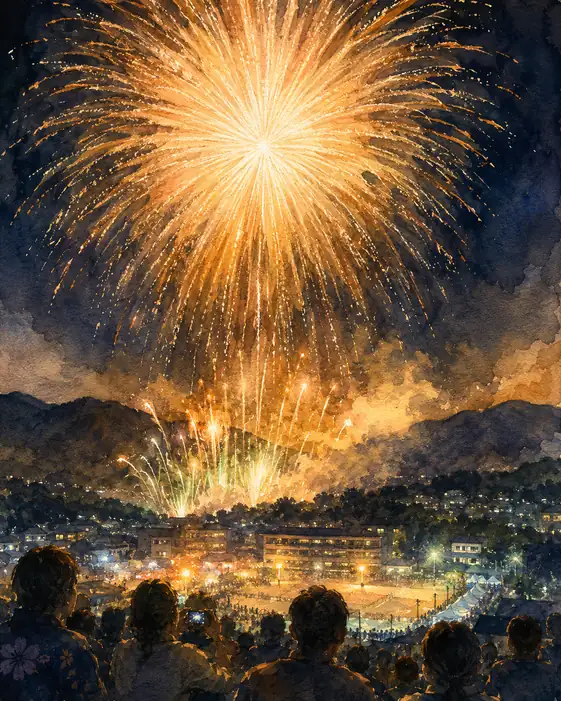 Golden Bloom Over the Village Festival
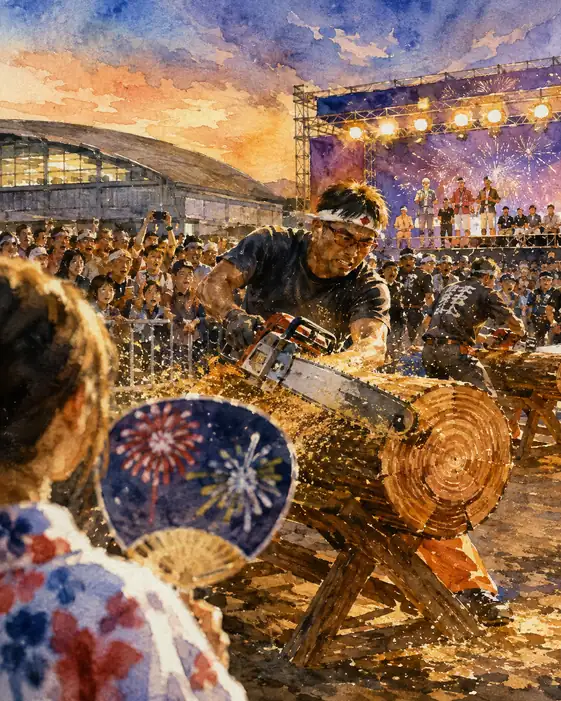 Sawdust Flying with a Single Saw Stroke
Similar Artworks
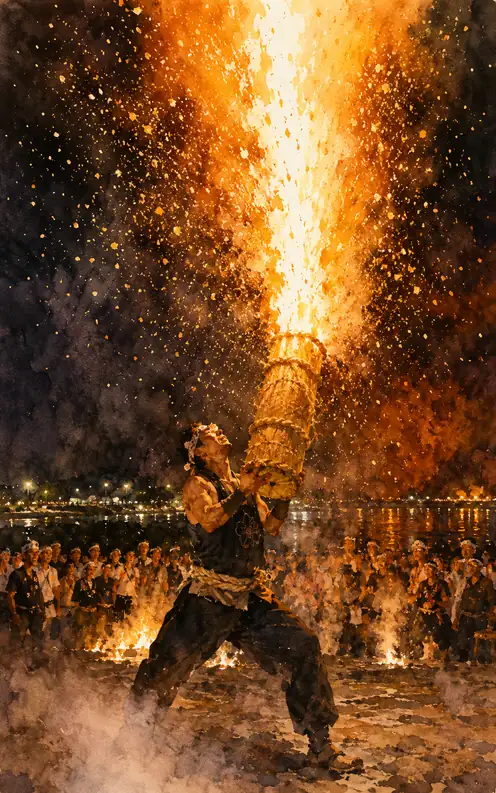 Soul Holding the Column of Fire
 Majesty of the Blue Lion Piercing the Mist
 An Instant Eternity Scorching the Sky (No. 85)
 An Instant Eternity Scorching the Sky (No. 84)
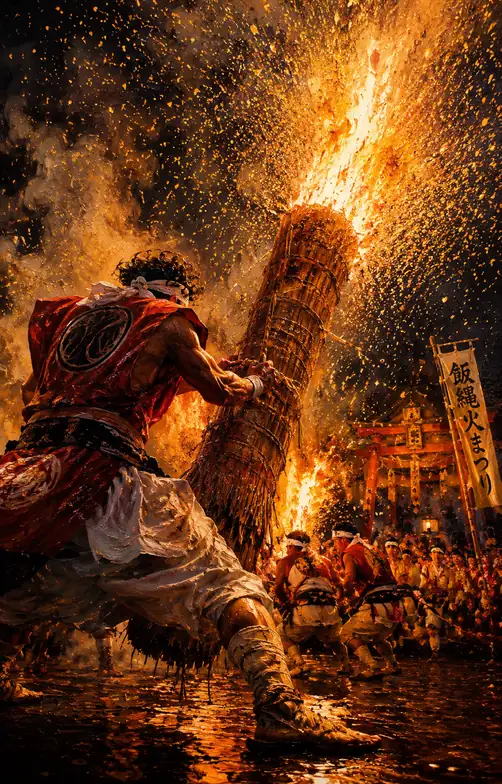 Burning Tezutsu Torch and Valiant Men at Iizuna Fire Festival Shrine
 An Instant Eternity Scorching the Sky (No. 45)
 We Carry the Mountain Fire Together
 Floating Lanterns and Fireworks Over Lake
 Burning Torches and Hands of Men Lighting the Daimonji Fire
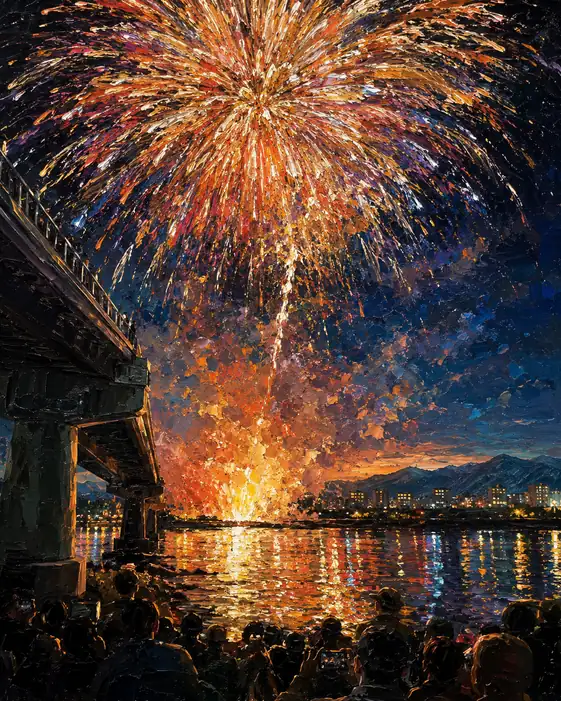 Golden Fireworks and River Reflection Viewed Beneath the Great Bridge