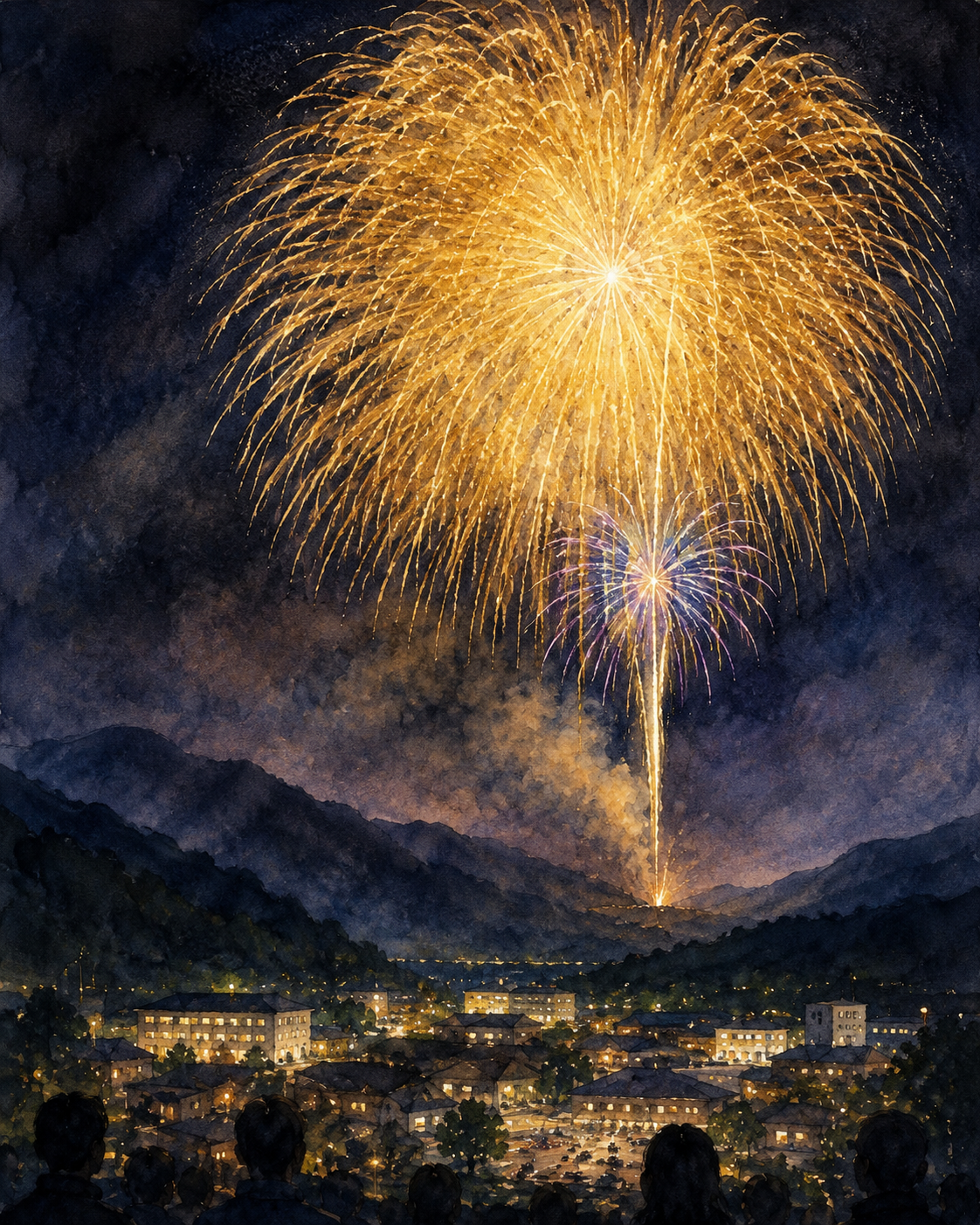
Golden Canopy Over the Valley Town
Critique
Introduction This panoramic night scene places a mountain town beneath two ascending fireworks, balancing cosmic spectacle with the intimate glow of inhabited streets. The painting turns a public display into a meditation on scale, distance, and collective wonder. Description A golden willow burst fills the upper half, its white core sending long trails downward. Below it, a smaller blue, violet, and gold flower rises on a stem from a valley launch point. Smoke spreads between dark mountain ridges. The town occupies the lower third with clustered roofs, illuminated windows, civic buildings, and the central square. Spectators appear as black silhouettes along the bottom edge. Analysis The composition is organized by layers: viewers, town, mountains, smoke, and fireworks. A central vertical line connects the launch, smaller burst, and golden core, while descending arcs broaden that axis into a luminous canopy. Warm windows repeat the firework’s color at human scale. Deep navy and charcoal surround gold, producing contrast without flattening the valley. Interpretation and Evaluation Anonymous spectators invite viewers to share their elevated lookout. Their dark heads establish bodily scale, making the upper radiance feel extraordinary. The large burst resembles a protective tree or celestial dome over the settlement, while the smaller one records the sequence of an unfolding display. Ordinary windows remain visible beneath the spectacle, suggesting that communal memory is grounded in lived places. Strong centrality risks solemn stiffness, but asymmetrical mountains and drifting smoke keep the scene natural. Conclusion The work succeeds through hierarchy, repetition, and atmospheric depth. It joins tiny domestic lights to a monumental flowering in the sky, allowing one color to connect daily life and rare celebration. The result is grand yet tender: a town briefly gathered under a shared roof of fire.
Same Subcategory
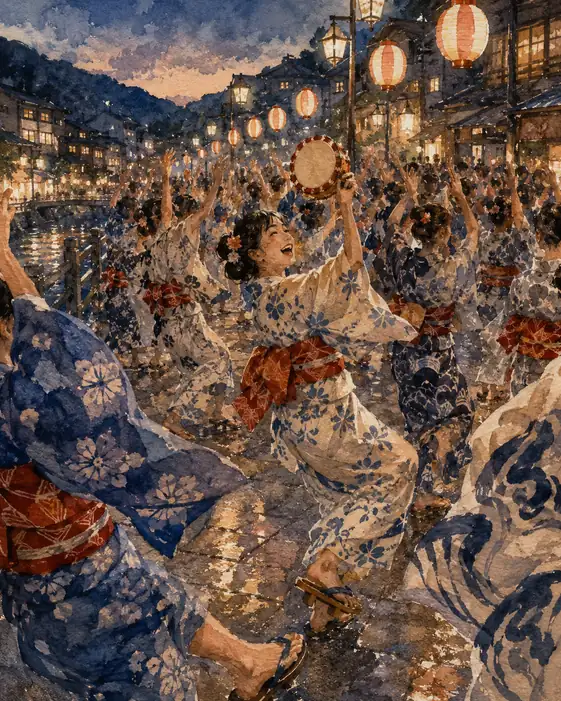 Echoes of Geta and Smiles Under Lantern-Lit Streets
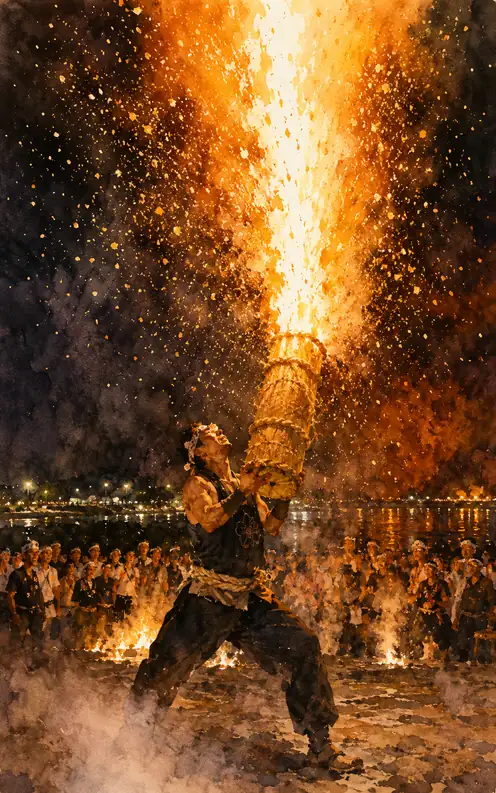 Soul Holding the Column of Fire
Similar Artworks
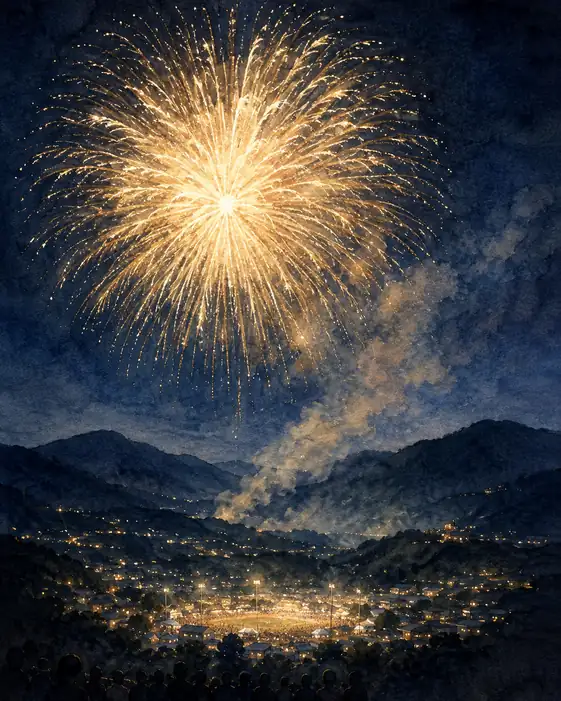 Golden Crown Radiant Over the Basin Town
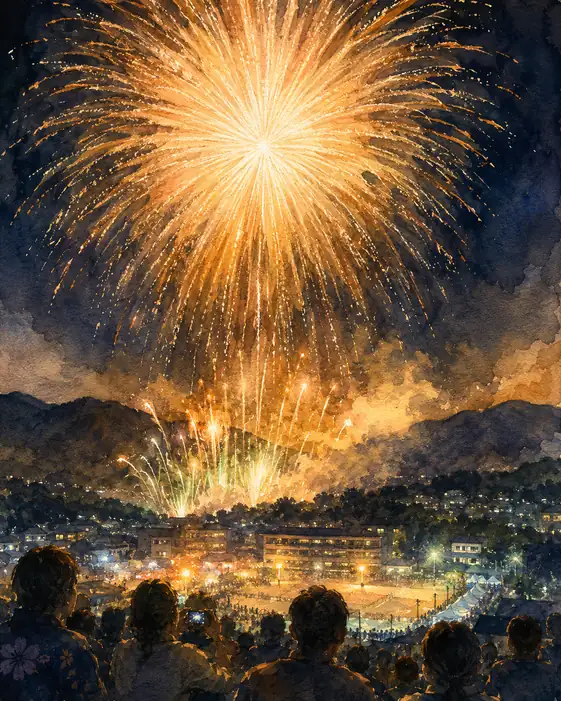 Golden Bloom Over the Village Festival
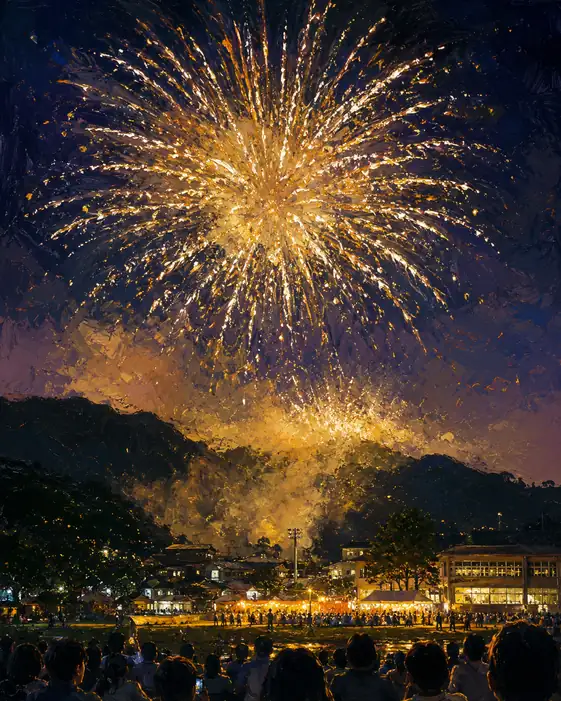 Sparkle of the Great Blossom Over the Mountain Town
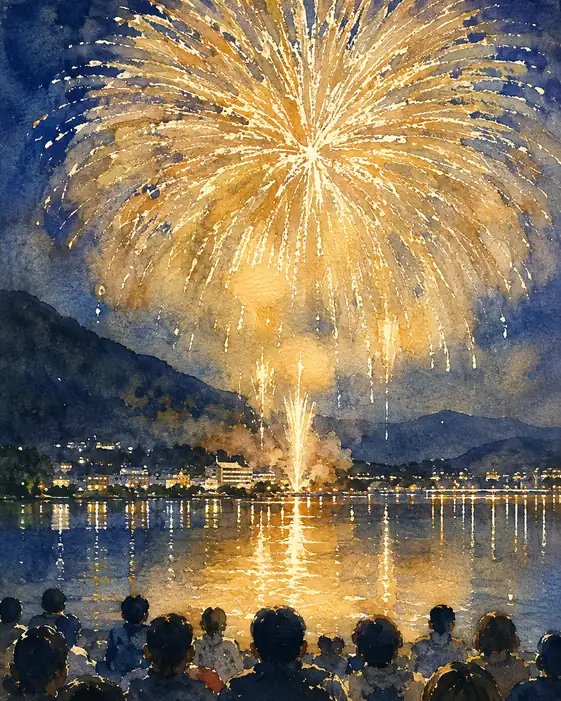 Golden Willow Canopy Over the Lake
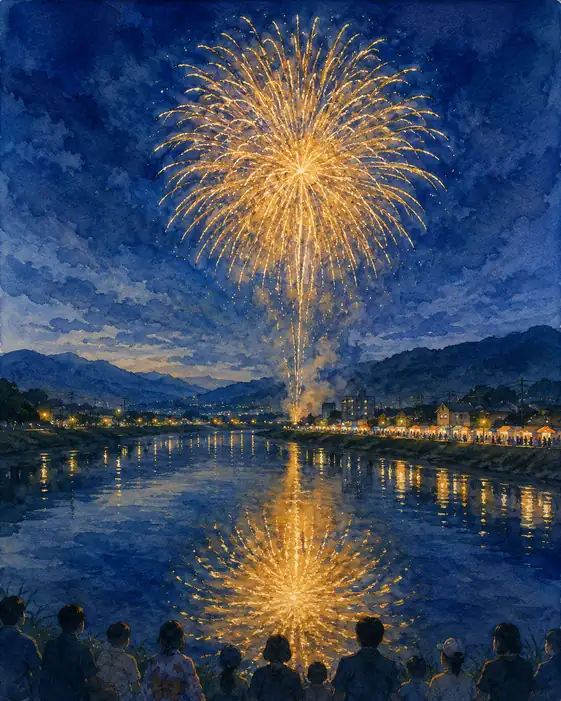 Golden Mirrored Fireworks Joining Sky and Water
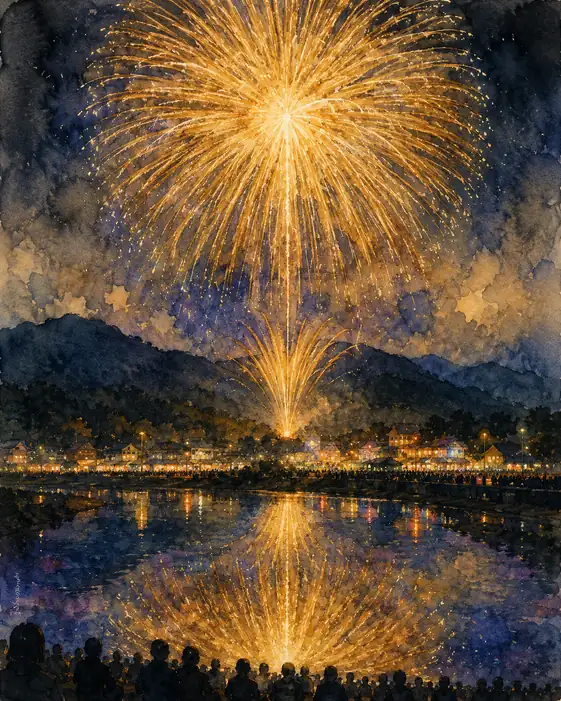 Golden Blossoms Reflected in Symmetrical Harmony
 Symmetrical Golden Mirror Flowers on the Lake
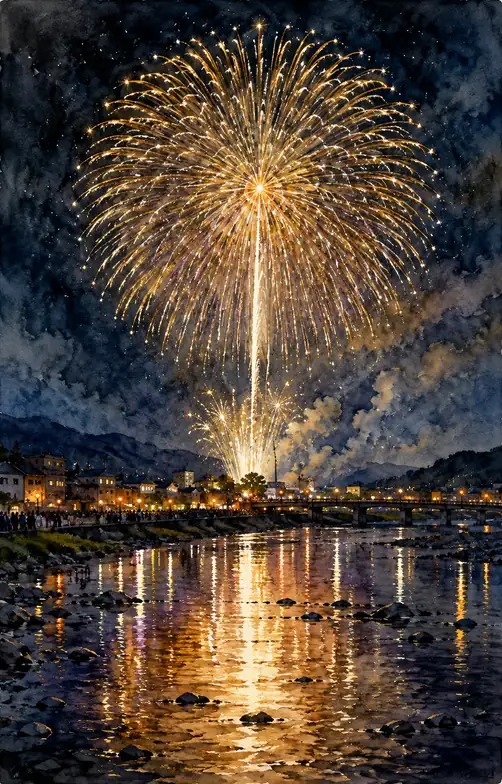 Golden Pillar of Light Reflected in the Clear Stream
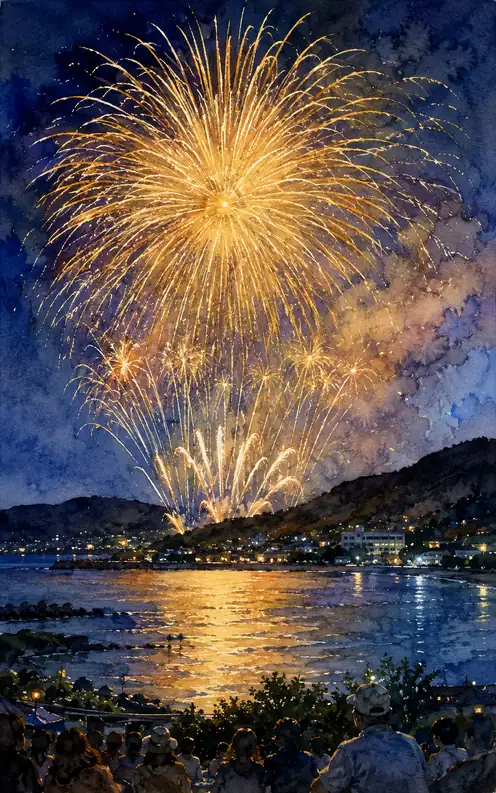 Golden Starmine and Sea Reflections Over the Bay
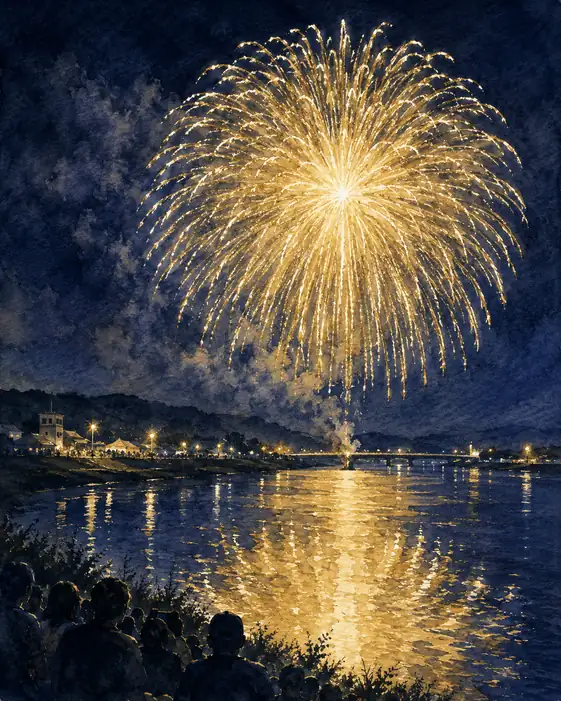 An Instant Eternity Scorching the Sky (No. 99)