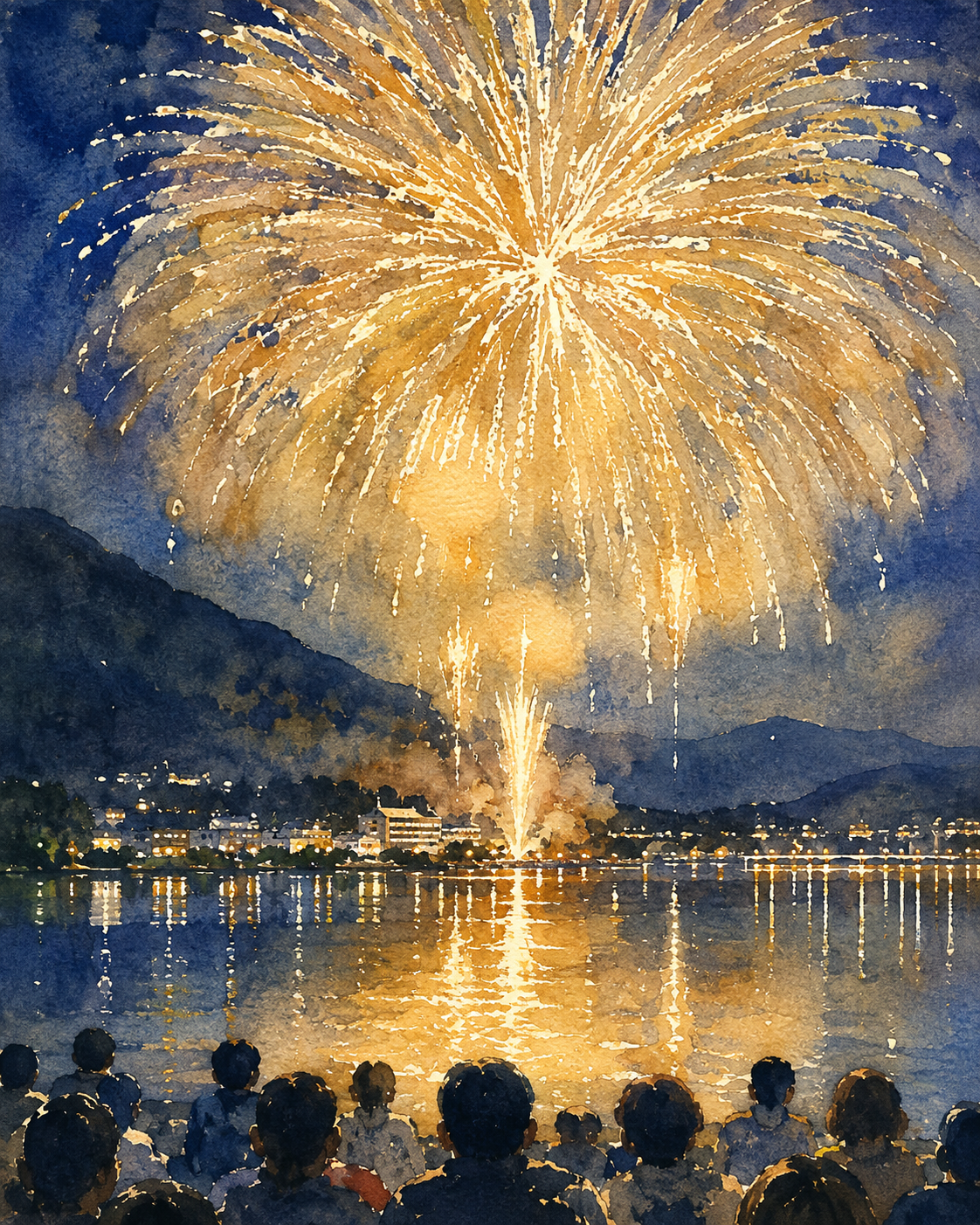
Golden Willow Canopy Over the Lake
Critique
Introduction This lakeside night scene presents a vast golden firework above a town enclosed by mountains. The display fills nearly the entire upper half, while the dark spectators below and the reflective water convert its scale into a shared spatial experience. Description A brilliant central burst opens into hundreds of descending gold trails, with smaller fountains rising from the opposite shore. Low buildings and scattered lights form a narrow band beneath overlapping mountain silhouettes. The lake carries a broad amber reflection toward the foreground, where rows of viewers appear as dark heads and shoulders along the lower edge. Analysis The composition rests on a strong vertical axis linking the firework’s white core, the launch point, and the brightest path on the water. Curving trails spread far beyond that axis, forming a canopy that nearly touches both sides of the frame. Transparent blue washes separate sky, smoke, mountains, and lake, while reserved whites and warm ochres give sparks and reflections several degrees of intensity. Interpretation and Evaluation The enormous firework appears to shelter the town and audience beneath one luminous dome. Yet the mountain profiles remain legible through the haze, grounding the spectacle in a specific basin-like landscape. The color restraint is especially effective: gold gains richness against deep blue without competing hues. Controlled diffusion in the smoke and crisp broken marks on the water demonstrate assured watercolor technique. Conclusion At first the image seems governed entirely by the aerial burst, but sustained viewing reveals an exact chain from sky to shore to spectators. Its balanced structure, convincing atmosphere, and sensitive use of reflection turn a fleeting explosion into a coherent experience of place.
Same Subcategory
 Joyful Dance in the Summer Rhythm
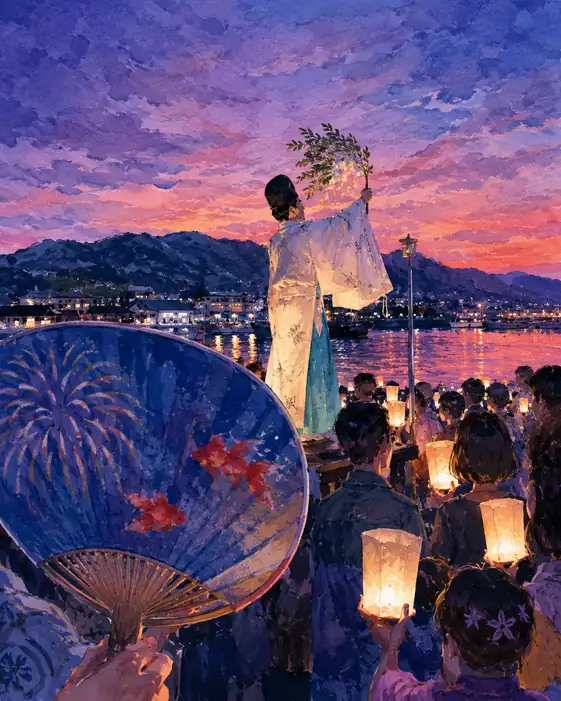 Prayers and Lanterns by the Twilight Harbor
Similar Artworks
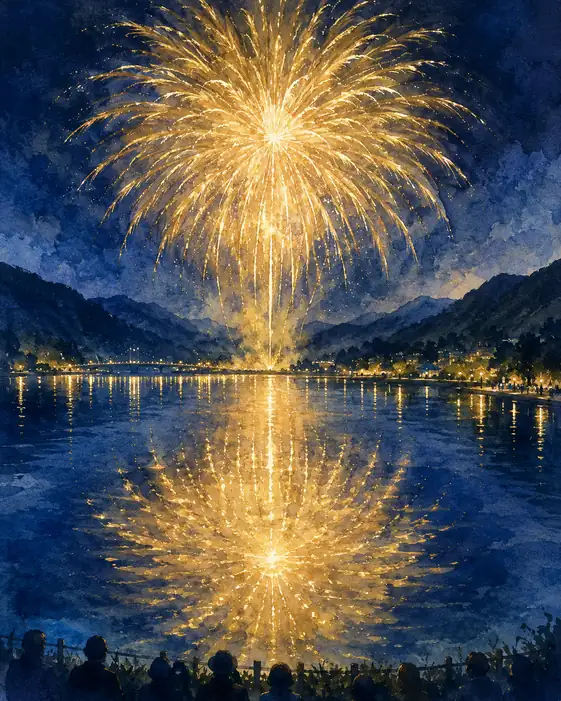 Symmetrical Golden Mirror Flowers on the Lake
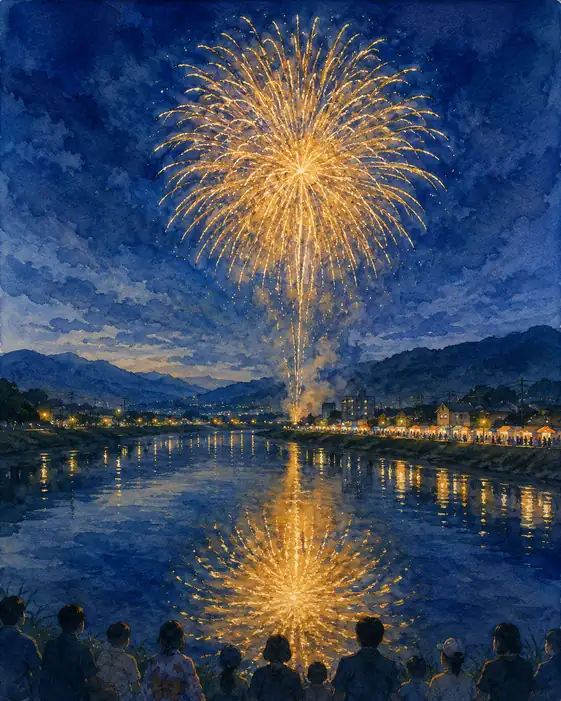 Golden Mirrored Fireworks Joining Sky and Water
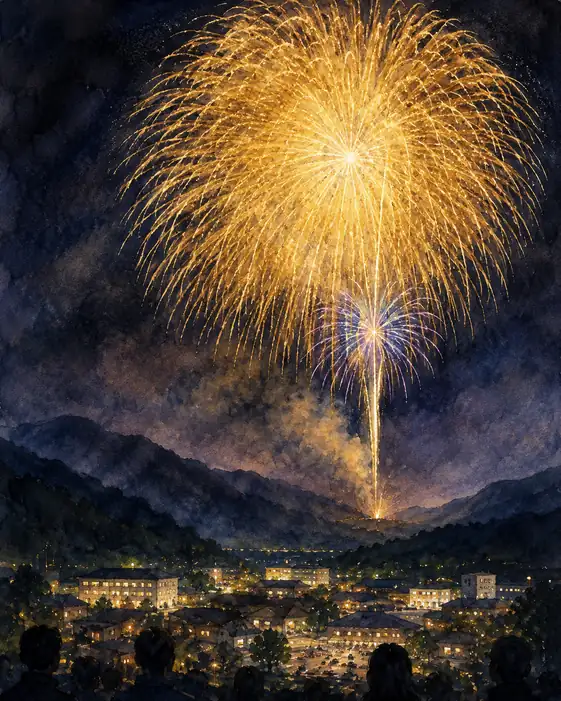 Golden Canopy Over the Valley Town
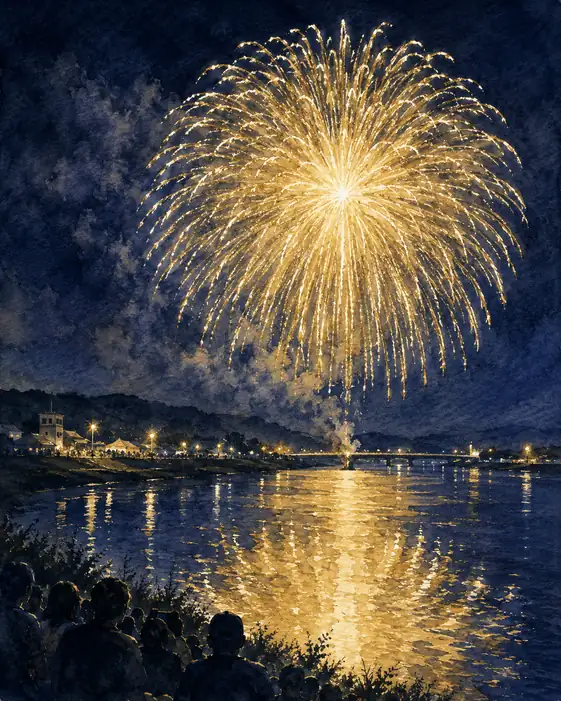 An Instant Eternity Scorching the Sky (No. 99)
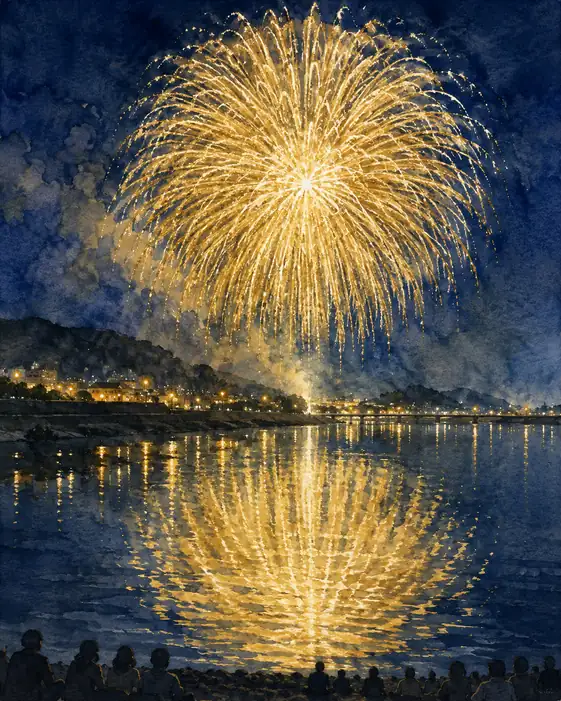 Golden Bloom Above and Reflected in the Quiet Waters
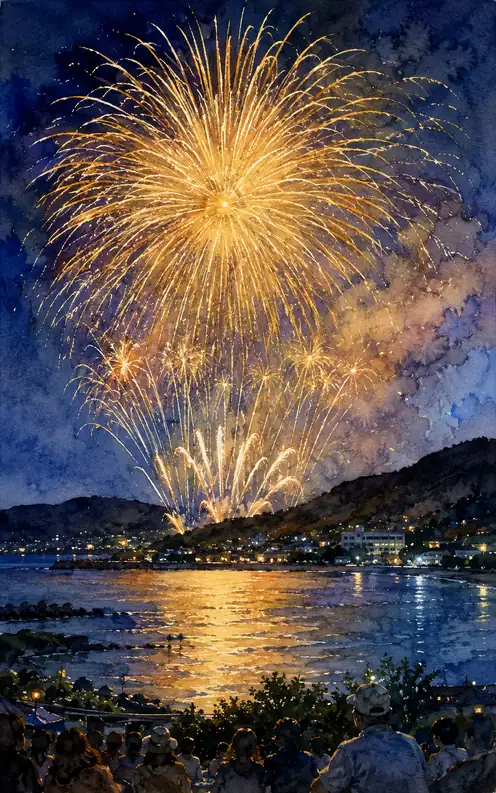 Golden Starmine and Sea Reflections Over the Bay
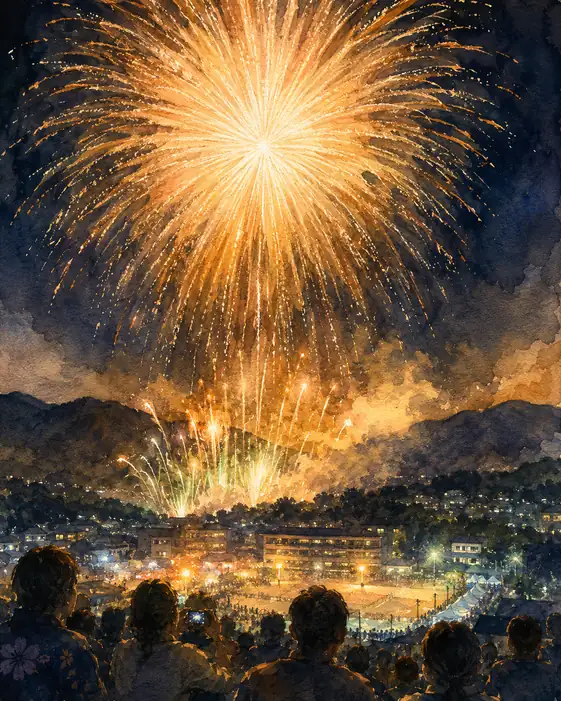 Golden Bloom Over the Village Festival
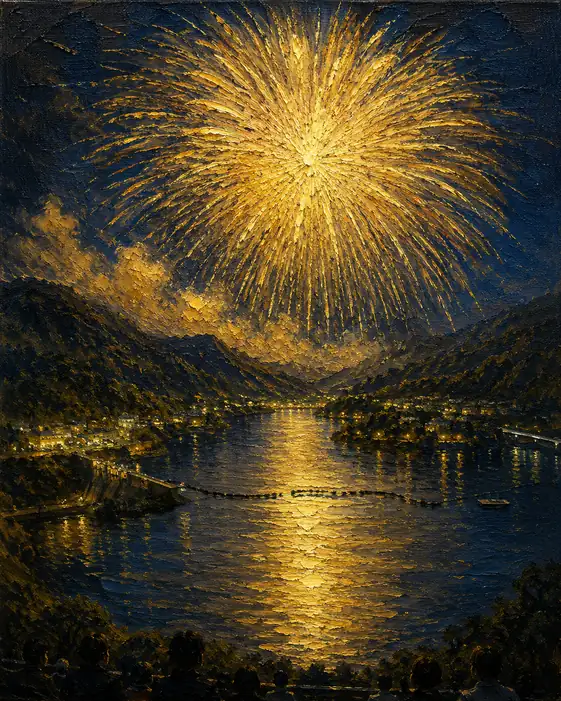 Golden Bloom Over the Mountain Lake
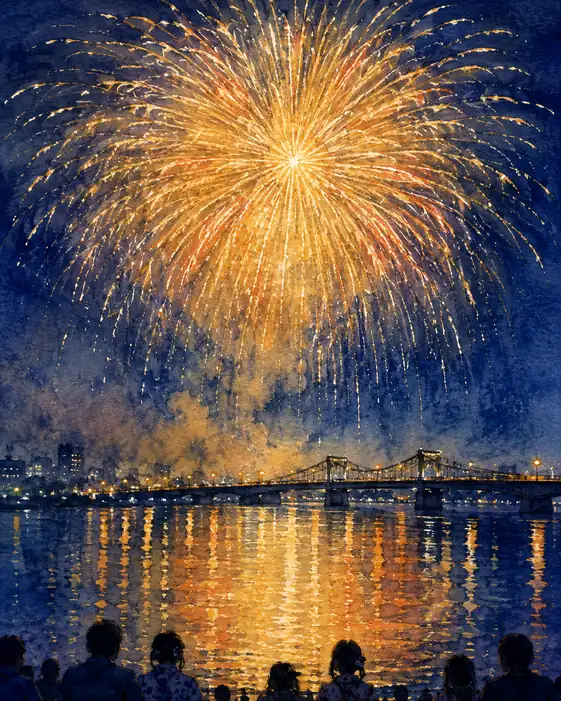 An Instant Eternity Scorching the Sky (No. 59)
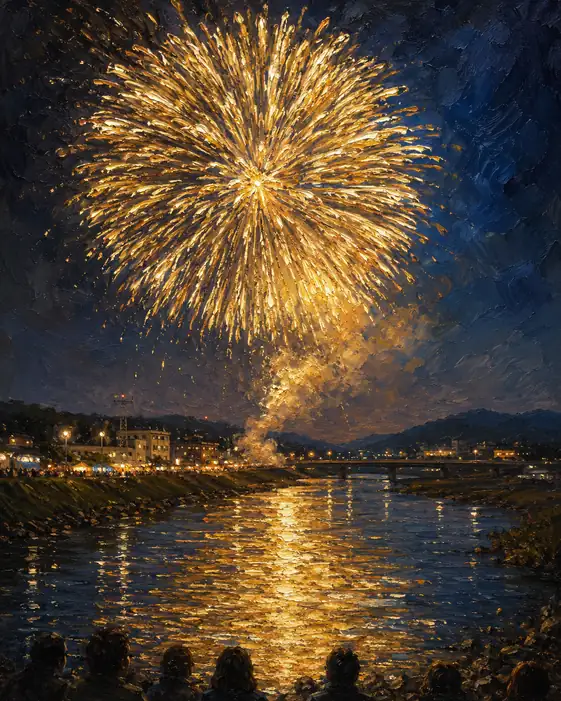 An Instant Eternity Scorching the Sky (No. 96)