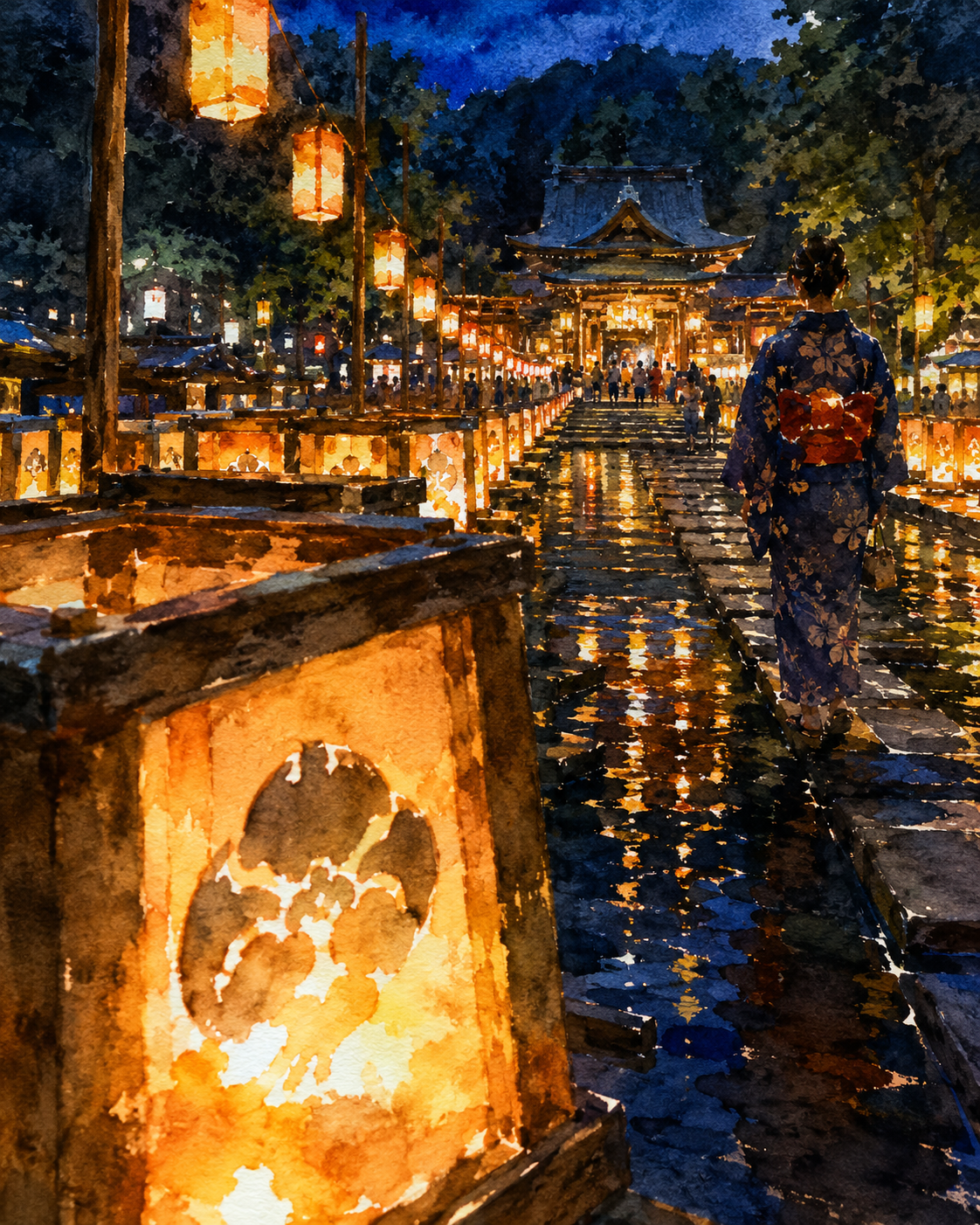
Warm Luminescence Rising in Darkness (No. 89)
Critique
Introduction This evening festival scene follows a woman in a dark blue floral kimono toward an illuminated shrine. Seen from behind on the right, she provides a quiet focal point within a crowded setting organized by lantern light. Description A large paper lantern fills the lower-left foreground, while smaller hanging lanterns recede diagonally from the upper left. The woman walks beside a narrow reflective channel or rain-darkened passage that leads toward the central gate and layered roofs. Stalls and visitors gather on both sides, and warm rectangles of light flicker across the wet paving. Analysis Strong converging lines carry the eye from the oversized foreground lantern, along the water and low illuminated barriers, to the shrine entrance. The woman's upright silhouette interrupts this rapid recession and balances the weight of the left foreground. Orange and amber lights stand against ultramarine sky, blue fabric, and shadowed foliage, while broken watercolor edges soften the architecture without obscuring its symmetry. Reflections extend the lantern rhythm downward and deepen the space. Interpretation and Evaluation The image presents approach as both physical movement and attentive transition. The woman remains distinct from the crowd through scale, placement, and the red-orange obi, yet her destination joins her to the communal procession. Spatial description is persuasive, the asymmetrical framing is controlled, and the warm-cool palette sustains a ceremonial mood. The enlarged cutout pattern in the nearest lantern is an inventive detail that turns decoration into a threshold between viewer and scene. Conclusion The first impression of festival illumination develops into an understanding of guided passage. Repeated lamps, wet reflections, and the woman's measured stride unite foreground intimacy with the distant shrine, making the composition both lively and contemplative.
Same Subcategory
Similar Artworks
 Warm Luminescence Rising in Darkness (No. 91)
 Warm Luminescence Rising in Darkness (No. 27)
 Warm Luminescence Rising in Darkness (No. 25)
 Warm Luminescence Rising in Darkness (No. 51)
 Warm Luminescence Rising in Darkness (No. 26)
 Warm Luminescence Rising in Darkness (No. 48)
 Warm Luminescence Rising in Darkness (No. 23)
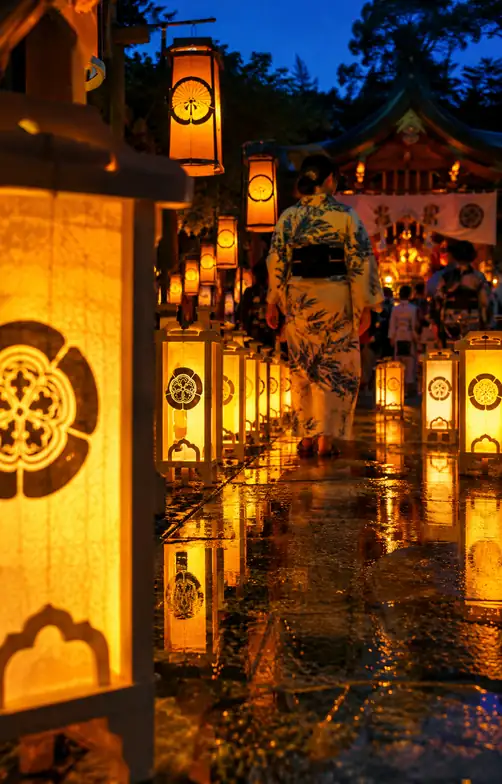 Lanterns and Serenity of a Yukata Figure on the Rain-Washed Shrine Path
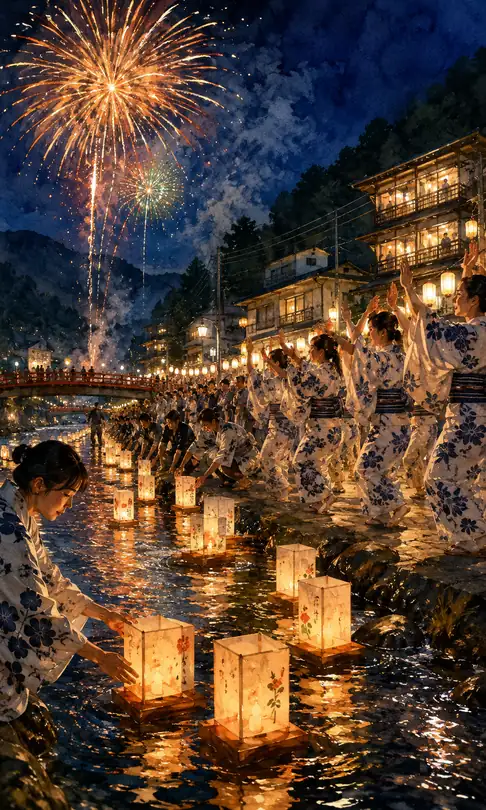 Floating Lanterns and Matching Yukata Bon Dance by the Spa Town Stream
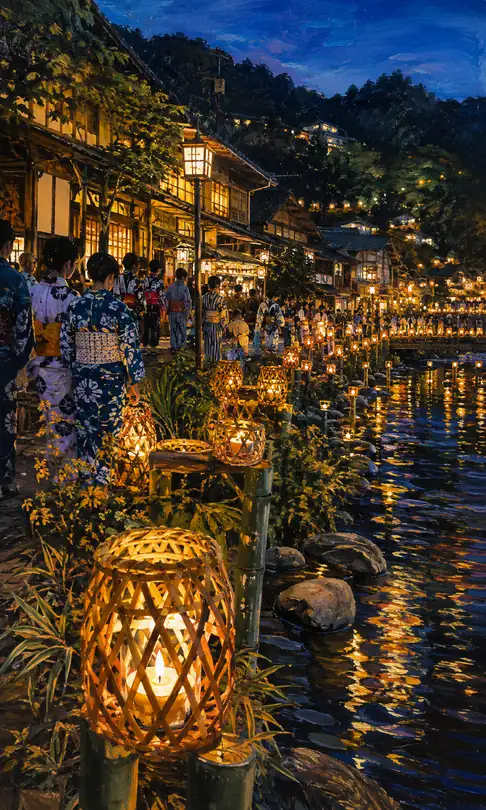 Bamboo Candle Lights and Strolling Yukata Ladies by the Hot Spring Stream