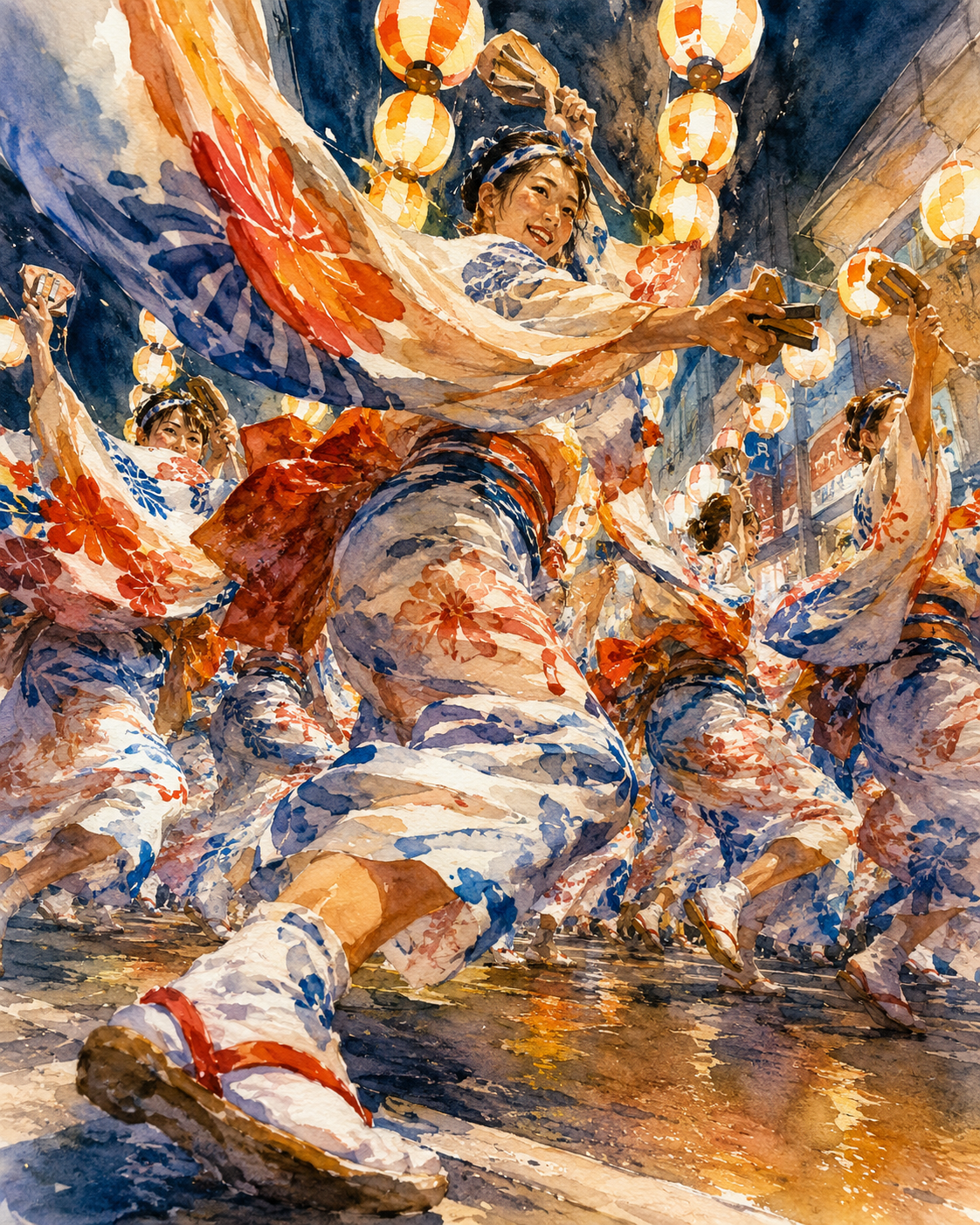
Swirling Summer Robes in Night Air (No. 43)
Critique
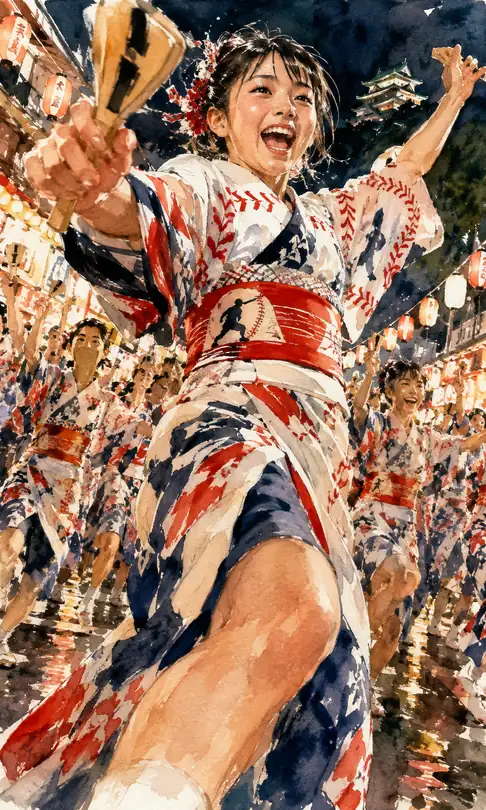
Introduction This work depicts a street festival dance from an exceptionally low and close viewpoint. A smiling woman, patterned garments, wooden clappers, and stacked lanterns create a scene defined by forward thrust and sweeping fabric. Description The central dancer lunges toward the viewer, her wrapped foot enlarged at the lower edge and her bent leg filling much of the foreground. She turns back with a smile while raising one clapper overhead and extending another to the right. Her white robe carries broad blue and coral floral patterns, and a deep red sash knots behind her waist. Other women repeat the clapper gestures across the street beneath columns of orange-white lanterns. Analysis The near foot, knee, torso, and face form a steep ascending diagonal. A sleeve sweeps from the upper left toward the hands, converting fabric into a frame. Repeated lantern circles stabilize the turbulent field, while distant feet clarify recession. Transparent blue washes and coral strokes spread across reserved paper; warm reflections connect costume and lantern light. Overlaps remain legible despite the crowd’s density. Interpretation and Evaluation The backward glance gives the advancing figure both confidence and sociability, as if inviting the observer into the dance. Wooden clappers make the implied rhythm tangible, and the broad sleeve turns sound into a visual sweep. The foreshortening is ambitious, the watercolor handling is luminous, and the patterned color scheme is coherent. The radical proximity gives conventional festival imagery a distinctive bodily immediacy. Conclusion What first seems a single dramatic figure gradually reveals a coordinated field of gestures, lanterns, and reflected colors. The work succeeds by joining precise spatial construction to fluid marks, placing the viewer almost at ground level within the procession’s path.
Same Subcategory
 An Instant Eternity Scorching the Sky (No. 42)
 Swirling Summer Robes in Night Air (No. 44)
Similar Artworks
 Swirling Summer Robes in Night Air (No. 32)
 Swirling Summer Robes in Night Air (No. 97)
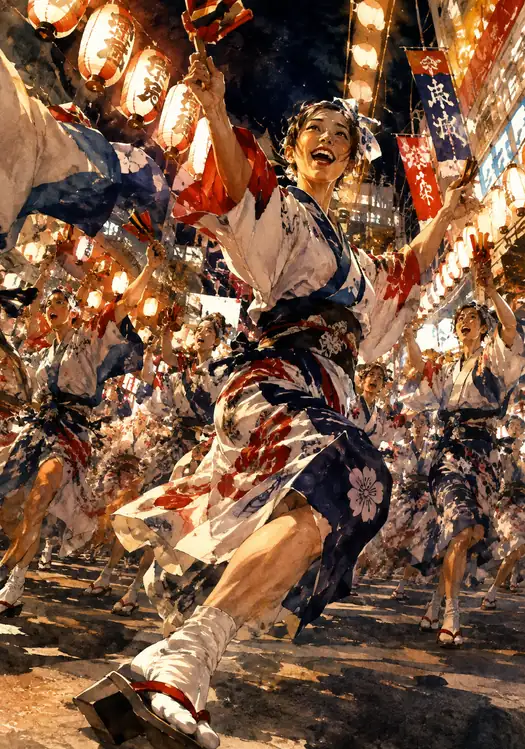 Swirling Summer Robes in Night Air (No. 47)
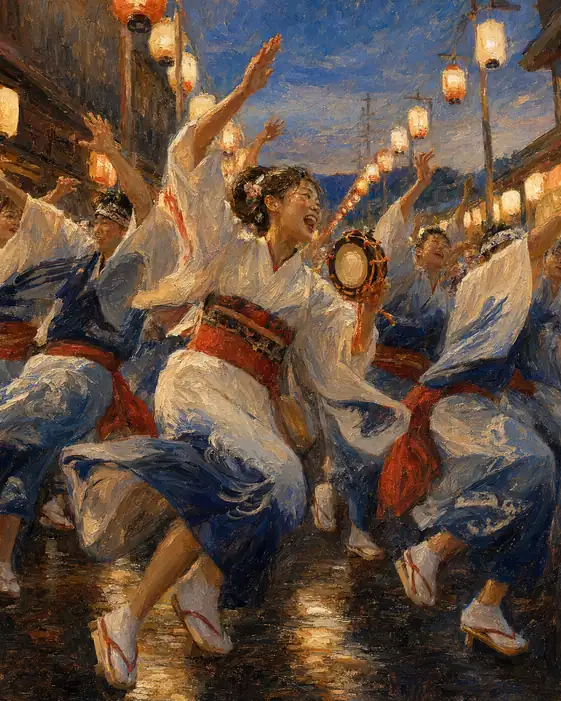 Swirling Summer Robes in Night Air (No. 37)
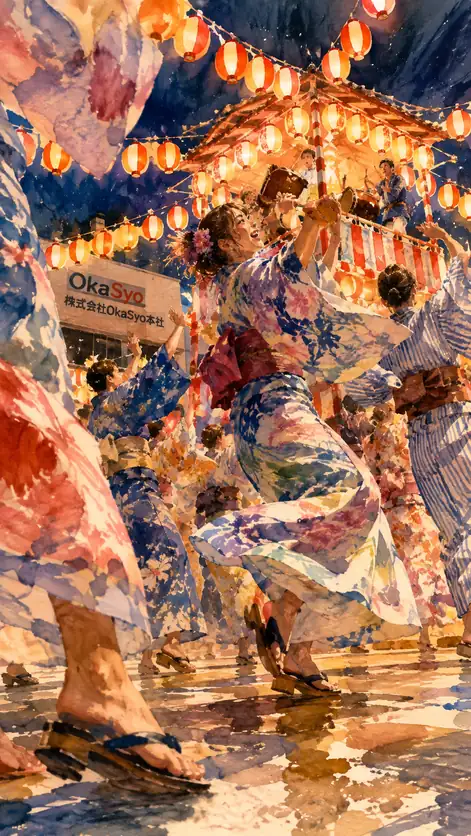 Floral Yukata and Taiko Beats Under Tower Lights
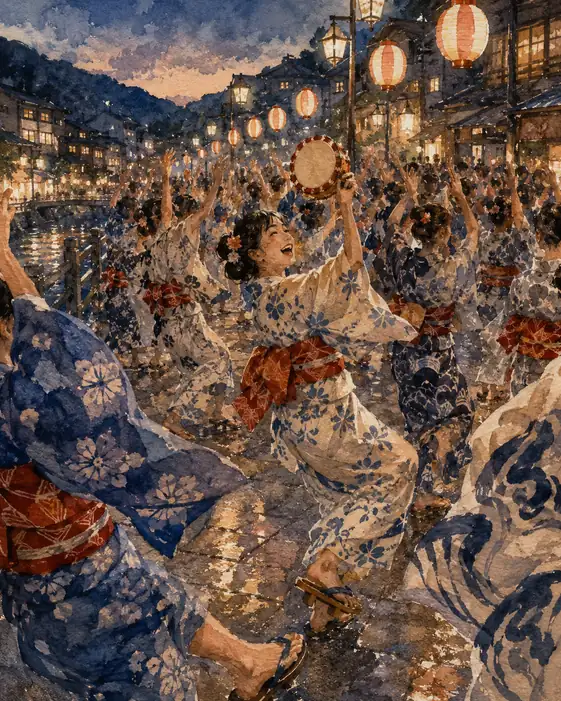 Echoes of Geta and Smiles Under Lantern-Lit Streets
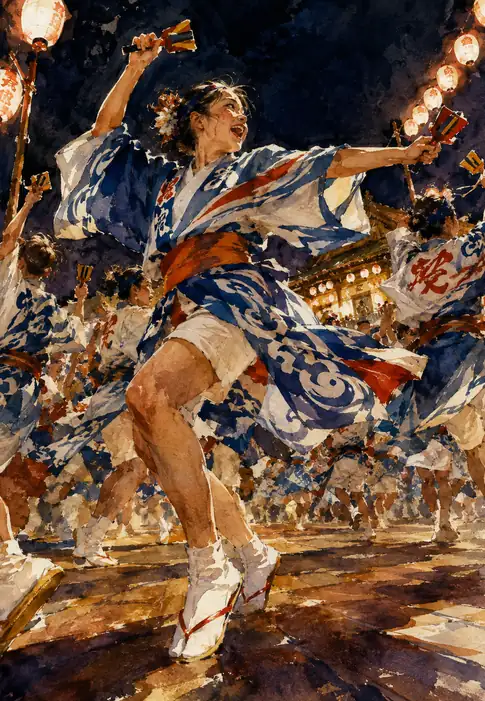 Joyful Dance in the Summer Rhythm
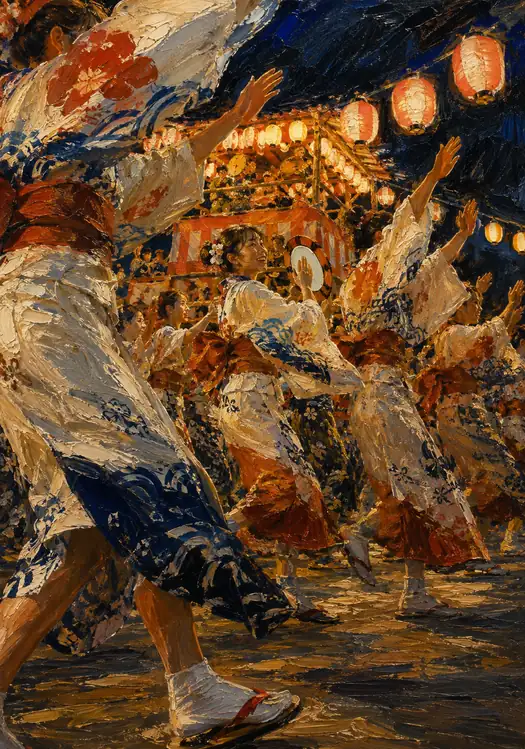 Swirling Summer Robes in Night Air (No. 94)
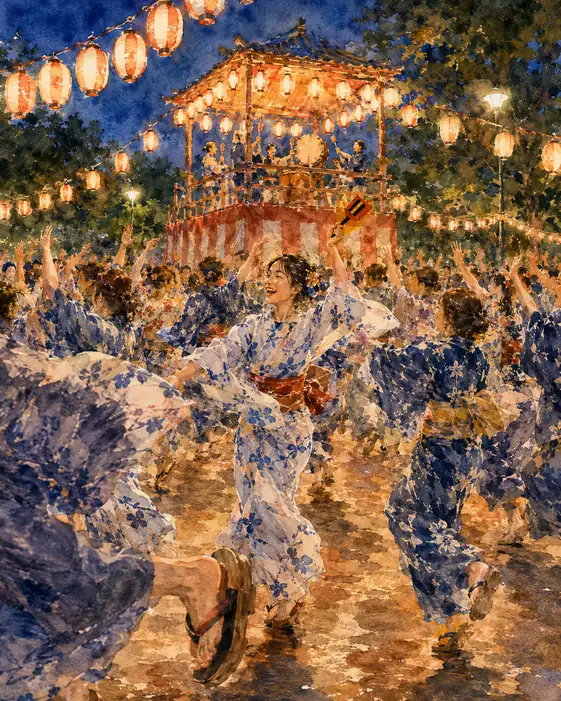 Swirling Summer Robes in Night Air (No. 19)
 Resonating Naruko and Vibrant Yosakoi Smiles Before the Castle