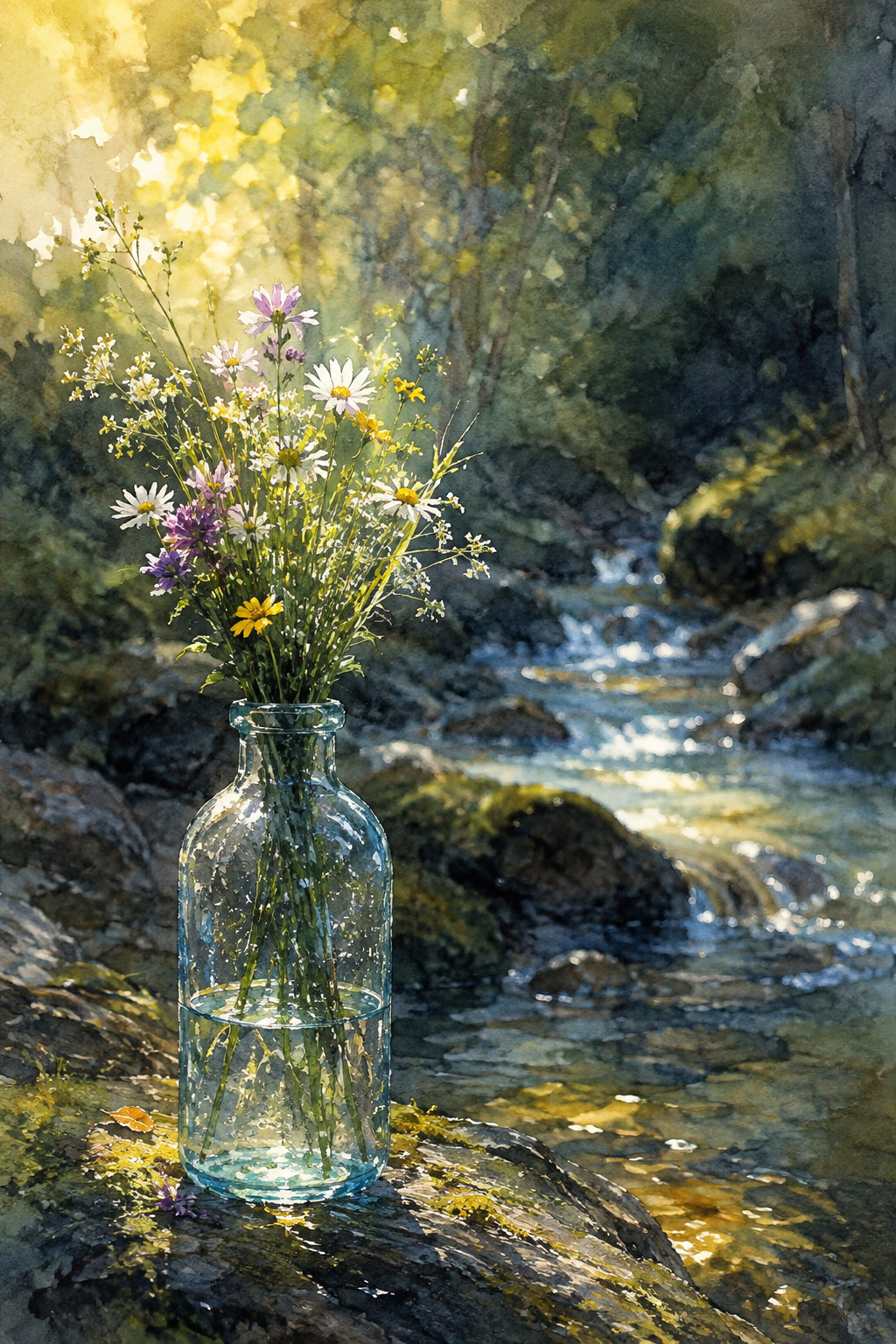
Wildflowers Drink the Forest's First Gold
Critique
Introduction This vertical watercolor depicts a glass bottle of wildflowers on a mossy rock beside a forest stream. Its date and circumstances cannot be confirmed, but the work relates an arranged bouquet to water, stone, and filtered sunlight. Description The bottle stands at lower left with white daisylike blooms, yellow flowers, purple blossoms, and branching stems. Its waterline and submerged stalks remain visible through blue-green glass. Behind it, a shallow stream curves from the shaded center toward the bright lower right among mossy rocks. Sunlight enters from the upper left, catching petals, glass bubbles, and ripples. Analysis The upright bottle anchors the composition against the stream’s diagonal movement and receding trees. Stems spread above the narrow neck, creating a transition from compact vessel to diffuse canopy. Transparent blue, green, and gold washes unite glass and water, while reserved whites distinguish reflections and petals. Controlled bouquet edges contrast with granulated, merging forest passages, producing convincing depth and texture. Interpretation and Evaluation The bouquet was gathered and arranged, although who placed it and why remain unknown. Its temporary order beside moving water suggests contact between human selection and natural growth. Descriptive skill appears in the layered transparency of bottle, stems, and water. The off-center composition, luminous color, and wet-on-wet handling are effective, while the correspondence between vessel and stream gives the familiar subject originality. Conclusion At first, the work reads as a bright outdoor still life. Closer viewing shows that the bottle is not isolated: its water, reflections, and flowers echo the stream and foliage. By coordinating precise observation with open watercolor textures, the painting turns a simple bouquet into a balanced study of containment, flow, and borrowed light.
Same Subcategory
Similar Artworks
 Wildflowers Stand Where the Stream Becomes Light
 Wildflowers Hold the First Light of the Wisteria Path
 A Lantern Learns the Language of the Stream
 A Basket Brims with the Forest's Morning
 Moonlit Wildflowers Overlook the Sleeping Vines
 Blossoms Sail the Forest's Hidden Mirror
 Wildflowers Bring Daylight into the Seaside Room
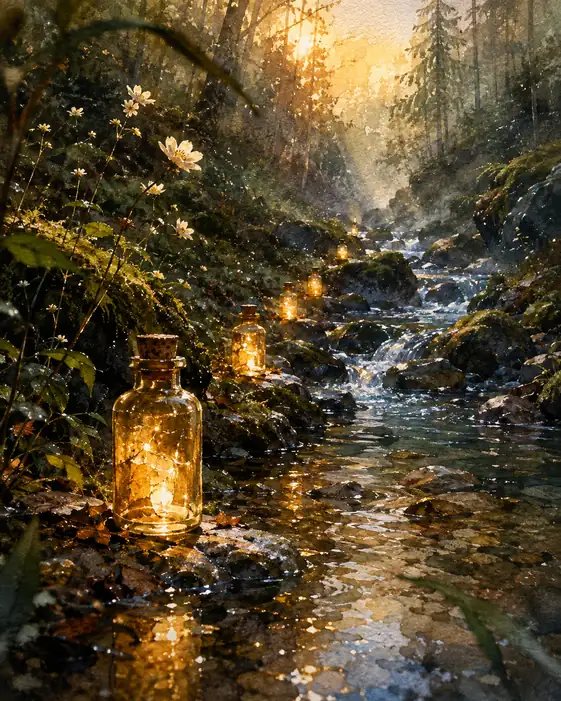 Bottled Stars Follow the Stream toward Dawn
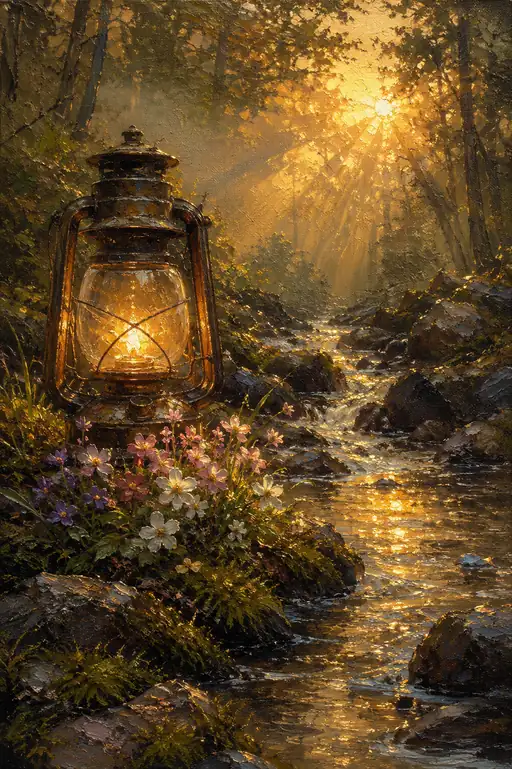 Two Fires Meet beside the Golden Stream
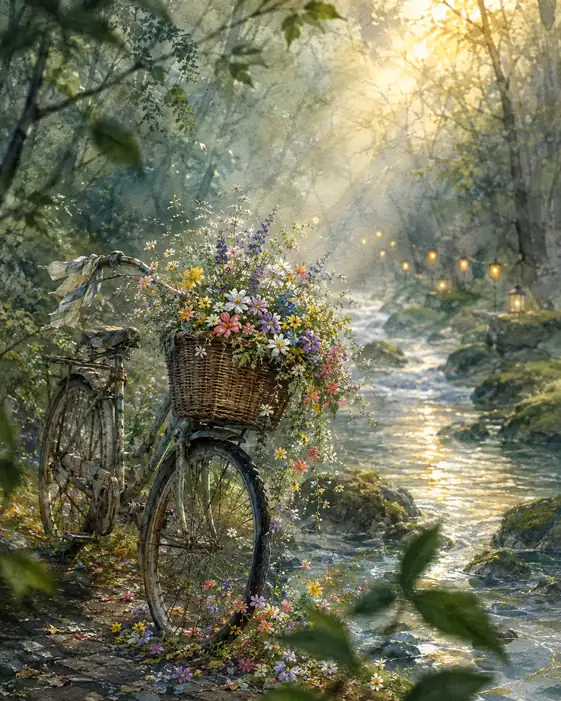 The Flower Bicycle Finds a Road of Water