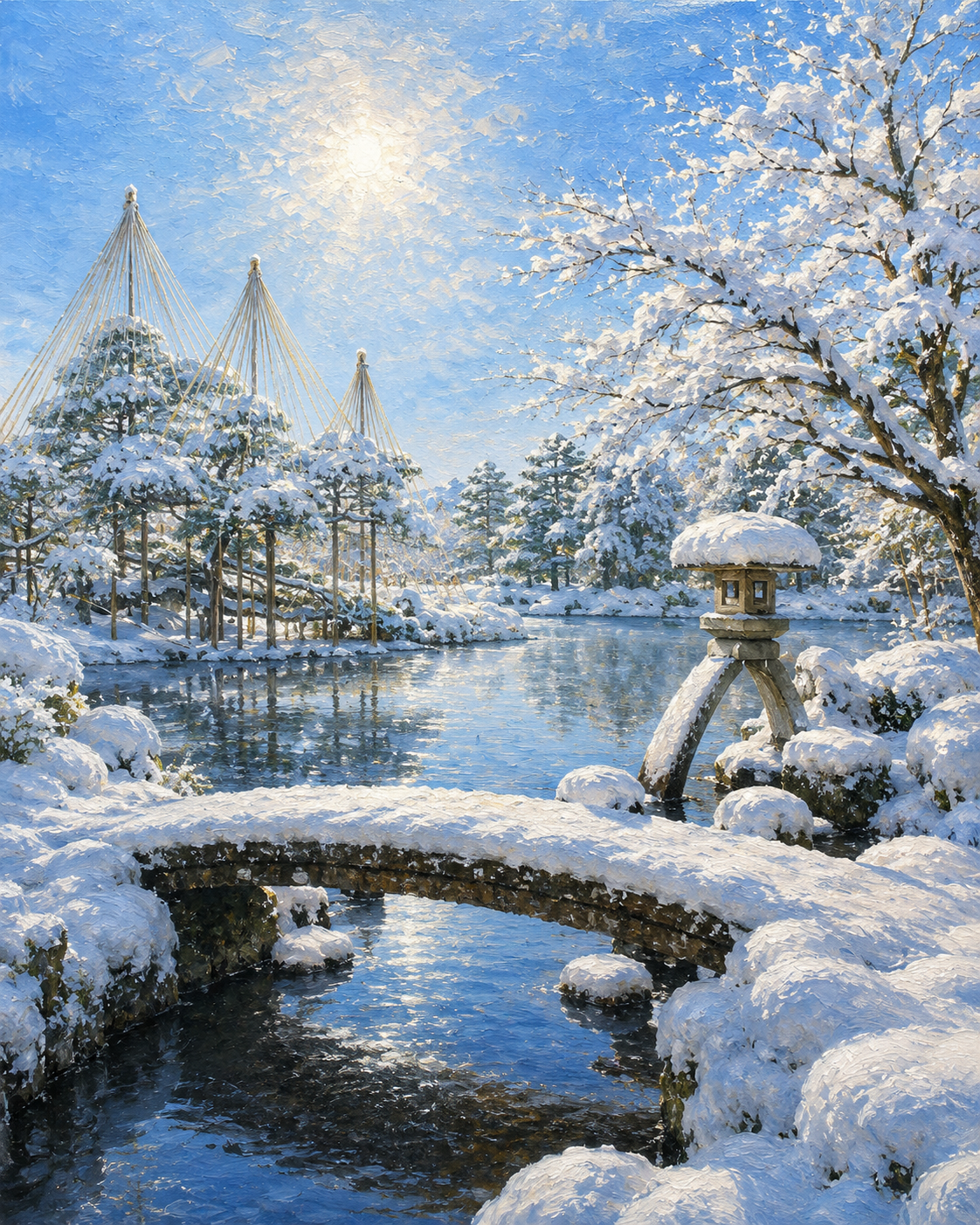
Sunlight Rests on the Bridge of Snow
Critique
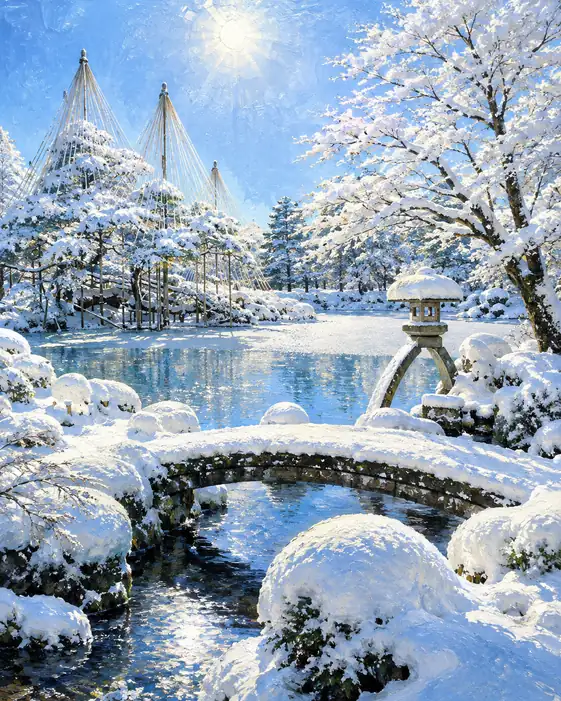
Introduction This vertical winter garden emphasizes ascent, light, and maintained balance. Snowy pines, protective ropes, a lantern, and a pond rise beneath a high blue sky. Luminous marks give the scene physical richness while preserving spacious calm. Description A dark stream enters from the bottom and passes beneath a low arched bridge. The pond occupies the middle, bordered by rounded snowy shrubs. Three prominent yukitsuri structures stand on the left, while a lantern and a spreading deciduous tree occupy the right. A hazy sun glows high above, and its pale reflection extends down the water toward the viewer. Analysis The portrait format turns the garden into a vertical journey from shadowed water to radiant sky. Bridge and bank supply curved horizontal pauses, whereas rope cones and tree trunks pull upward. The lantern stabilizes the asymmetrical distribution of mass. Reflected light forms a central axis without becoming rigid, since ripples fragment it. Impasto-like whites vary from cool blue shadow to warm cream, preserving the volume of every snow load. Interpretation and Evaluation The composition frames endurance as hopeful movement. Yukitsuri embody foresight: their elegant lines remain inseparable from the practical task of supporting branches. The lantern suggests human scale, while the bridge implies a route across the sealed garden. Especially successful is the sun’s restraint; diffused rather than dazzling, it illuminates the atmosphere as well as objects. Conclusion By exploiting vertical format, the painter gives familiar garden motifs renewed momentum. Water, bridge, lantern, ropes, branches, and sun form a coherent progression from earthbound weight to open brightness. The work remains credible because its optimism grows from visible care and material resistance, not from denying winter’s burden.
Same Subcategory
Similar Artworks
 Winter Opens a Mirror Beneath the Bridge
 The Pond Keeps Winter's Blue Silence
 Morning Crosses the Snowbound Garden Bridge
 In the Snow’s Radiance, the Lantern Listens to the Koto of Water
 Starlight Born Before Evening
 Noon Rings Across the Quiet Pond
 A Summer Whisper Through Three Stones
 The Garden Keeps a Window of Blue
 Morning Opens the Stone Lantern
 When Snow Learns the Shape of Stillness