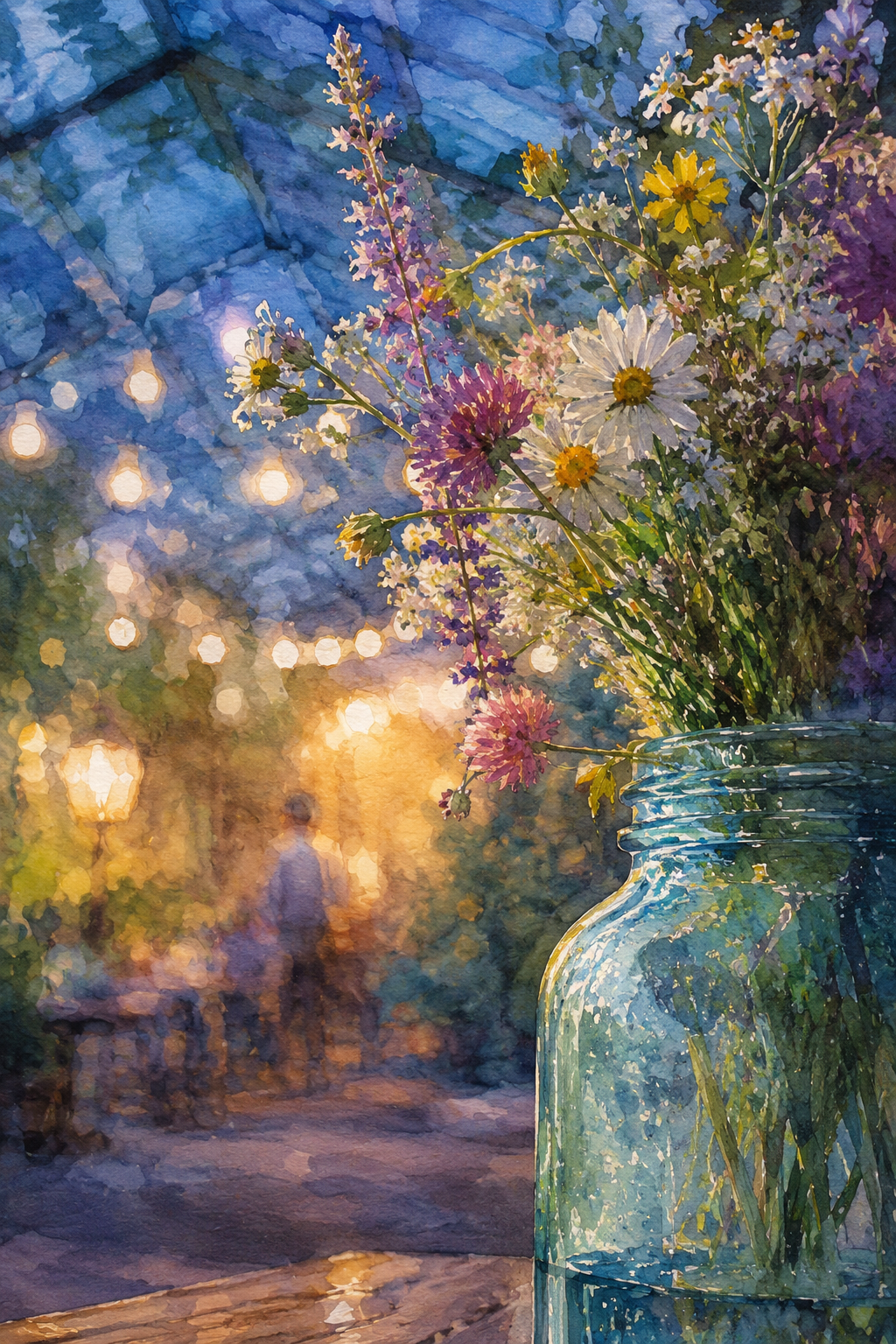
Evening Waits Beyond the Wildflower Jar
Critique
Introduction This watercolor brings a large jar of meadow flowers close to the viewer while a blurred figure and lantern path recede behind it. The contrast makes private gathering and shared garden life coexist across different degrees of focus. Description A blue-green glass jar fills the lower right, holding water and a profusion of daisies, clover, yellow flowers, purple spikes, and tiny white sprays. Highlights break across its ribbed rim and wet surface. Behind, numerous round lamps float under a blue glass roof. A solitary indistinct person stands near a table at left center, surrounded by foliage and warm haze. Analysis The bouquet’s diagonal spread moves from the jar toward the upper right, countering the background path and lights. Large crisp flowers dominate the near plane, while the figure dissolves into broad washes. Cool blue occupies roof and glass; yellow centers and lamps create continuity through depth. The cropped jar gives the still life monumentality. Reflected stems distort below the waterline, and scattered white reserves make both petals and lamp halos sparkle. Interpretation and Evaluation Focus establishes an ethics of attention: the anonymous person is not the scene’s owner, while gathered plants receive full particularity. Yet the lamps connect individual blossoms to a maintained communal route. The jar preserves flowers temporarily, not permanently, and visible water makes that care practical. The distant figure may have gathered them or may simply pass, leaving the relationship open. Conclusion The work rewards looking at ordinary diversity. Its close flowers do not cancel human space; they teach another way to inhabit it. Through focus, refraction, and repeated light, the bouquet becomes a vivid participant in evening life.
Same Subcategory
Similar Artworks
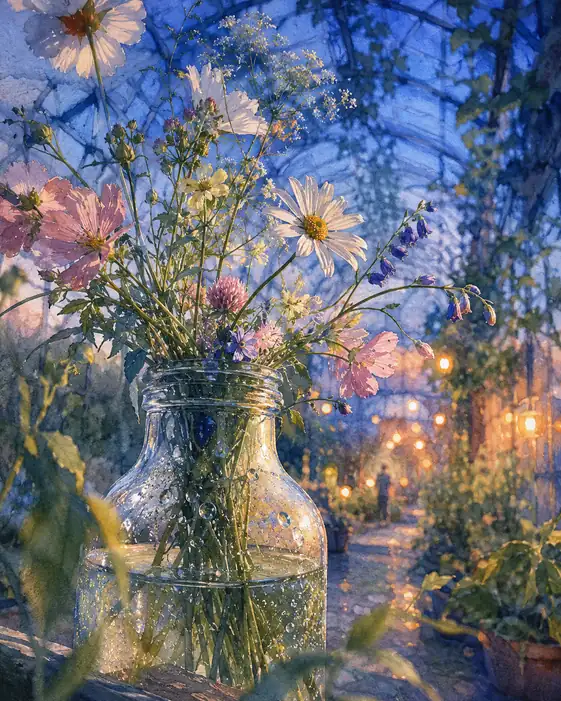 Wildflowers Drink the Blue-Hour Lanterns
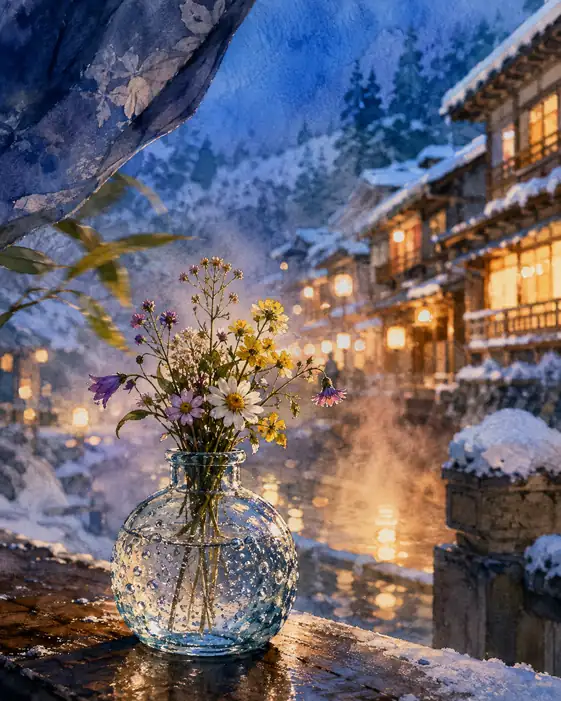 Wildflowers Watch the Hot-Spring Evening Steam
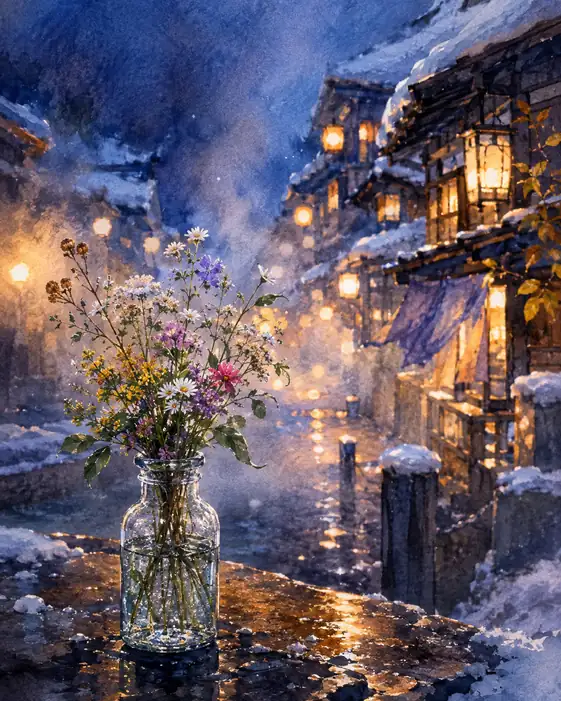 Wildflowers Gather the Lanterns of a Snowy Evening
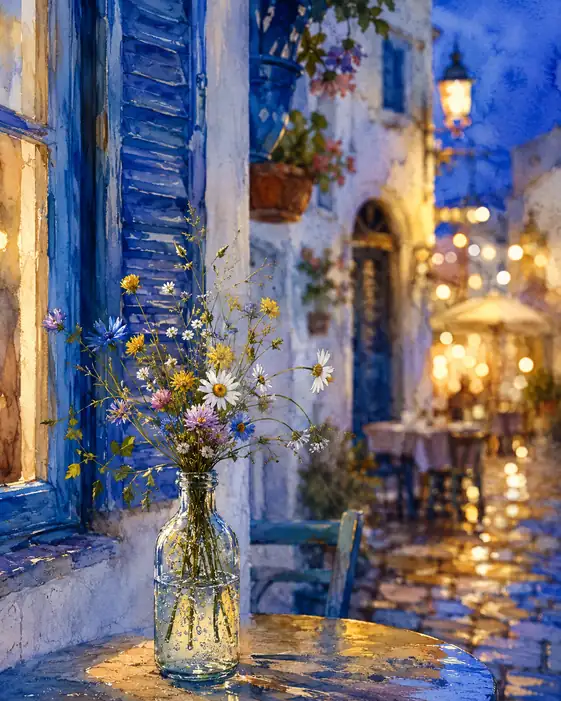 Wild Petals in the Blue Hour
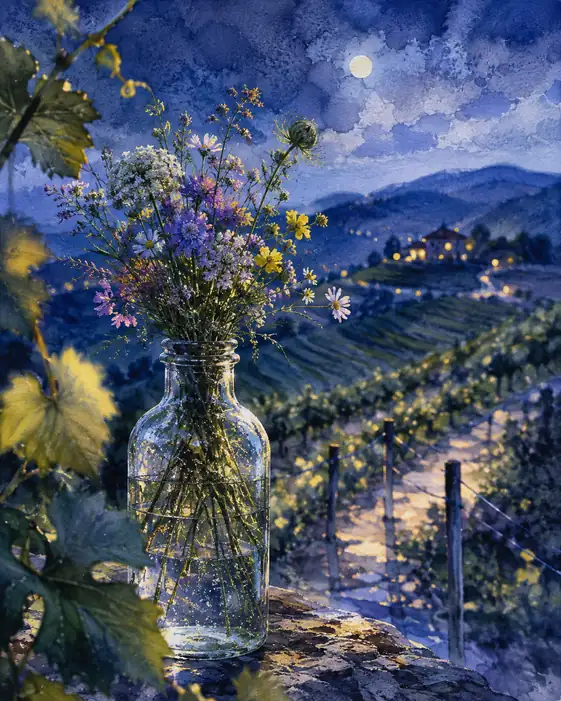 Moonlit Wildflowers Overlook the Sleeping Vines
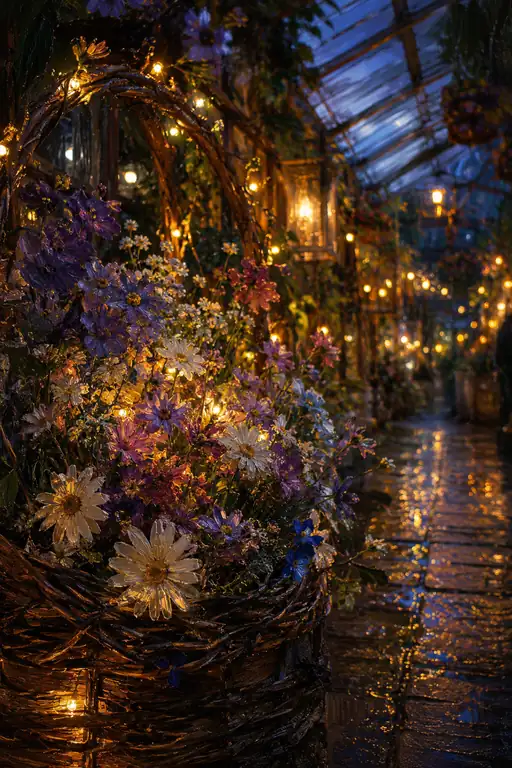 The Flower Arch Where Evening Lights Gather
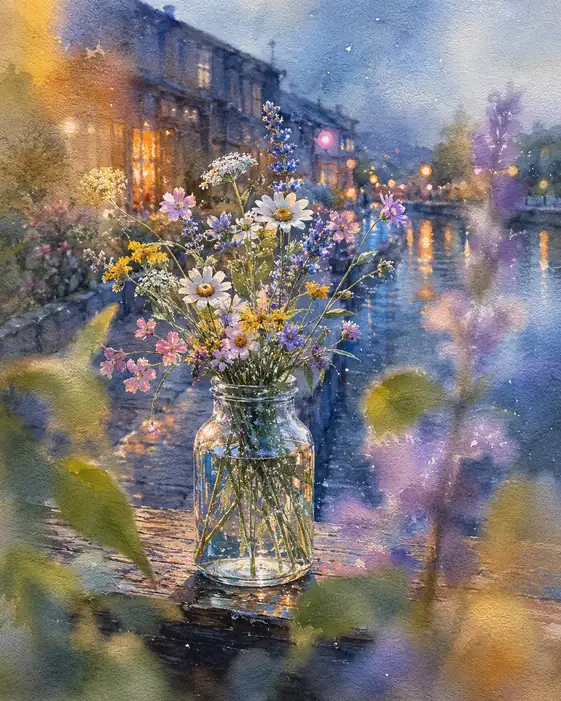 Evening Gathers in a Jar of Wildflowers
 The Greenhouse Reflects a River of Petals
 Petals Sail the Blue Glasshouse Floor
 The Sky Opens for a Bottle of Meadow Flowers