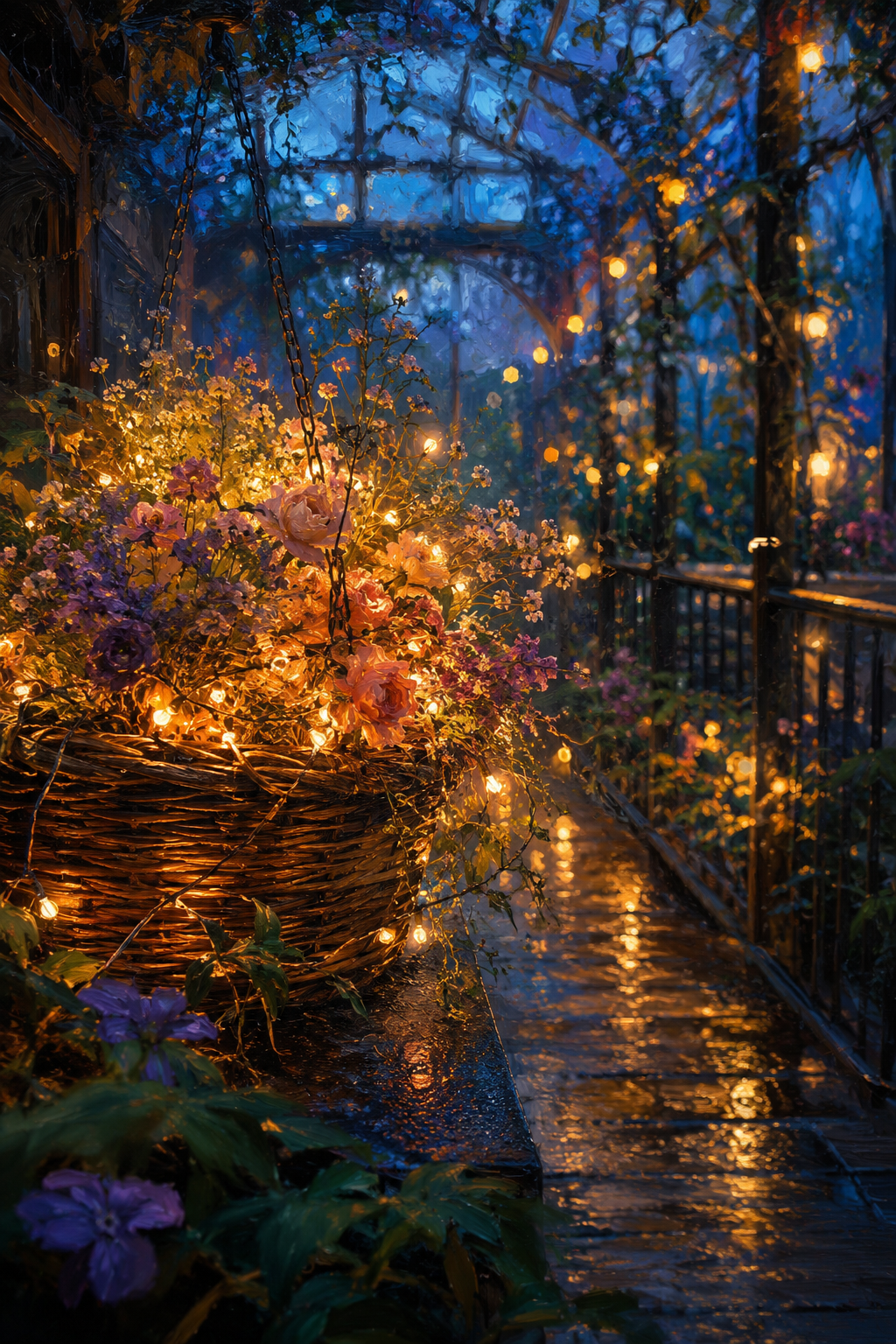
The Hanging Garden Learned to Glow at Night
Critique
Introduction This nocturnal greenhouse painting makes a hanging flower basket the radiant source of a long garden passage. Woven fiber, blossoms, tiny bulbs, and wet paving combine cultivation with festivity without losing the scene’s working architecture. Description A broad wicker basket hangs by two dark chains in the left foreground. Roses and smaller purple, pink, and white flowers overflow it, entwined with many warm miniature lights. A narrow wet walkway recedes to the right beneath a blue glass roof and vine-covered metal arches. Additional bulbs and lamps continue throughout the dark greenery, their reflections broken across the paving. Analysis The basket’s dense horizontal oval balances the corridor’s strong diagonal recession. Chains establish firm verticals, while stems and wire spill beyond the rim. Saturated cobalt encloses concentrated orange-gold, producing a vivid nocturnal contrast. Near woven strands and petals are sharply modeled; distant lamps soften into bokeh. Repeated gold points link basket, roof, beds, and floor, making depth through both scale and focus. The wet path supplies a second, fragmented constellation. Interpretation and Evaluation The basket resembles a suspended hearth assembled from living and manufactured materials. Electric light does not imitate flowers exactly, but enters their branching organization, suggesting technology accommodated by growth. Its hanging position implies both display and ongoing work. The empty corridor makes the lights anticipatory: someone has prepared a route before visitors appear. Moisture prevents the celebration from feeling detached from labor or weather. Conclusion The image succeeds through controlled abundance. A concentrated gift of flowers releases light into the entire greenhouse, while the path carries that welcome forward. Festivity emerges as an extension of tending rather than its opposite.
Same Subcategory
 Sunlit Conservatory and Elegant Petals
Similar Artworks
 The Flower Arch Where Evening Lights Gather
 A Basket of Stars Blooms before Nightfall
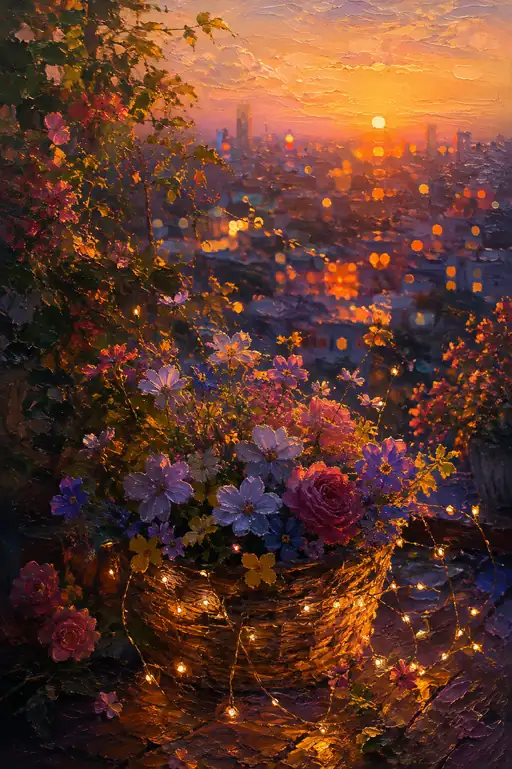 A Basket of Flowers Gathers the City's Sunset
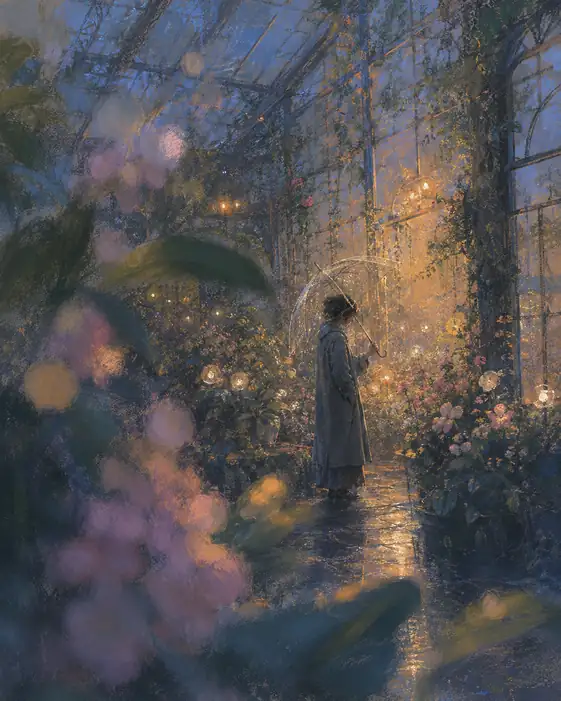 She Found a Golden Rain Inside the Greenhouse
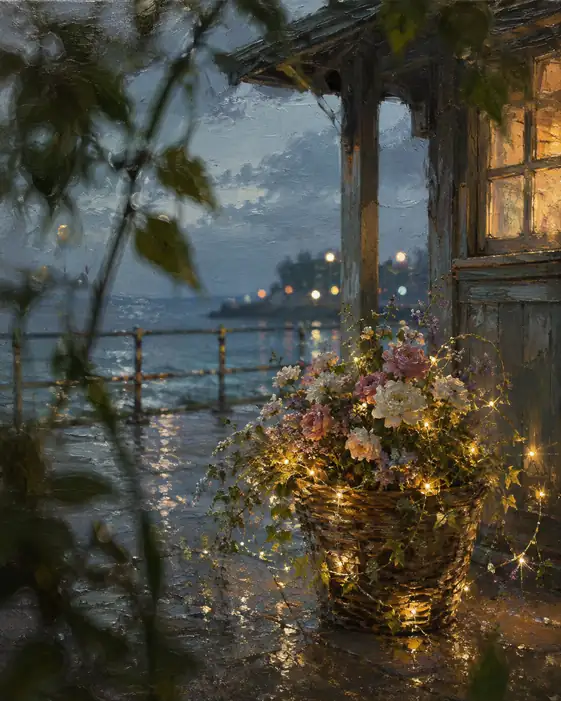 Roses Carry Their Own Constellation to the Sea
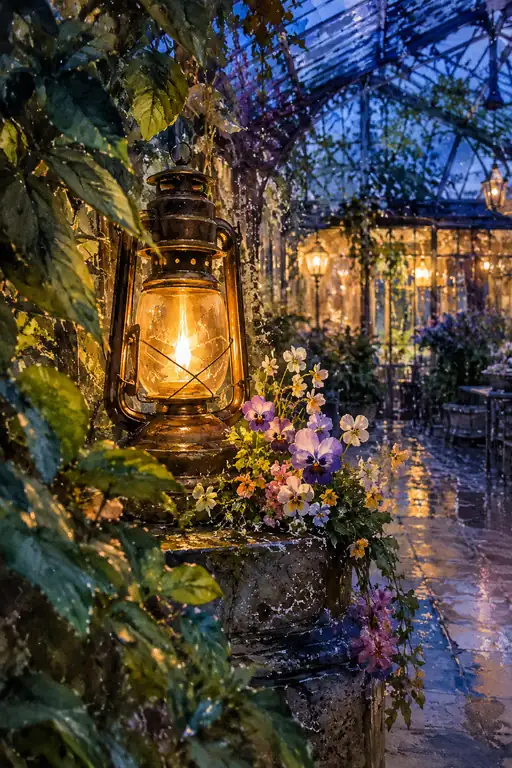 Rain Makes a Garden of Every Lantern
 A Basket of Light on a Rainy Street
 The Basket of Golden Dreams
 A Basket Woven with Flowers and Sunbeams
 Constellation in the Glass Pavilion