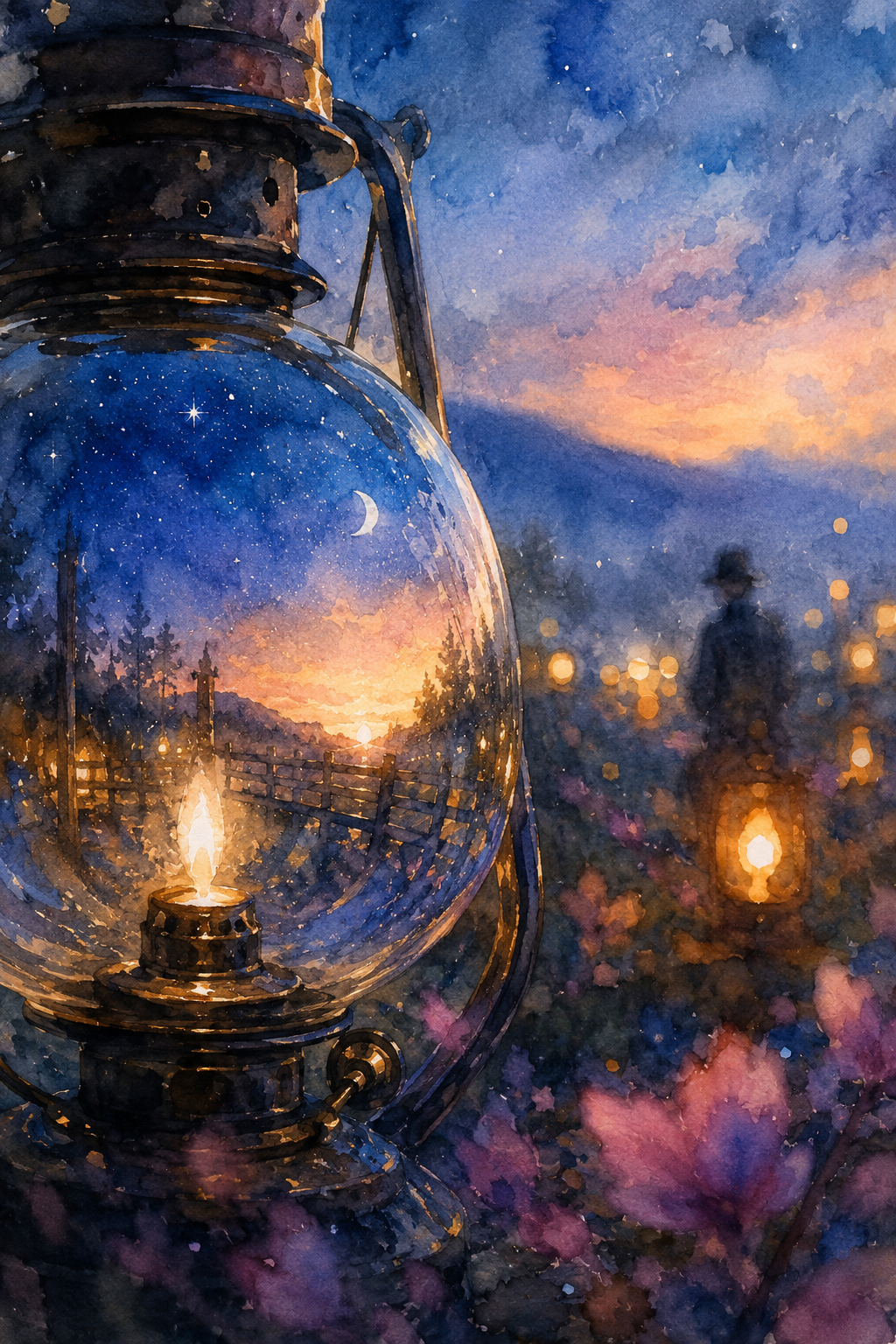
The Lantern Holds Both Crescent and Sunset
Critique
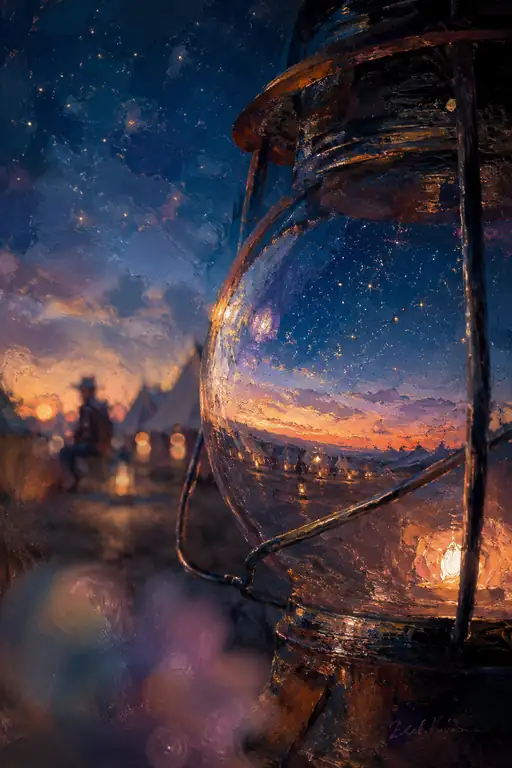
Introduction This watercolor magnifies an old oil lantern until its glass globe becomes a world. Sunset, stars, crescent moon, fence, and flame coexist in reflection, joining practical guidance to cosmic wonder. Description The lantern dominates the left two-thirds, cropped at top and bottom to emphasize scale. Its dark metal frame surrounds a rounded blue glass chamber containing a small bright flame. Across the globe appears a miniature twilight landscape with trees, fence, glowing horizon, crescent moon, and many stars. To the right, a blurred figure stands among pink-purple flowers and scattered lanterns under a clouded sky. Analysis The globe’s circle counters the vertical format and concentrates multiple depths in one form. Dark metal arcs provide structural weight, while blue and violet washes create transparency. Gold repeats from wick to reflected horizon and distant lights. Sharp stars and metal highlights contrast with the dissolved figure and flowers. The curved glass bends fence lines and compresses sky and ground, making optical distortion part of the composition rather than a technical display. Interpretation and Evaluation The lantern holds more than fuel: it gathers an entire route and sky into a portable vessel. Its crescent and stars may be literal reflections or imaginative projections, and that ambiguity is productive. The anonymous figure remains outside the globe, perhaps traveler, keeper, or memory. Practical light thus becomes a container for orientation, longing, and accumulated journeys. Despite its romantic premise, corrosion and soot keep the object materially grounded. Conclusion The work succeeds by aligning reflection with metaphor. A hand-carried lamp appears capable of preserving both the road already traveled and the heavens used to navigate it. Its intimate flame opens onto an unexpectedly vast interior.
Same Subcategory
Similar Artworks
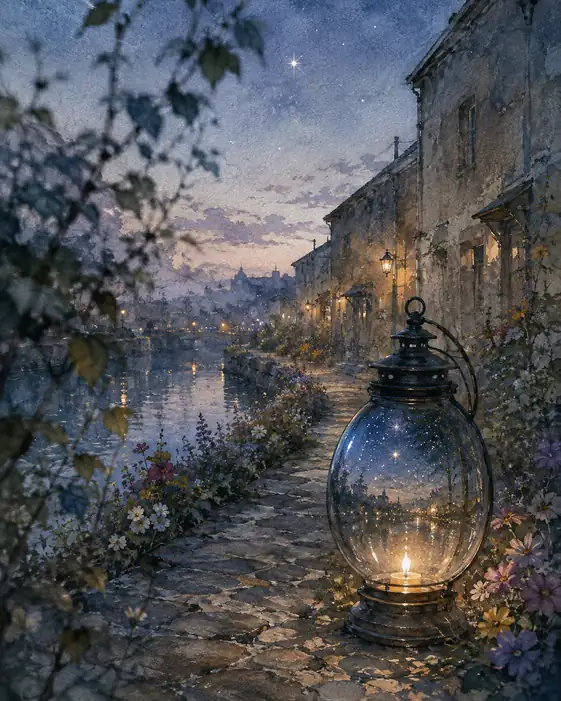 The Lantern That Gathered a Fallen Star
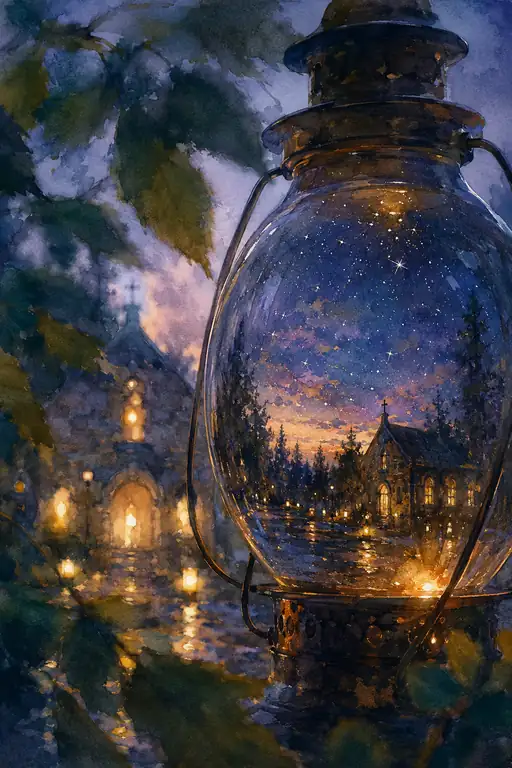 A Village Sky Kept Under Glass
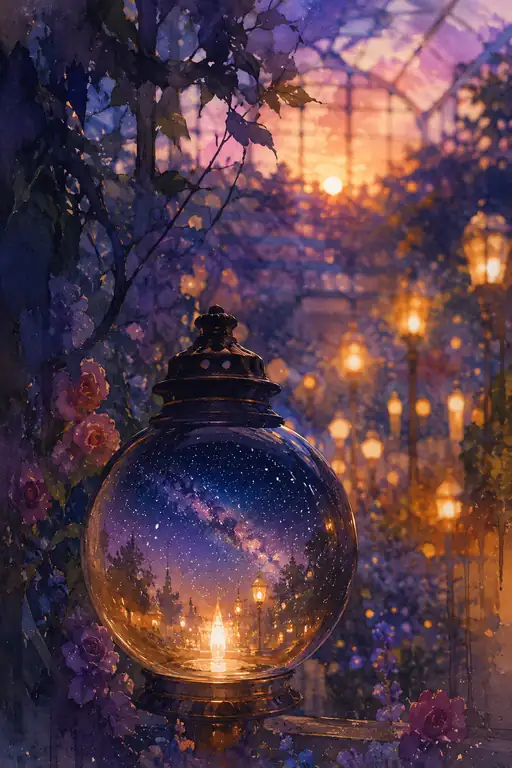 A Starlit Town Dreaming Inside the Garden Lamp
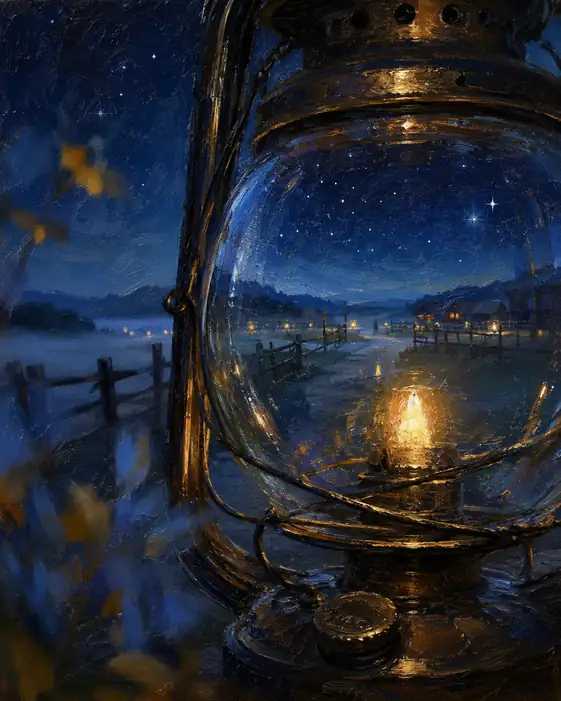 A Village of Stars Inside the Lantern Glass
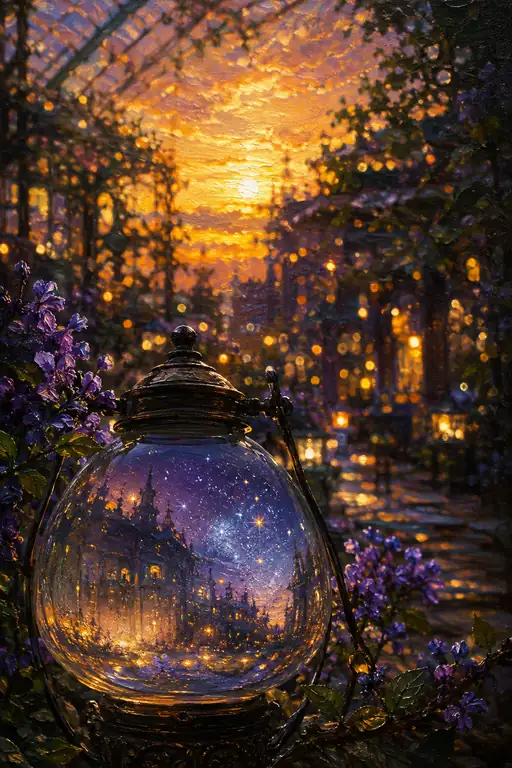 The Lantern Shelters a City Beneath the Milky Way
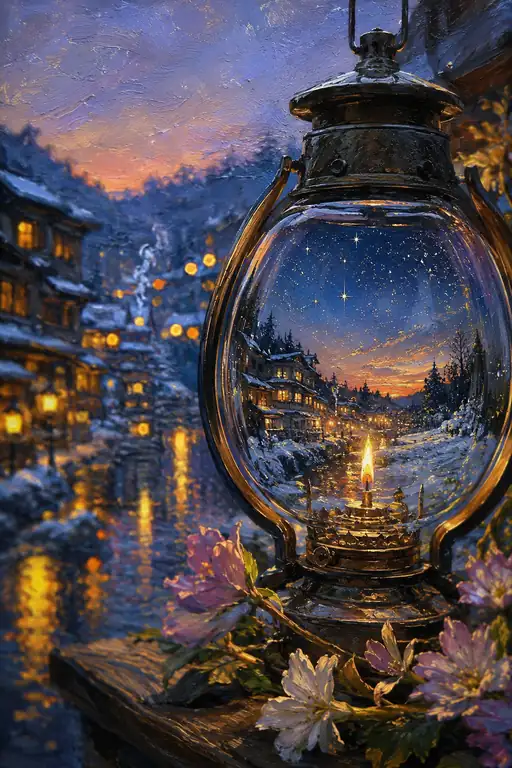 A Lantern Holds the Village's Starry Dusk
 The Chapel Sleeping Inside the Lantern
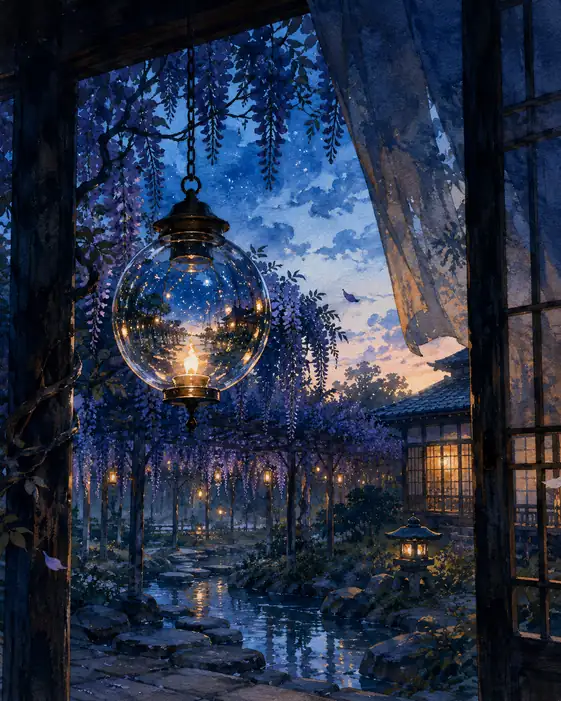 A Glass Lantern Keeps the Blue Hour's Stars
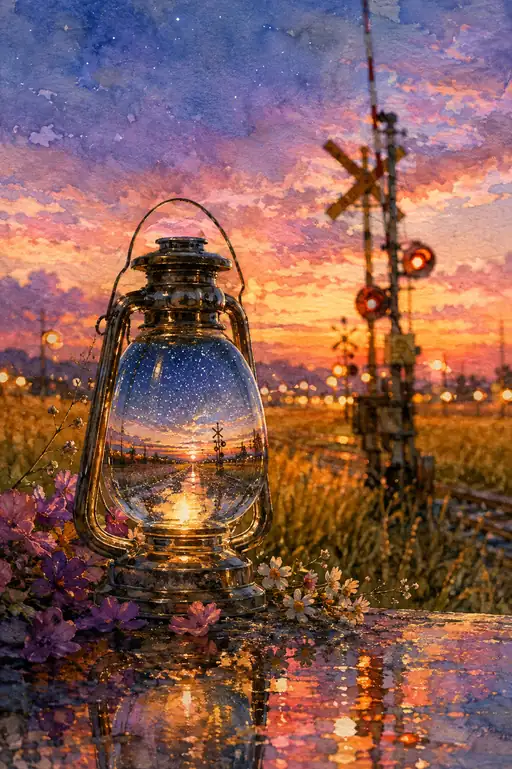 Sunset Train Path Captured in Glass
 Sunset Horizon Sealed in the Traveler's Lantern