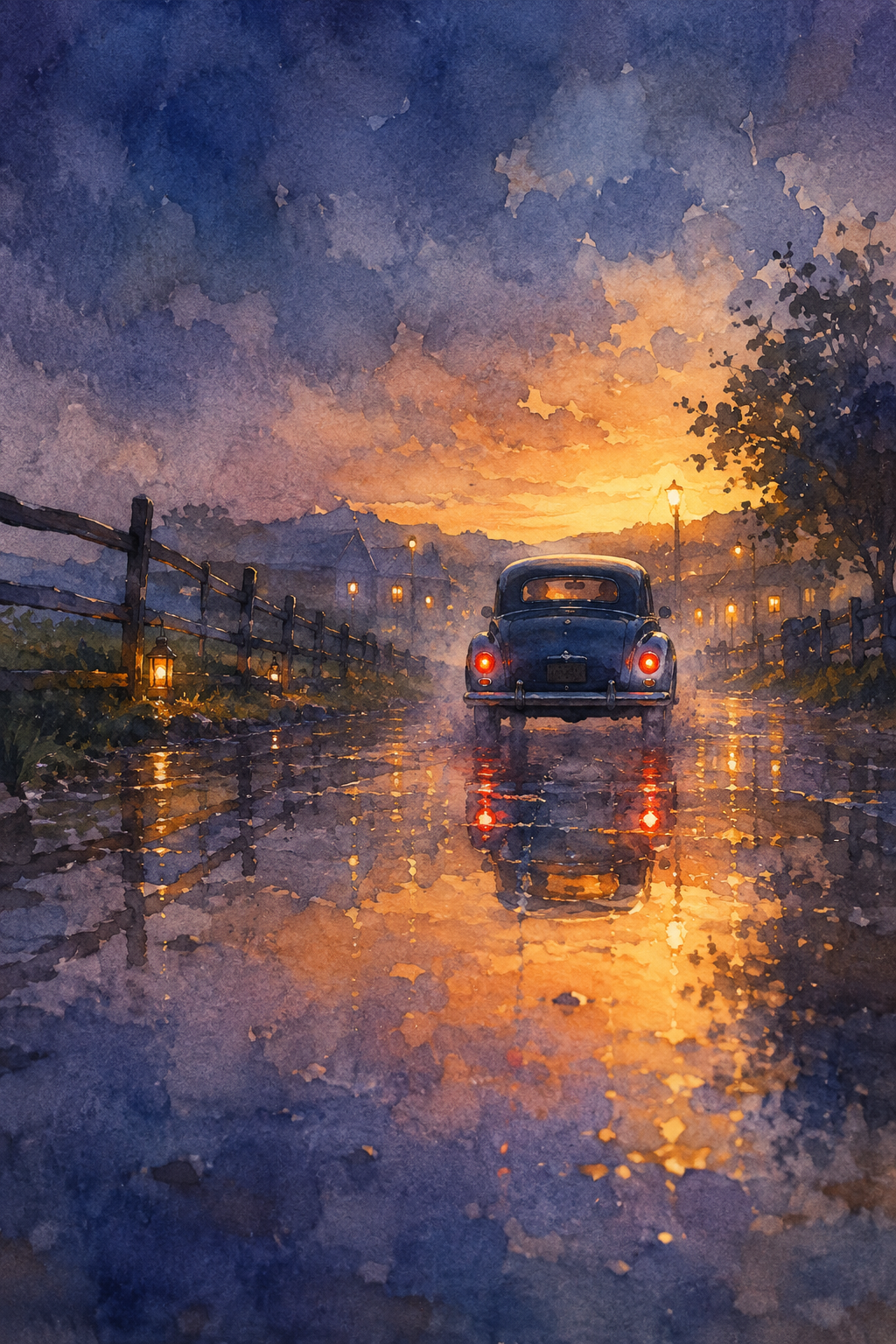
The Blue Car Drives into a Burning Sky
Critique
Introduction This watercolor follows a solitary vintage car along a rain-soaked village road at sunset. By combining saturated reflections with a low, centered viewpoint, it turns ordinary travel into a poised passage between storm and evening light. Description A dark blue sedan drives away near the center, its red tail lamps glowing. Wet pavement fills most of the foreground, reflecting the vehicle, roadside lanterns, and a broad orange opening beneath violet clouds. Wooden fences converge on both sides toward low houses and utility poles. A dense tree silhouettes the right edge, while distant hills settle beneath the radiant horizon. Analysis The road’s converging boundaries and long reflection create forceful depth. The car interrupts the central golden band with a compact cool mass, while its twin red lights become vivid punctuation. Indigo and mauve dominate the sky and pavement; amber is reserved for horizon, lamps, windows, and pooled reflections. Broken watercolor edges make the road shimmer rather than read as a smooth mirror. Fence posts supply measured rhythm, and the high sky increases the vehicle’s apparent solitude. Interpretation and Evaluation The rear view denies access to the traveler’s identity, allowing the car to stand for departure itself. Yet the route is not desolate: repeated lights and inhabited windows imply guidance and welcome. Rain records every source of warmth twice, below and above, so difficult weather amplifies reassurance. The sunset ahead can signify destination, but its instability keeps the journey open rather than triumphant. Conclusion The painting succeeds through disciplined symmetry tempered by fluid surface effects. Car, lamps, and reflections bind human movement to weather and landscape. It offers a convincing image of continuing forward while storm and daylight exchange places.
Same Subcategory
Similar Artworks
 Rain Carries the Last Car Toward Sunset
 Little Lanterns Guide the Blue Car Home
 The Last Car Along the River of Lanterns
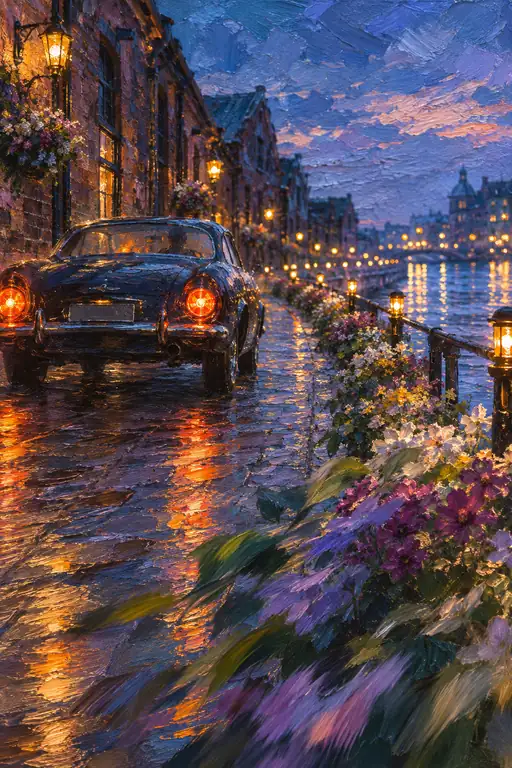 The Road Shines Before the Midnight Drive
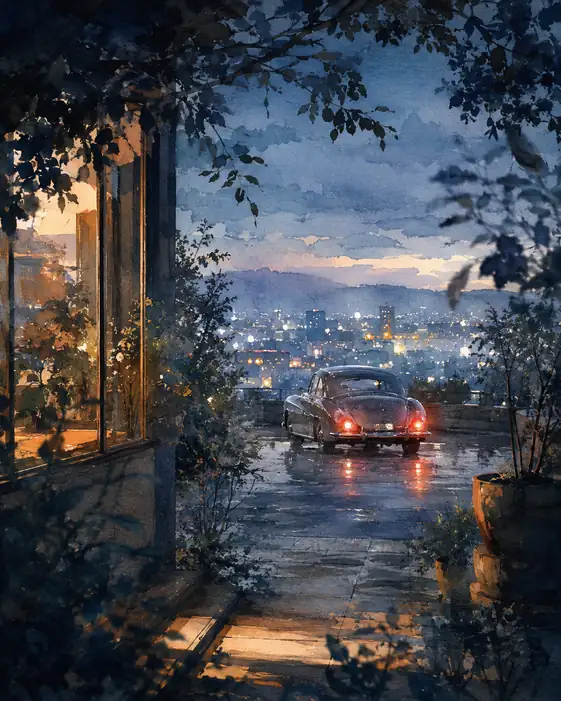 The Old Car Pauses between Home and the City Stars
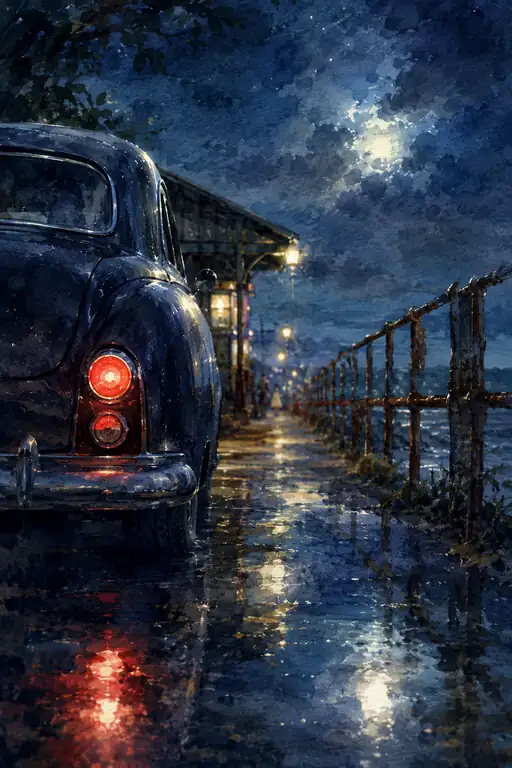 The Last Train Waits beneath a Rain-Washed Moon
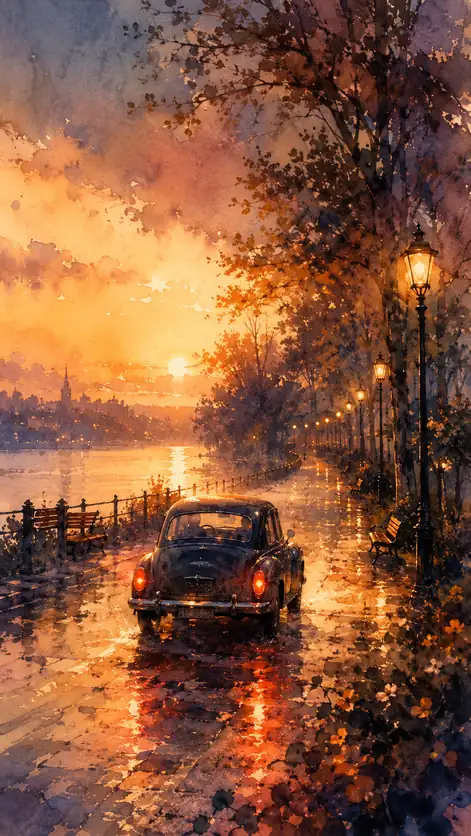 Taillights, Flowers of Dusk
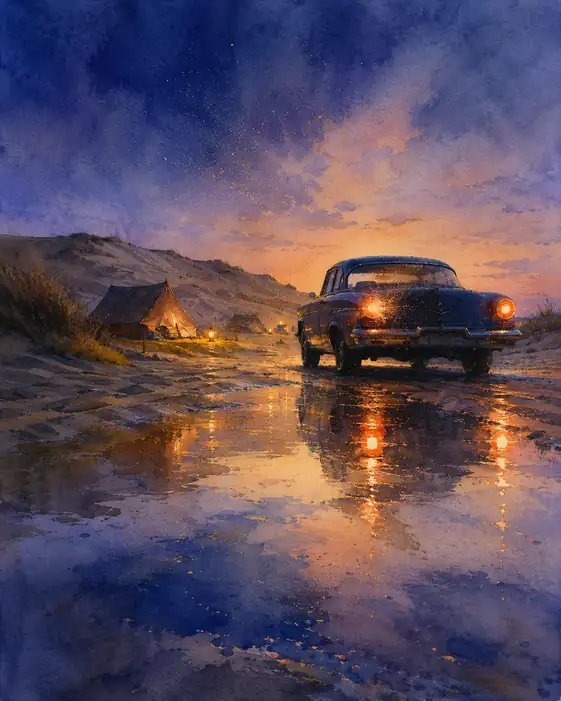 Twilight Traveler Resting by the Dunes
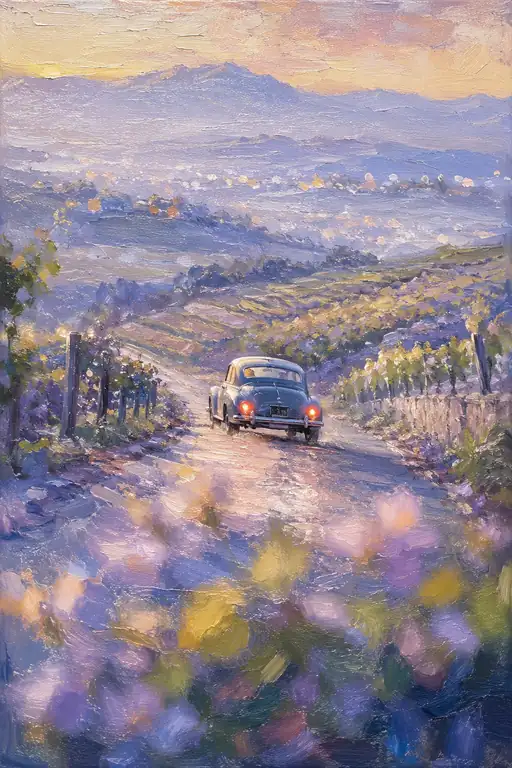 The Old Car Drives into a Lavender Dawn
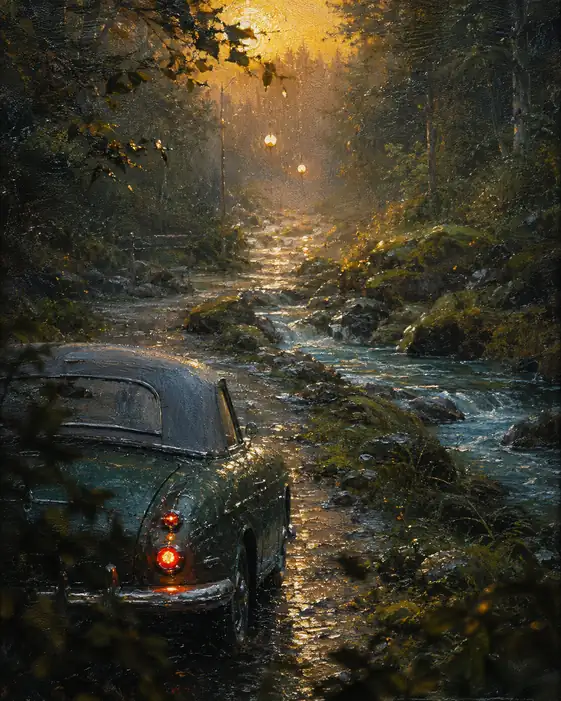 The Old Car Follows Lanterns into the Forest