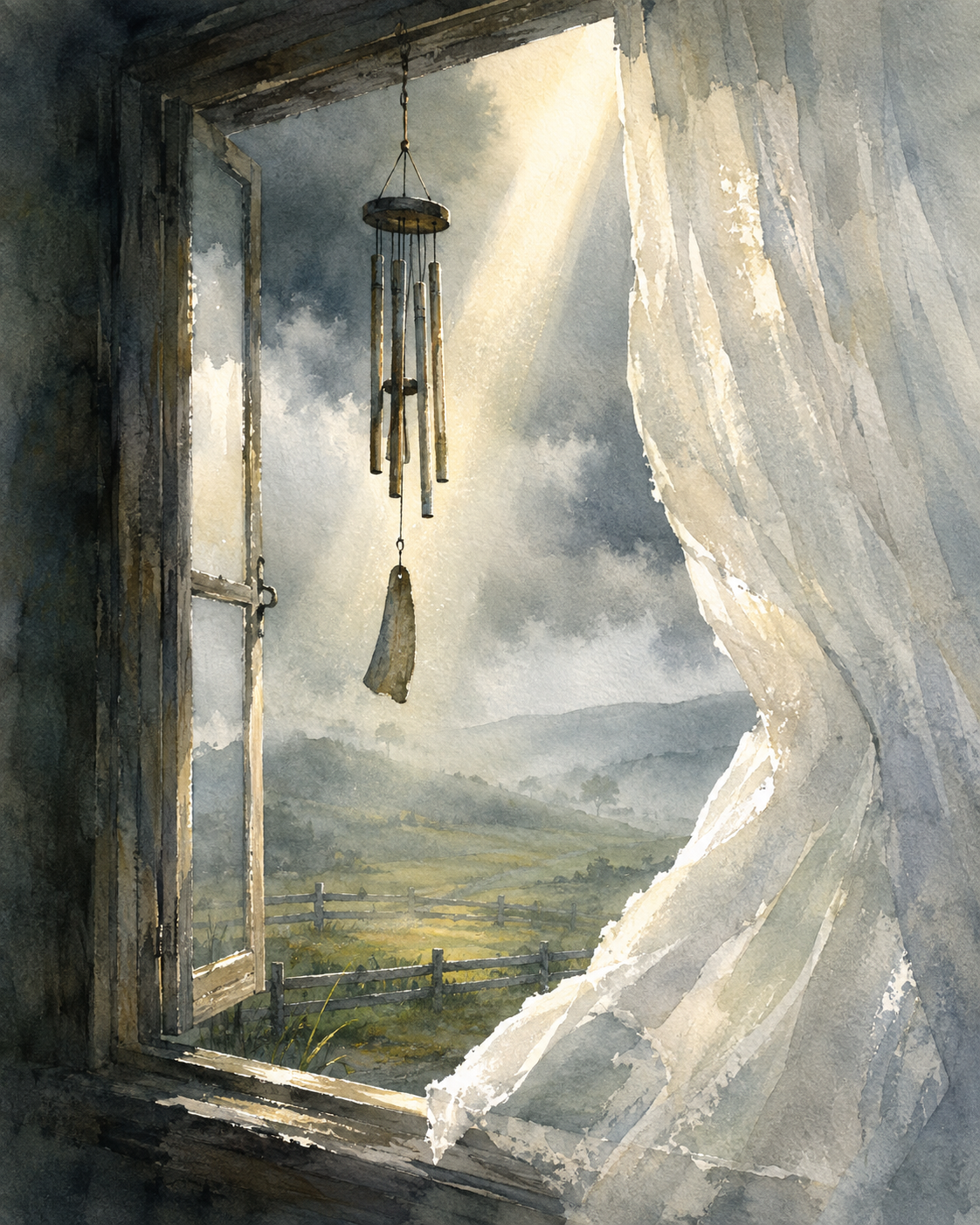
The Chimes Ring Sunlight into the Valley
Critique
Introduction This watercolor turns an open window into a threshold between shelter and weather. A suspended wind chime and a billowing curtain make invisible air the central subject, while the valley beyond supplies breadth and calm. Description A worn wooden frame encloses a pale, cloud-filled landscape of fields, fences, and distant hills. Near the upper center hangs a circular metal chime with several narrow tubes and a weighted paper sail. On the right, a translucent white curtain surges inward, catching a diagonal shaft of warm light. Deep gray shadows occupy the left wall and sill. Analysis The composition balances three vertical structures: dark jamb, slender chime, and luminous curtain. Their unequal weights create tension without disturbing the serenity. Cool blue-gray washes dominate, but diluted ochres around the sunbeam and fields keep the image from becoming austere. Hard edges on the frame contrast with bleeding cloud shapes and broken fabric contours. The chime acts as a still axis around which light and cloth appear to circulate. Interpretation and Evaluation The painting concerns receptivity. The room does not merely overlook nature; wind, light, and implied sound enter it. Weathered timber gives the threshold a history, while the delicate curtain suggests continued habitation. Particularly effective is the refusal to show a person: movement records a presence through its effects. The chime’s silent tubes prompt imagined sound, extending the watercolor beyond sight. Conclusion By joining solid architecture to fugitive atmosphere, the work makes openness feel both vulnerable and restorative. Its restrained palette, tactile paper texture, and lucid organization sustain contemplation. The lifted curtain and waiting chime preserve a charged instant in which the world seems about to speak.
Same Subcategory
Similar Artworks
 The Wind Chime Opens a Window in the Clouds
 A Wind Chime Between Curtain and Canal
 The Wind Chime Calls the Blue Evening Home
 The Wind Chime Sings Down the Rainlit Arcade
 The Sky Opens for a Bottle of Meadow Flowers
 Wildflowers Holding Open the Storm
 A Sunbeam Chose the Wildflower Vase
 Twilight Breeze and the Clear Wind Chime
 Morning Glory Wind Chime at Dusk
 Summer Wind Chime Whispering by the Cloister