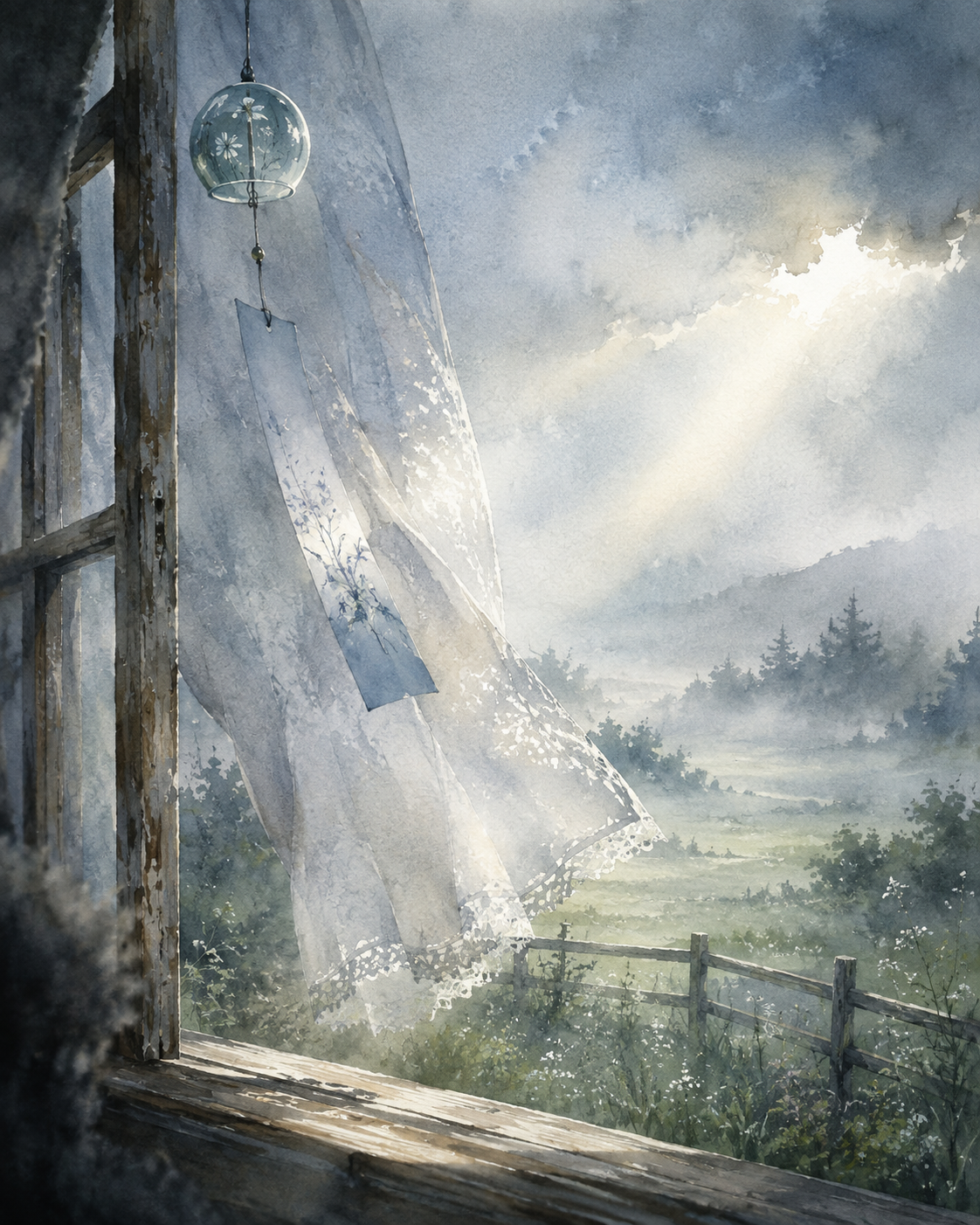
The Wind Chime Opens a Window in the Clouds
Critique
Introduction This window scene suspends a floral wind chime beside a lace curtain above a misty valley. The frame becomes an instrument through which craft, air, sunlight, and land communicate. Description A round transparent wind bell hangs near the upper left from a thin cord. White flower motifs decorate its globe, and a long pale paper strip painted with blue stems descends below. A translucent lace-edged curtain sweeps diagonally through the center, catching bright light and revealing folds. The old wooden window frame occupies the left and lower edges. Outside, fences cross a green meadow toward shrubs, conifers, and layered mountains. Gray clouds open at upper right, sending cream light across fog and grass. Analysis The dark window frame supplies rigid vertical and horizontal structure, while curtain and paper create flexible diagonals. The globe provides a compact circular focus against the broad landscape. Transparency repeats across glass, cloth, mist, and light beam, allowing layers to overlap without erasure. Cool gray-blue controls most surfaces; pale cream concentrates along the opening and curtain edge. The floral motifs echo small plants below, joining craft to living growth. Interpretation and Evaluation Wind is invisible, but the lifted curtain and angled paper make its movement readable. The chime promises sound, translating air into anticipated tone, while fabric translates it into visible volume. The open window is therefore not merely a view but a responsive boundary. Human-made objects receive weather and answer it through movement, pattern, and possible sound. Conclusion The painting evokes listening through sight. Bell, paper, curtain, frame, cloud, field, and sunlight become parts of one receptive system. Its lightness comes from showing shelter as open exchange rather than sealed separation.
Same Subcategory
Similar Artworks
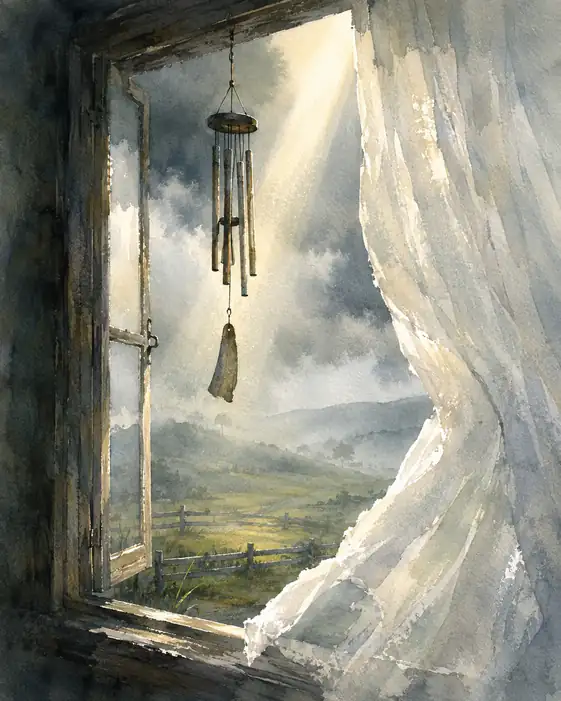 The Chimes Ring Sunlight into the Valley
 A Wind Chime Between Curtain and Canal
 The Wind Chime Calls the Blue Evening Home
 The Wind Chime Sings Down the Rainlit Arcade
 The Sky Opens for a Bottle of Meadow Flowers
 Wildflowers Holding Open the Storm
 A Sunbeam Chose the Wildflower Vase
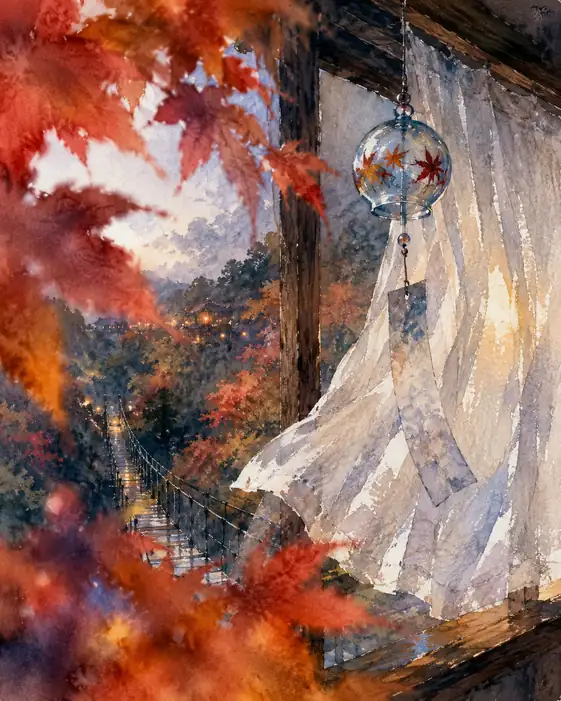 Autumn Chime by the Window of Crimson Leaves
 Two Swimmers in the Summer Sky
 Whispers in Glass and Summer Breeze