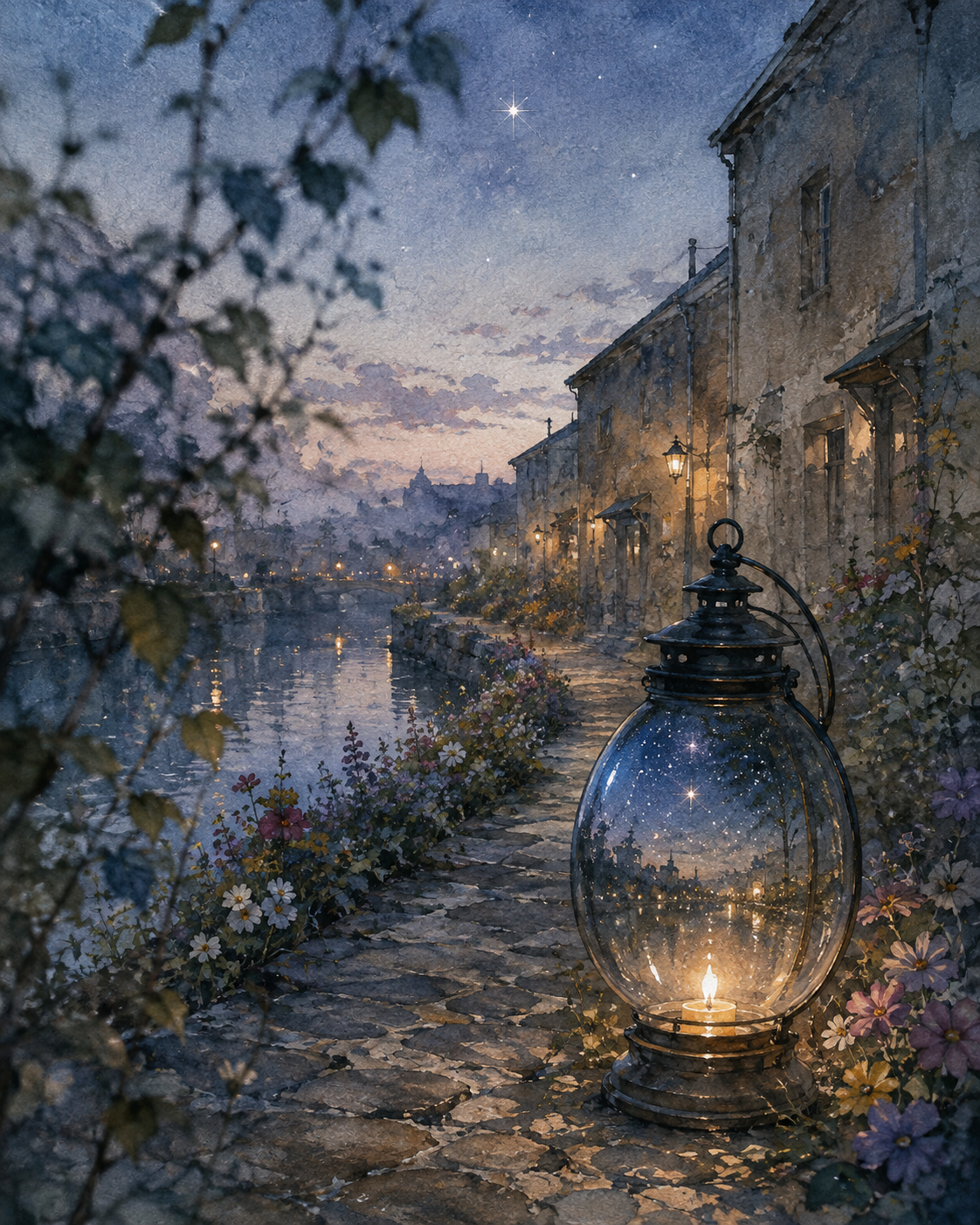
The Lantern That Gathered a Fallen Star
Critique
Introduction This twilight scene enlarges a glass lantern seemingly containing stars, town lights, and another horizon. It becomes both flame holder and miniature cosmos, linking guidance with wonder. Description The large oval lantern stands in the lower right foreground among pink, violet, yellow, and white flowers. A small candle burns inside beneath a black metal cap, handle, and circular base. Speckled glass reflects or imagines a starry sky and distant illuminated town, including two bright starbursts. A stone path curves behind it between the canal and weathered houses with wall lamps. Dark blurred foliage veils the left edge, while a bright star hangs in the real blue-gray sky above the distant settlement. Analysis The lantern's oval body forms the dominant enclosed shape against the path's recession. Its internal horizon repeats the exterior canal town, producing an image within the image. The real star, reflected stars, candle flame, windows, and water lights establish a vertical hierarchy from sky to object to ground. Cool blue-gray controls most of the scene, while amber remains concentrated around human habitation. Foreground blur and the lantern's crisp metalwork create strong spatial layering. Interpretation and Evaluation Ordinarily a lantern makes only nearby ground visible, but this vessel appears to gather an entire night landscape. Its flame represents tended human light, while the stars suggest an immeasurable order beyond it. Housing both within glass makes guidance and imagination mutually sustaining. The repeated town may be reflection, memory, or fantasy; that ambiguity is productive rather than confusing. Conclusion The painting turns a lighting tool into attentive seeing. The lantern illuminates the path while preserving a wider world. Candle, stars, flowers, and town make practical care capable of enchantment.
Same Subcategory
Similar Artworks
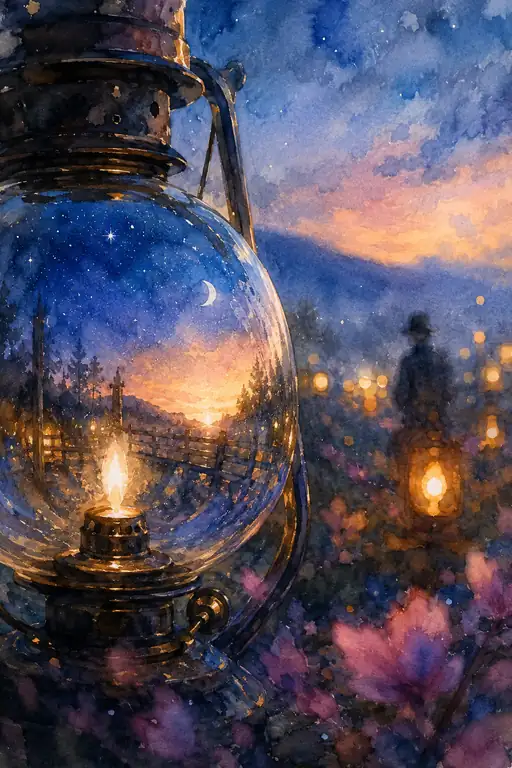 The Lantern Holds Both Crescent and Sunset
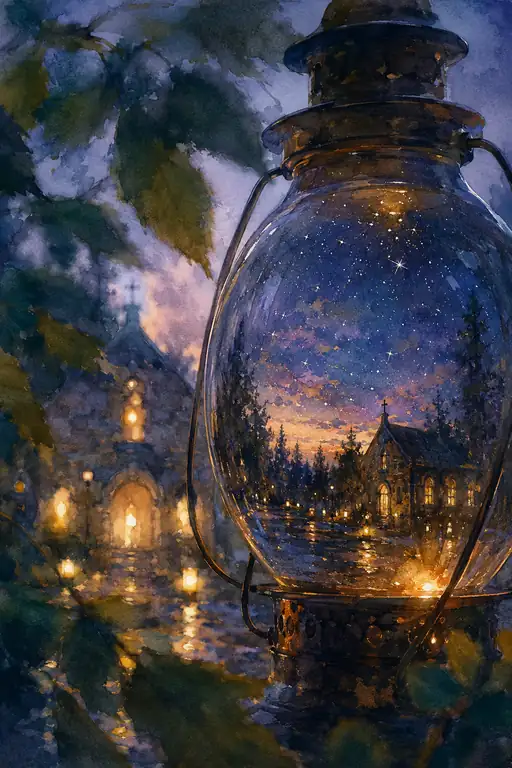 A Village Sky Kept Under Glass
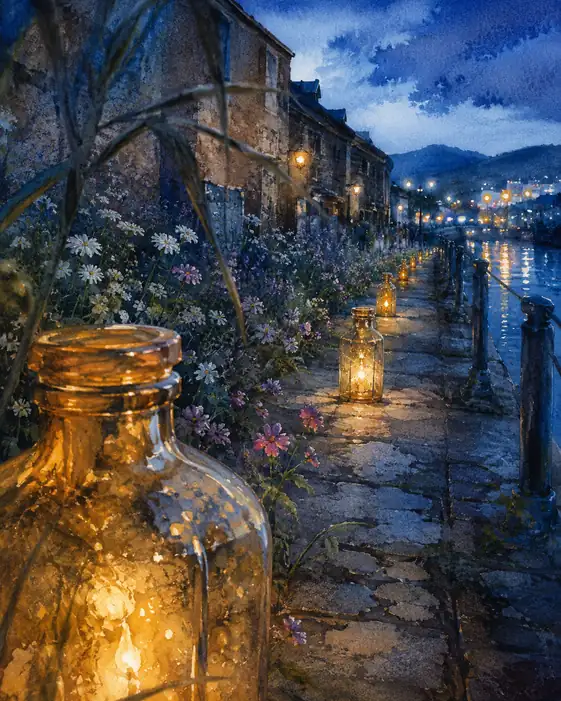 A Path Lit by Bottled Stars
 The Chapel Sleeping Inside the Lantern
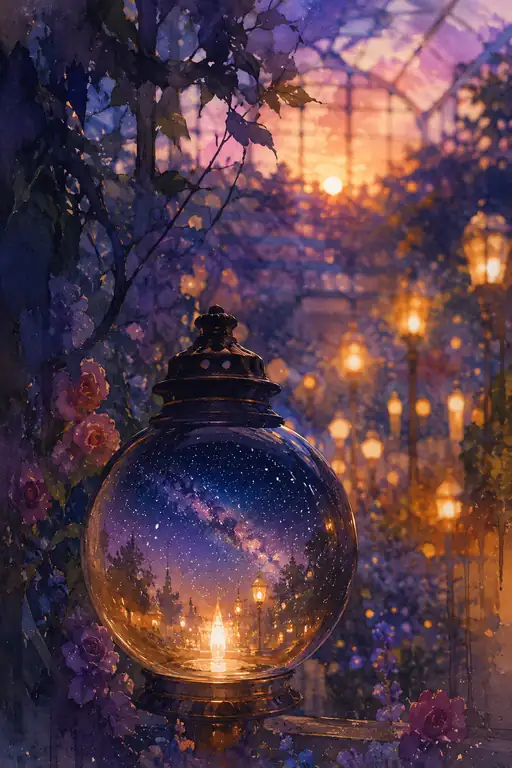 A Starlit Town Dreaming Inside the Garden Lamp
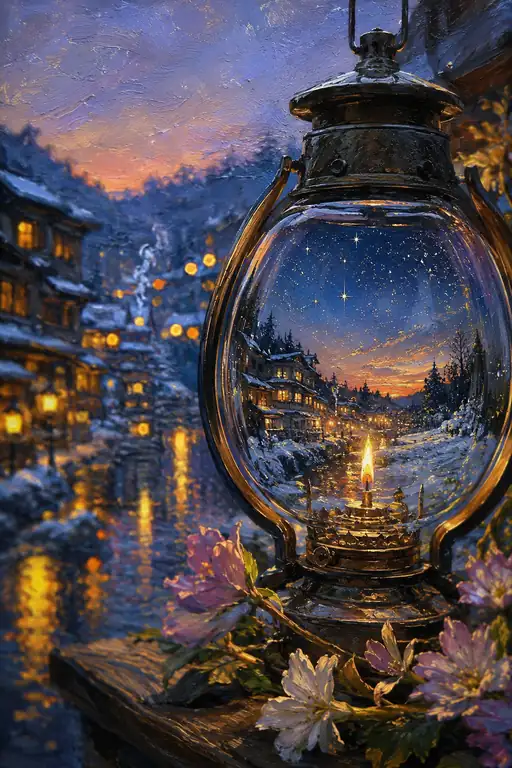 A Lantern Holds the Village's Starry Dusk
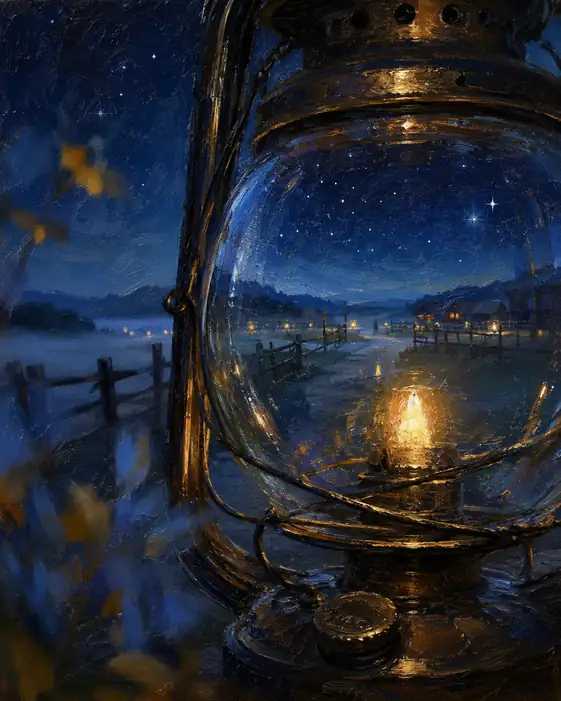 A Village of Stars Inside the Lantern Glass
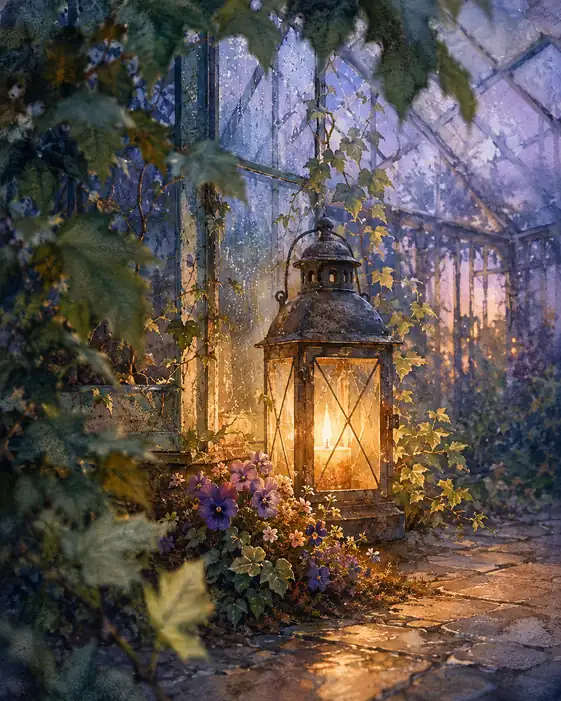 The Greenhouse Lantern Wakes the Violets
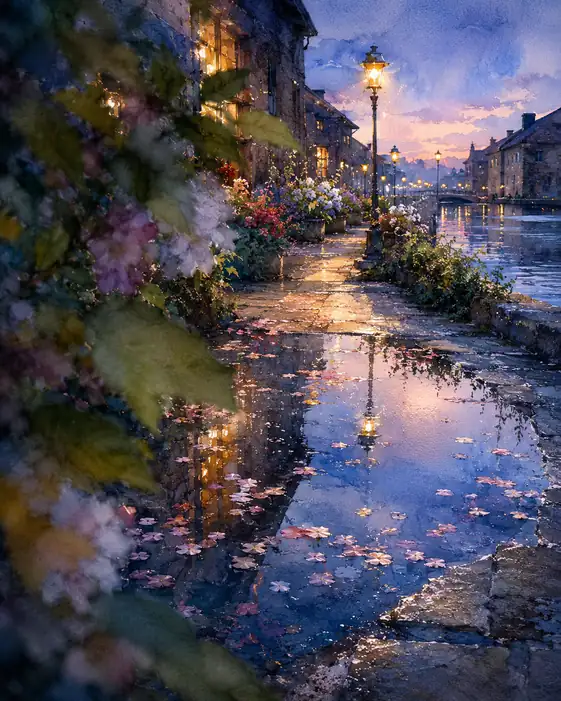 Twilight Poured into a Flower-Strewn Puddle
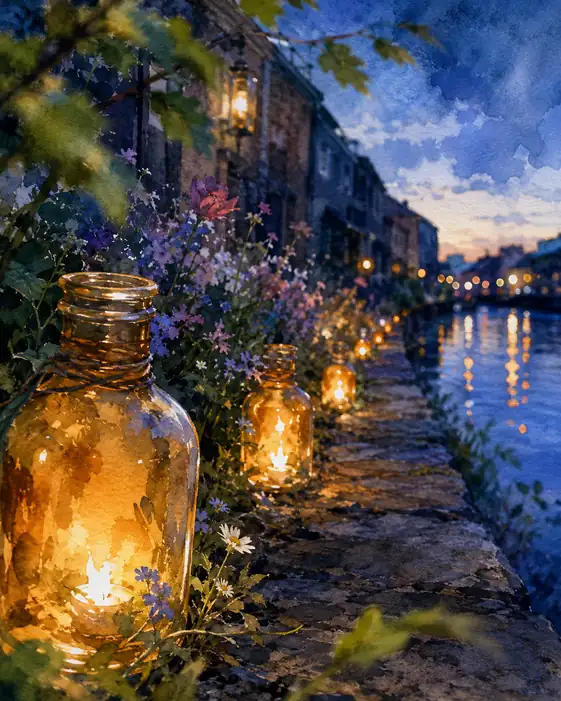 The Canal Follows a Trail of Little Suns