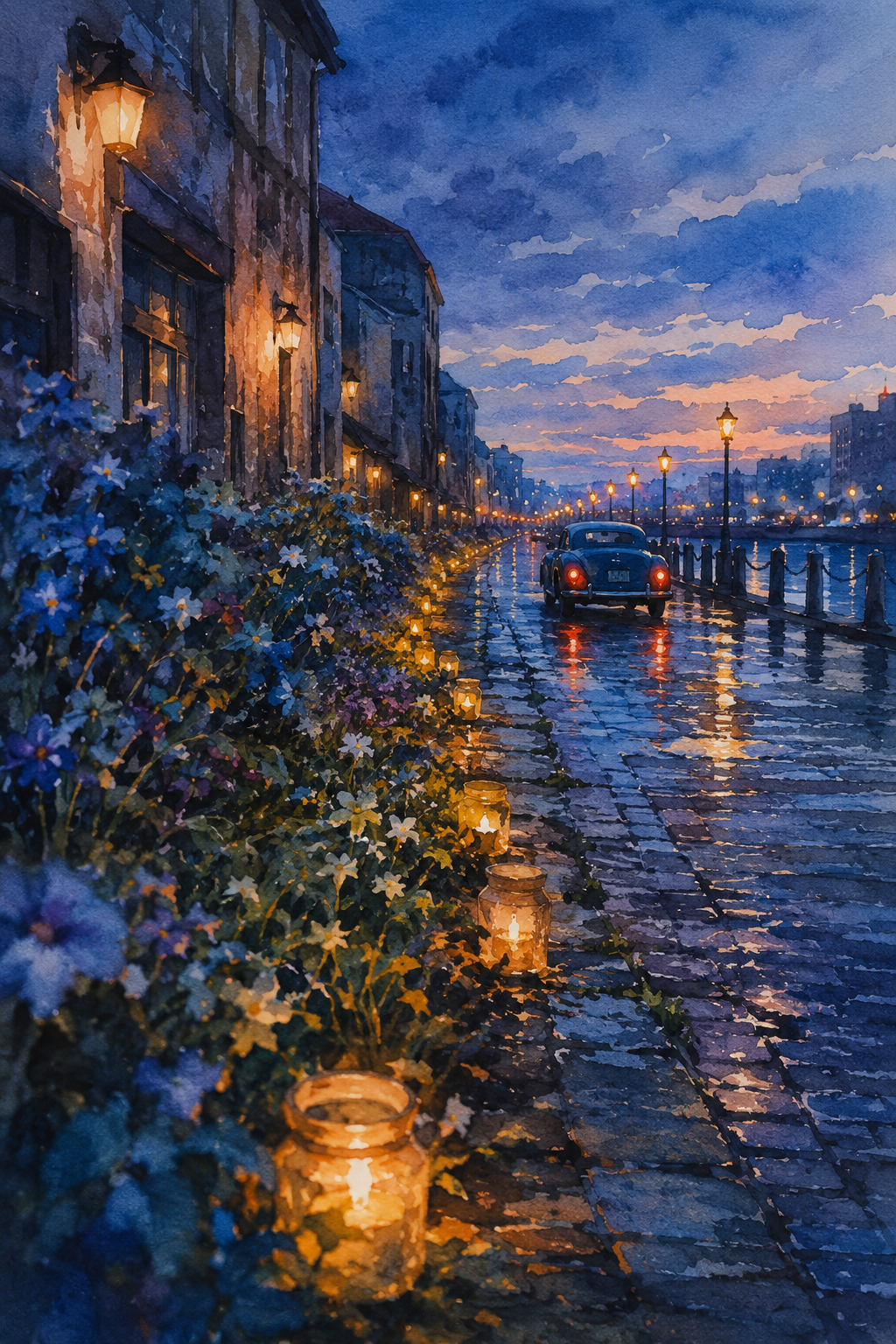
Little Lanterns Guide the Blue Car Home
Critique
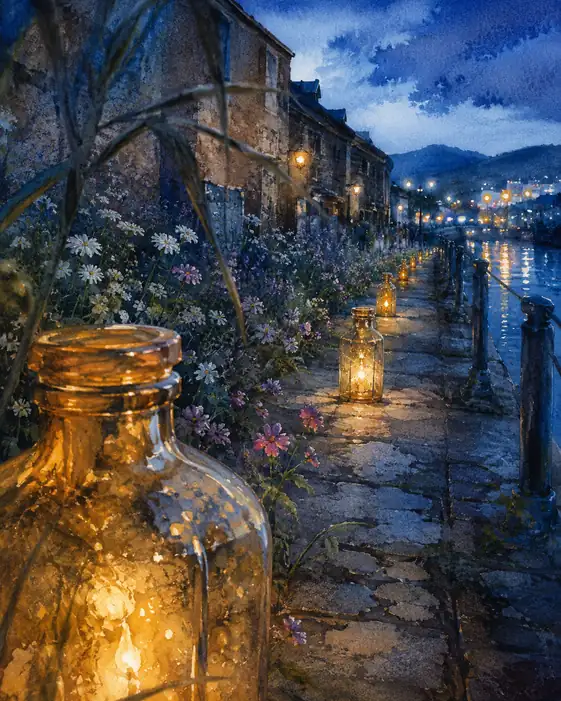
Introduction This blue-hour road follows a vintage car between canal flowers and lights. Rather than dramatizing speed, it turns driving into quiet passage through a tended town. Description A dark blue coupe sits right of center, its red tail lamps reflected on wet paving. The road bends along the canal beneath posts, chains, and streetlamps. At left, tall houses rise above blue, white, yellow, and pink flowers. Candle jars glow along the flower edge, including a large foreground vessel. Cobalt clouds open to peach near the horizon, while lamps continue toward distant buildings. Analysis Road, canal railing, floral border, and lamp rows converge toward the car and then the horizon, producing unusually strong directional depth. The vehicle acts as a dark compact hinge between near candlelight and far city illumination. Red tail-light reflections provide the only concentrated crimson accents amid blue and amber. Enlarged foreground flowers and jar establish proximity, while decreasing lights measure distance. Watercolor-like edges soften architecture without weakening the route's structure. Interpretation and Evaluation Seen from behind, the car becomes less an object for display than a traveler sharing the viewer's direction. Candle jars suggest personal care at ground level, whereas streetlamps express civic provision; the vehicle passes between these scales of welcome. Wetness records every light temporarily, so the journey is surrounded by signs of habitation. The slow visual rhythm resists associations of automobiles with haste. Conclusion The work presents departure as connection. The receding car carries the eye into town, while lamps prevent darkness becoming abandonment. Mobility, shelter, and flowers make the road humane.
Same Subcategory
Similar Artworks
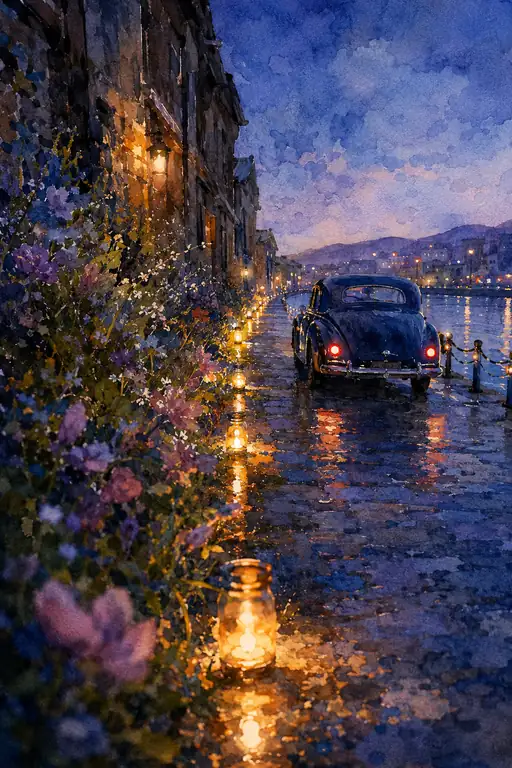 The Last Car Along the River of Lanterns
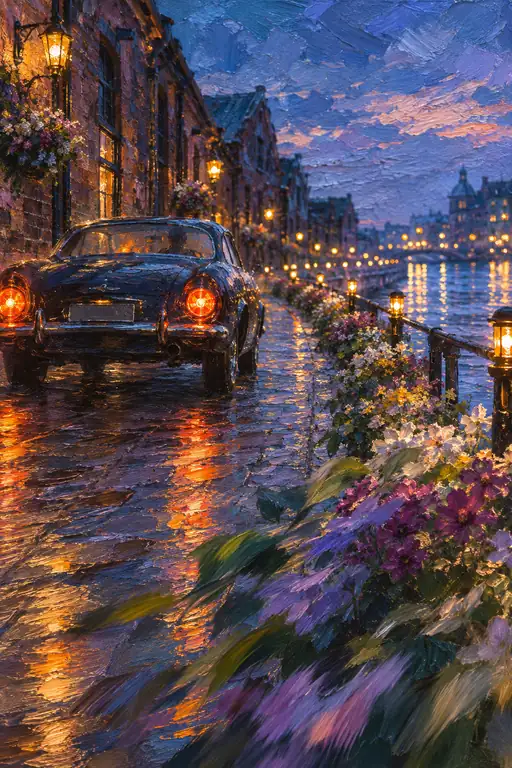 The Road Shines Before the Midnight Drive
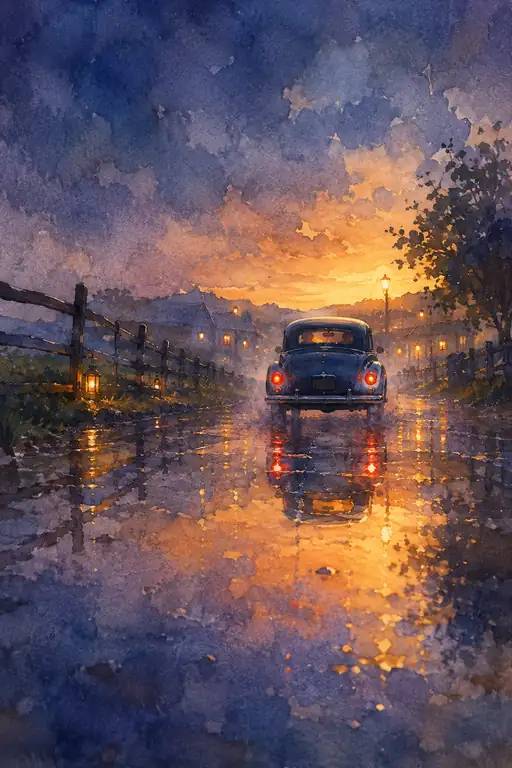 The Blue Car Drives into a Burning Sky
 Rain Carries the Last Car Toward Sunset
 The Old Car Pauses between Home and the City Stars
 The Last Car Leaves a Trail of Emberlight
 A Path Lit by Bottled Stars
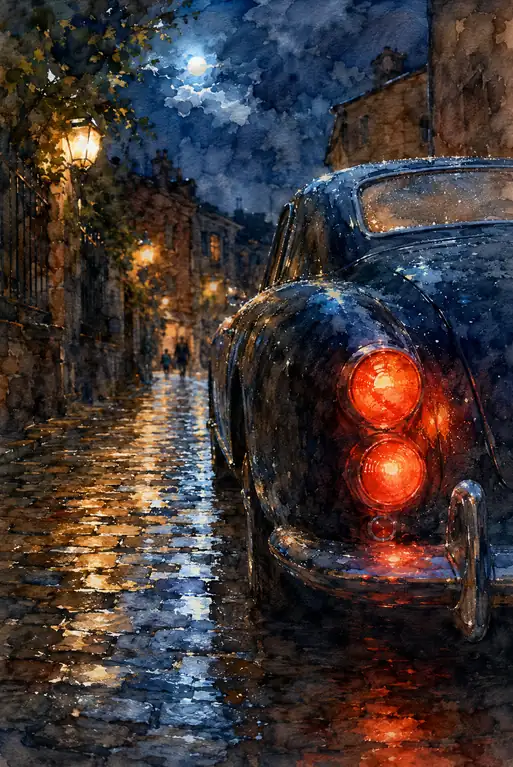 Crimson Whispers in the Moonlit Night
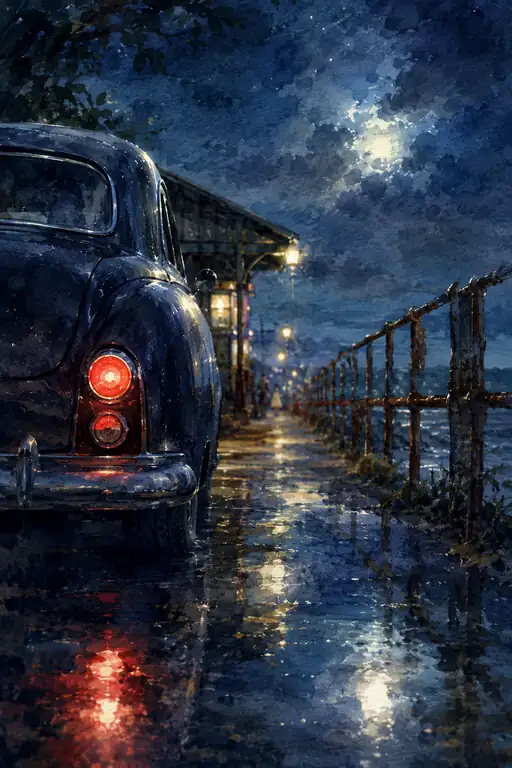 The Last Train Waits beneath a Rain-Washed Moon
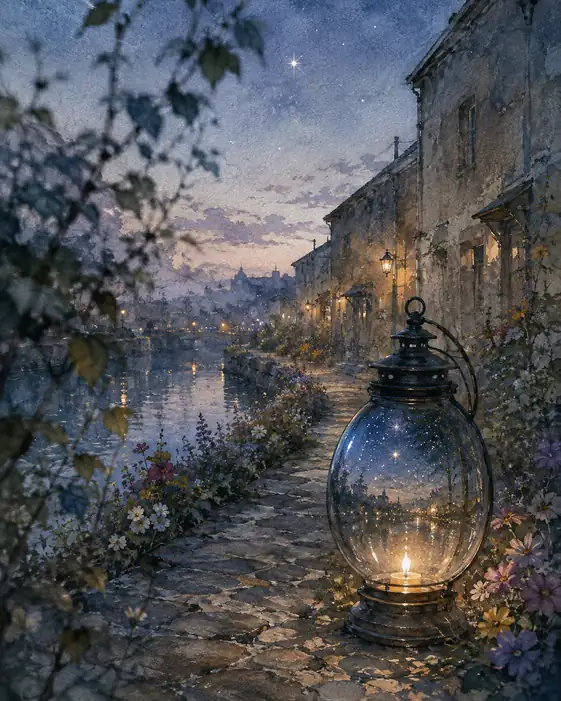 The Lantern That Gathered a Fallen Star