
A Wind Chime Between Curtain and Canal
Critique
Introduction This blue-hour interior frames a floral wind chime, luminous curtain, and canal town through an open window. The threshold becomes a meeting place for moving air, fading daylight, and street life below. Description A transparent spherical bell hangs near the upper center, with a narrow flower-painted paper strip descending from its clapper. A pale curtain sweeps across the left half in long translucent folds, warmed by orange interior light. Dark wood and leafy shadows enclose the window. Beyond it, tiled roofs, a canal, bridges, and strings of lamps recede through deep blue dusk. Blurred amber circles and foliage soften the lower corners. Analysis The dark window frame establishes a vertical aperture, while the curtain crosses it with flexible diagonals. The bell occupies the clearest patch of blue and acts as a small circular pivot. Transparent glass repeats the curtain's permeability, though one is taut and reflective and the other diffuse. Cobalt exterior color is balanced by amber along the curtain and town lights. Successive lamps and reflections draw the eye downward into depth. Interpretation and Evaluation Wind is invisible, yet the displaced fabric and angled paper make its passage legible. The chime promises sound while the curtain supplies visible movement, allowing separate senses to reinforce one another. Interior warmth does not oppose the cool town; it passes through thin cloth and glass to join the exterior lights. This makes dwelling appear open, attentive, and responsive rather than sealed away. Conclusion The work gives a fleeting breeze architectural importance. Window, bell, fabric, vegetation, and canal become one receptive instrument. Its achievement is balancing shelter with openness: the viewer feels protected yet connected to the evening beyond.
Same Subcategory
Similar Artworks
 The Wind Chime Calls the Blue Evening Home
 The Wind Chime Sings Down the Rainlit Arcade
 The Wind Chime Opens a Window in the Clouds
 Twilight Breeze and the Clear Wind Chime
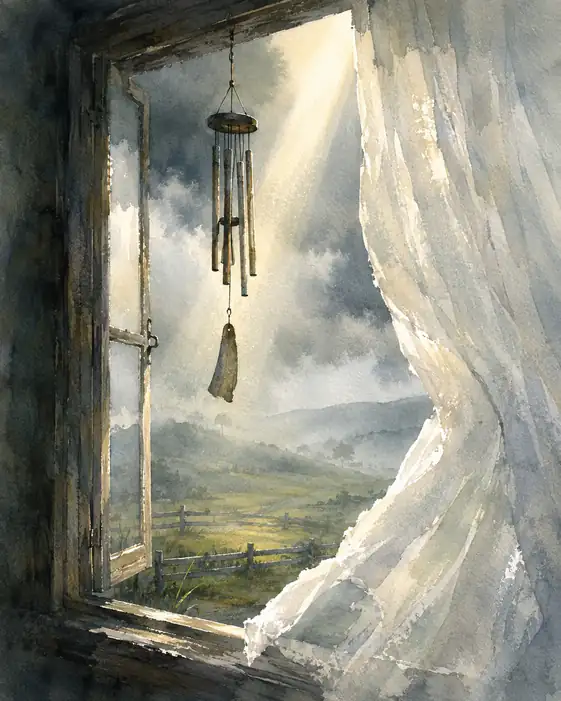 The Chimes Ring Sunlight into the Valley
 Morning Glory Wind Chime at Dusk
 Evening Air Carried on Chimes
 Where the Sea Wind Whispers to the Glass
 Summer Wind Chime Whispering by the Cloister
 Evening Gathers in a Jar of Wildflowers