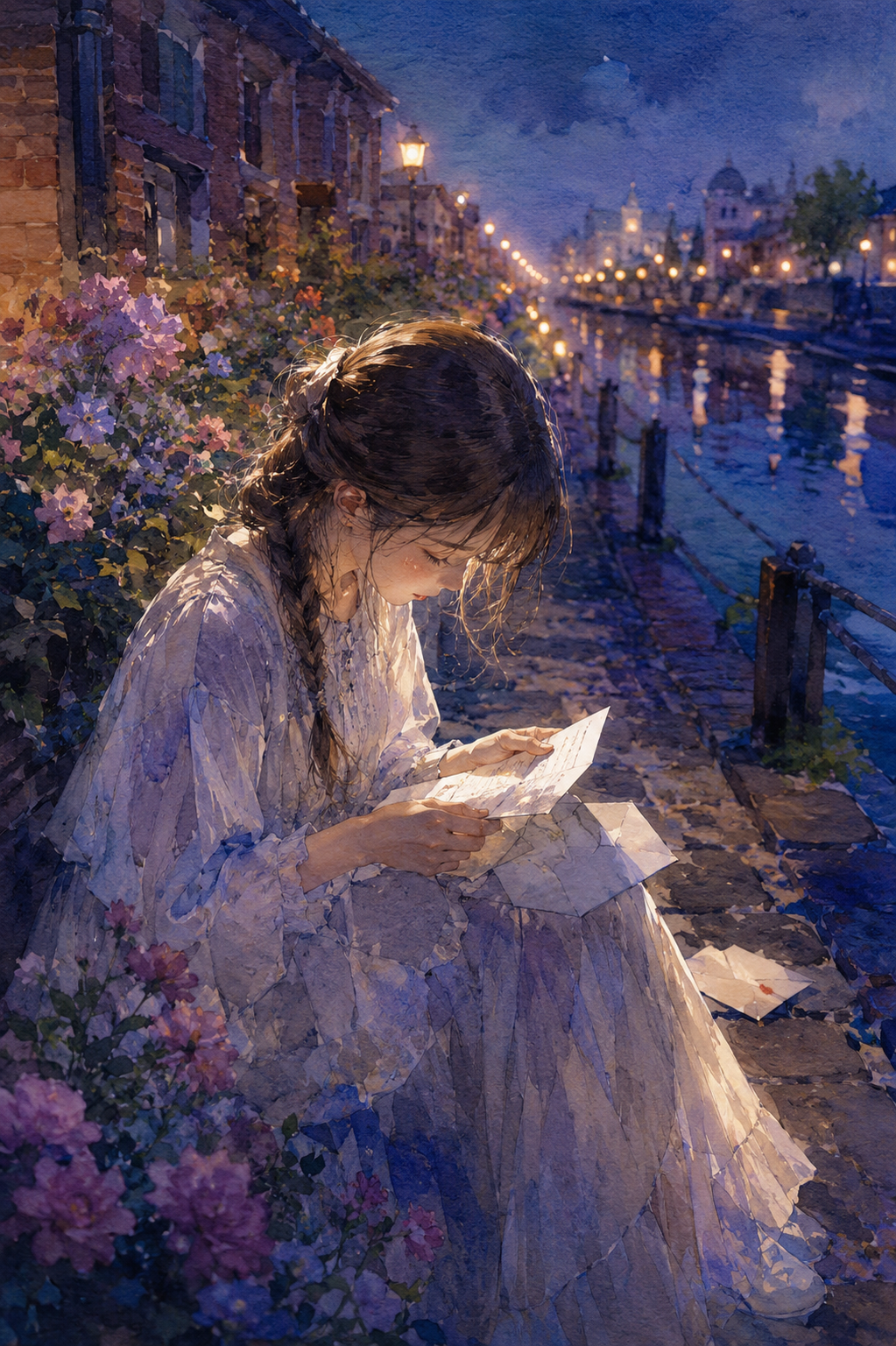
The Words She Kept Until the Lamps Awoke
Critique
Introduction This canal portrait shows a young woman among flowers, absorbed in handwritten pages. The downward composition emphasizes weight, duration, and rereading, while a chain of lamps places her solitude within an ordered night. Description The woman occupies the left foreground in a pale lavender-white dress. Her dark hair is tied back and braided, with damp strands falling across her face. She holds one letter over her lap; additional sheets lie on the stone beside her. Pink and violet flowers cluster at left. A narrow promenade and rope railing extend beside the canal toward lamps, pedestrians, distant buildings, and a domed silhouette. Analysis Her curved head, shoulders, and arms form a closed oval around the paper. This compact shape contrasts with the strong central perspective of path and canal. The illuminated sheet is the brightest local plane, drawing together face and hands. Pale fabric absorbs blue and violet shadows, while warm rim light separates hair and sleeves. Repeated lamps produce a continuous dotted line, and their water reflections counter the downward pull of her posture with vertical movement. Interpretation and Evaluation Multiple pages suggest sustained correspondence or repeated examination rather than a single casual message. Papers on the ground introduce vulnerability: language has entered physical space and may be difficult to gather again. Yet her careful grip and concentration imply agency, not helplessness. The distant pedestrians and illuminated town continue independently, making emotional absorption feel private but not world-ending. Conclusion The work gives reading bodily gravity. Paper, hands, bent posture, and surrounding night form a concentrated chamber of attention, while the canal preserves distance and continuity. Solitude becomes a temporary, meaningful interval within communal life.
Same Subcategory
Similar Artworks
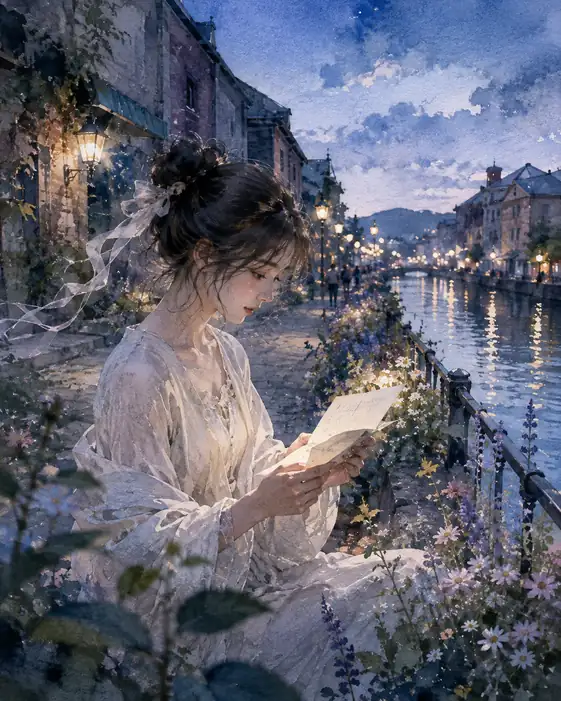 A Letter Read Where the Canal Turns Blue
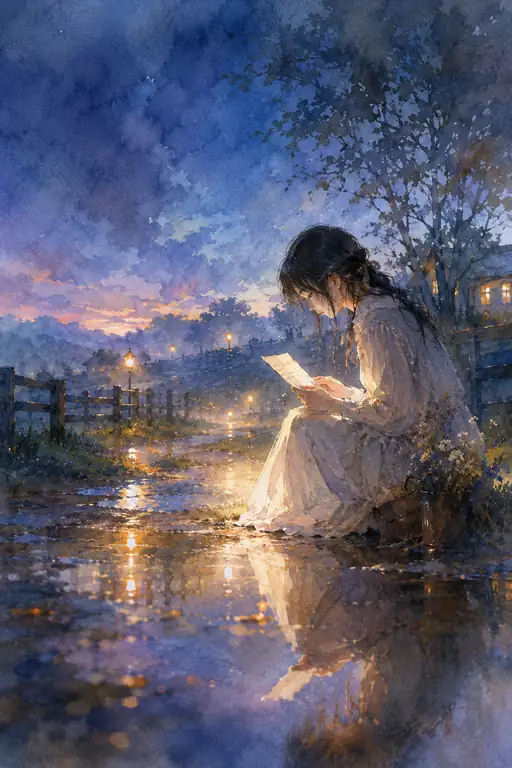 Her Letter Shines After the Rain
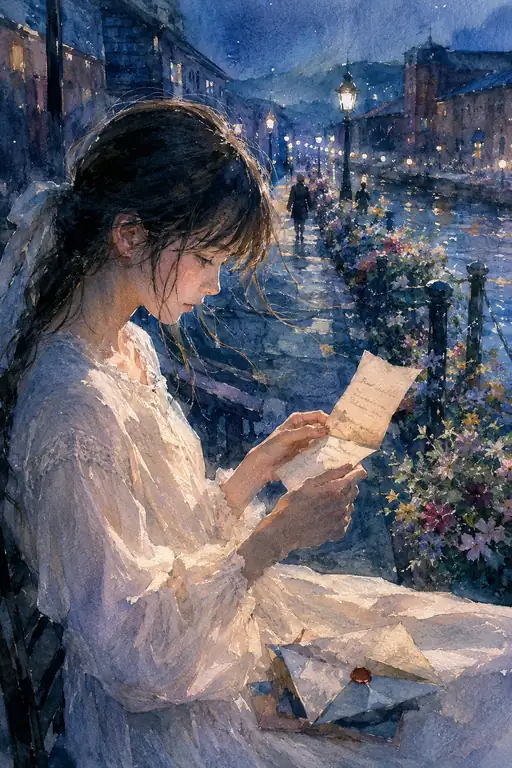 The Quiet Echo of Your Words
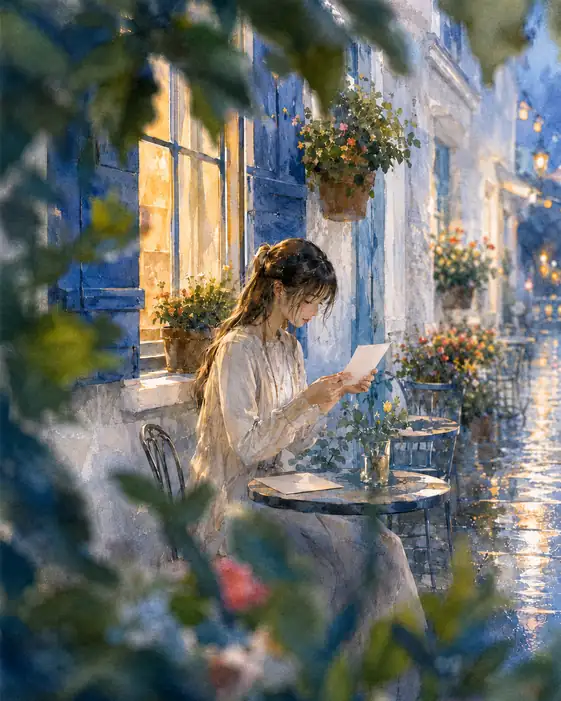 Reading Letters in the Drizzle-Kissed Cafe
 She Opens a Letter beneath the Rainlit Garden
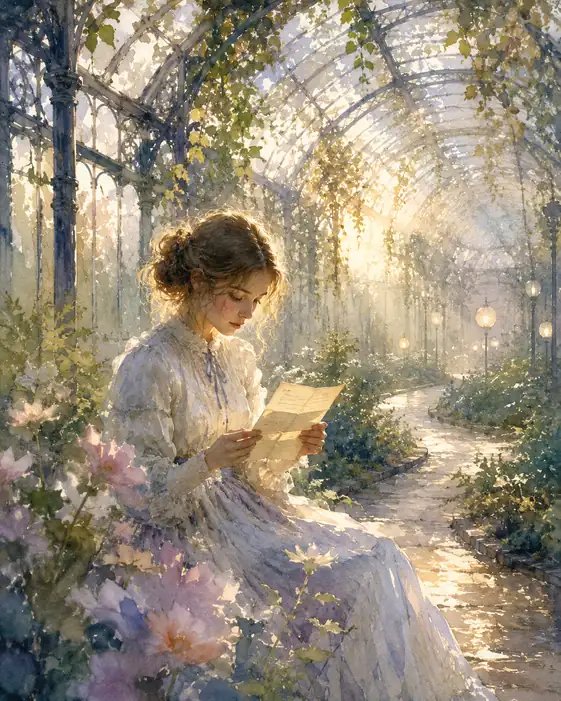 The Letter She Opened in a House of Sunlight
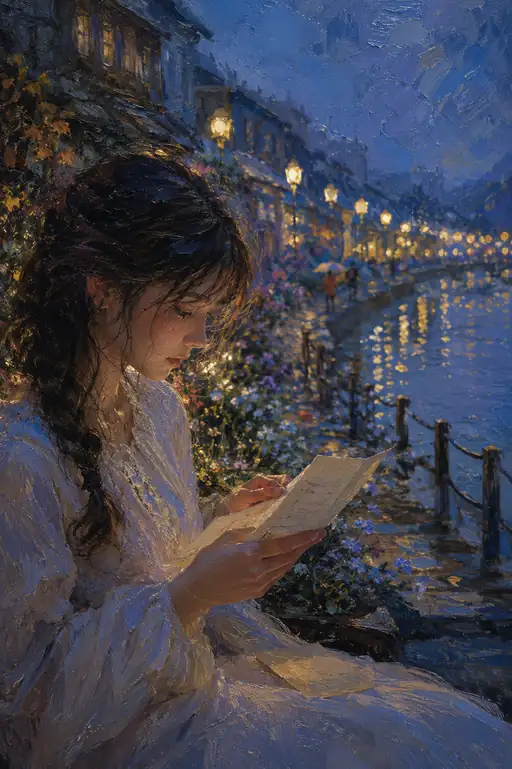 Whispers of a Distant Heart
 Words Whispered in Cobalt Rain
 Midnight Letter Under the Canopy of Stars
 She Reads the River's Letter at Sunset