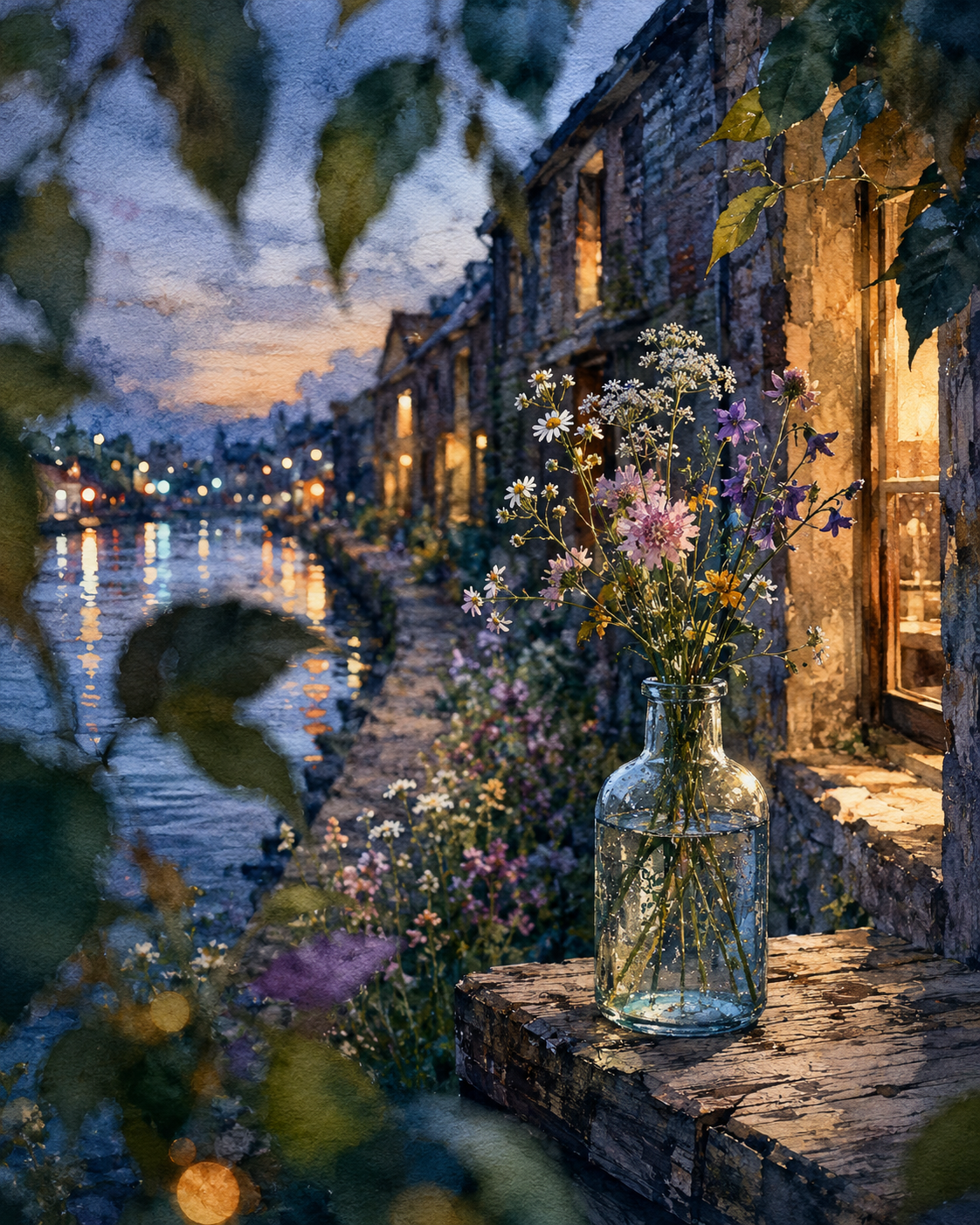
Wildflowers Waiting Beside the Blue Canal
Critique
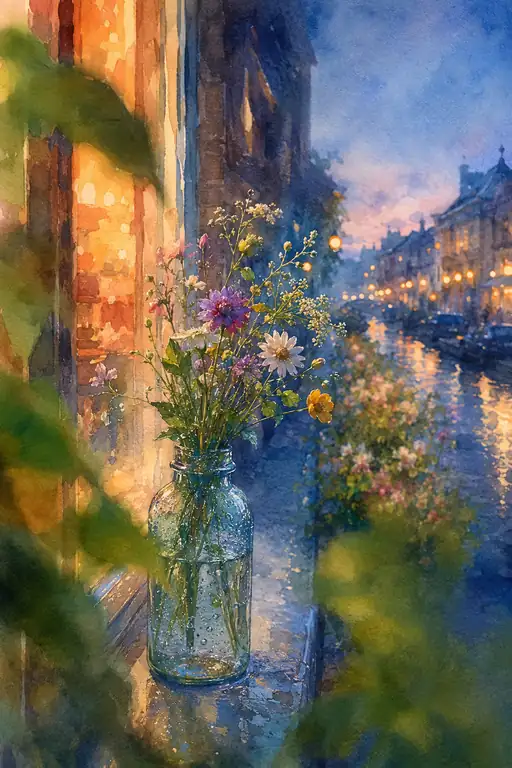
Introduction This blue-hour canal still life places a clear bottle of loosely gathered wildflowers on a weathered wooden ledge. Warm windows and water reflections surround the modest bouquet, integrating private arrangement with the evening life of the street. Description The glass bottle stands in the lower right, half filled with water and holding white daisies, pink pincushionlike flowers, violet bells, yellow accents, and tall sprays of tiny white blossoms. Green stems cross visibly underwater. The bottle rests on cracked, layered timber beside an open glowing window. A flower-bordered path and canal recede leftward past old stone houses. Amber lamps form long reflections. Blurred leaves frame the upper left and lower foreground. Analysis The bottle's simple vertical form anchors the near plane, while branching stems widen into an airy crown. Its transparency collects warm window light, cool sky, droplets, and distorted vegetation at once. White daisies repeat the brightest reflections; violet flowers connect the bouquet to blue dusk. The rough rectangular ledge contrasts with the curved glass. Selective focus moves from crisp vessel and stems to softened houses and circular lamps, creating layered depth. Interpretation and Evaluation The bouquet appears gathered casually rather than purchased or ceremonially arranged. This informality brings the canal's marginal growth into direct relation with domestic space. An open window suggests that someone has recently placed the flowers outside or is nearby within. Water visibly sustains the cut stems, turning care from an abstract sentiment into a practical condition. Conclusion The work finds continuity among glass, canal, and evening air. Each holds and reflects light differently, yet all remain permeable. A humble bottle becomes the near-scale expression of a neighborhood shaped by water and attention.
Same Subcategory
Similar Artworks
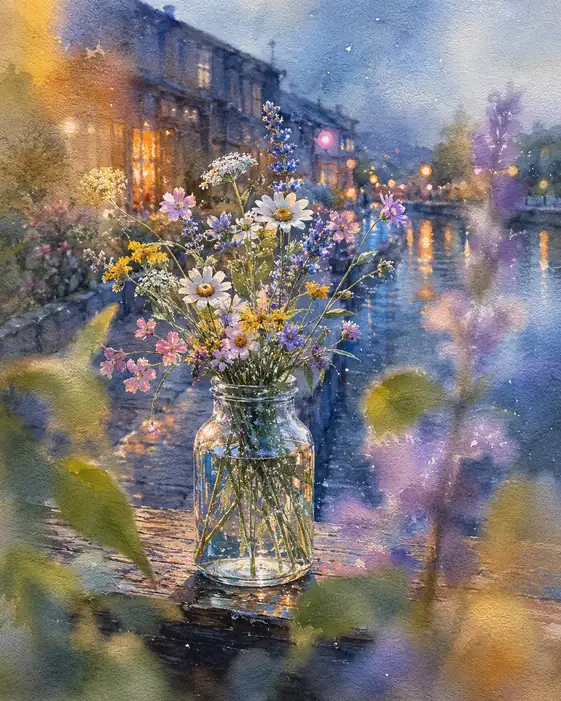 Evening Gathers in a Jar of Wildflowers
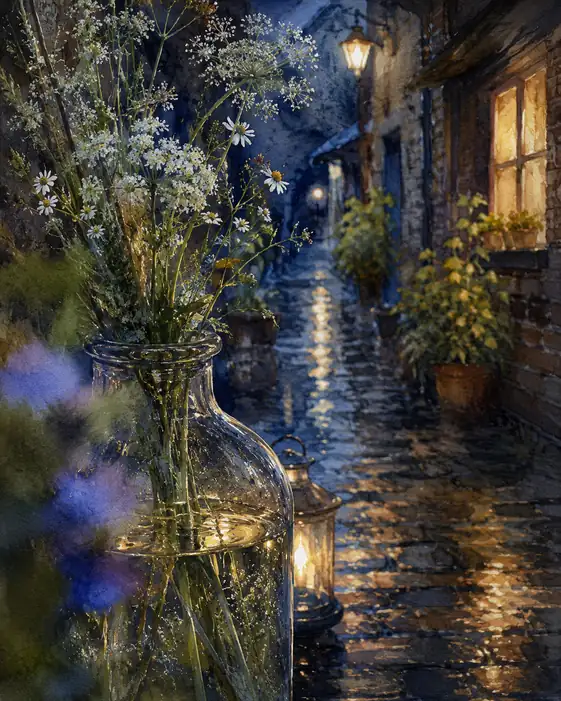 A Bottle Full of the Road's Last Light
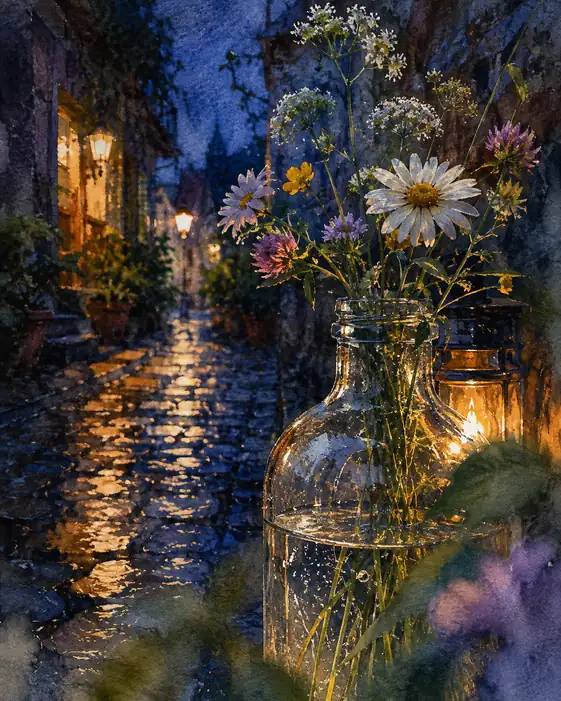 Wildflowers Borrow the Lantern's Gold
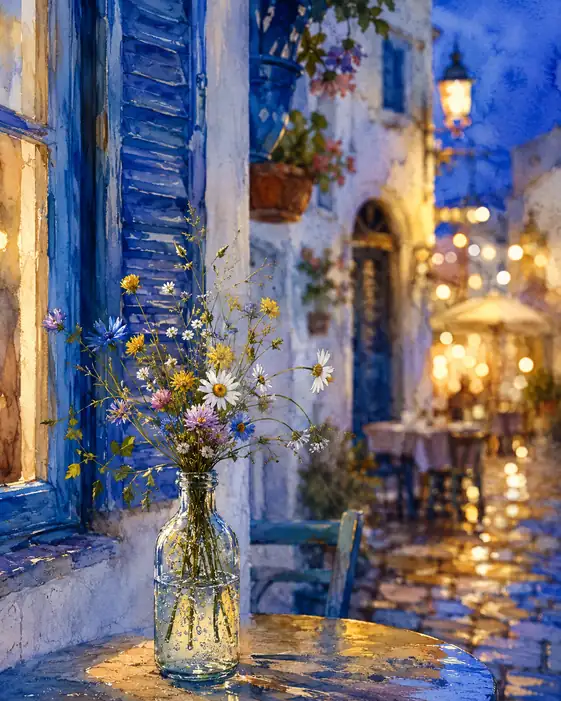 Wild Petals in the Blue Hour
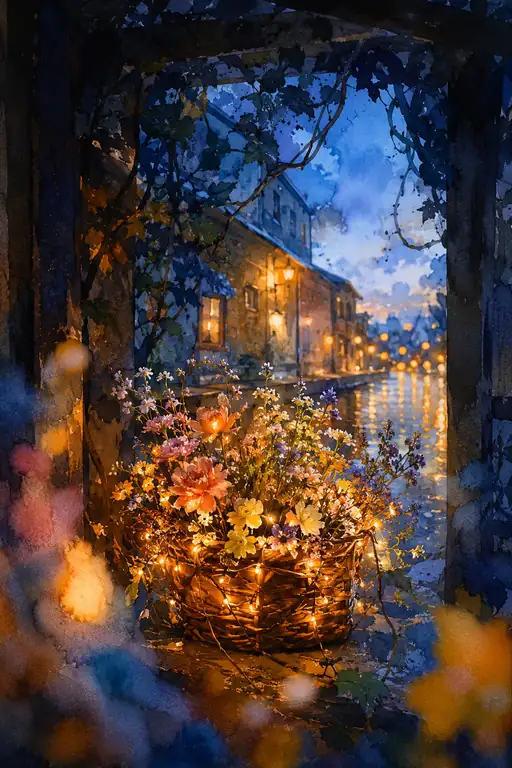 The Doorway Where Flowers Light the Blue Hour
 A Glass of Evening Light
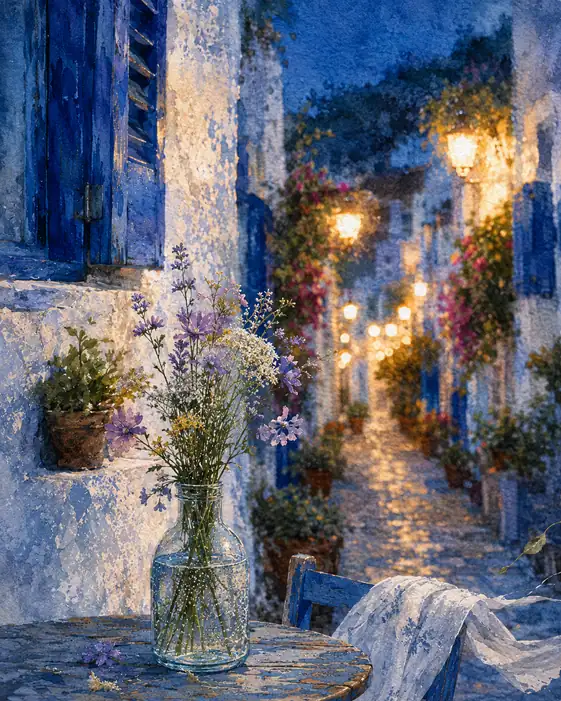 Evening Terrace with Wildflowers and Glowing Lamps
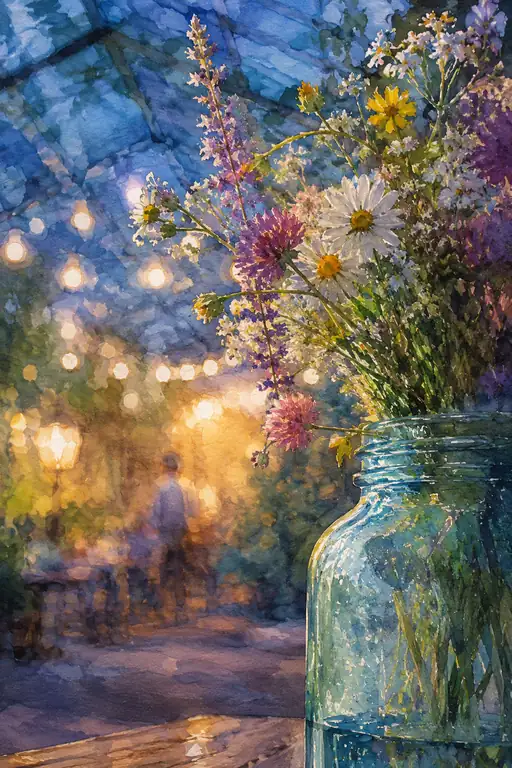 Evening Waits Beyond the Wildflower Jar
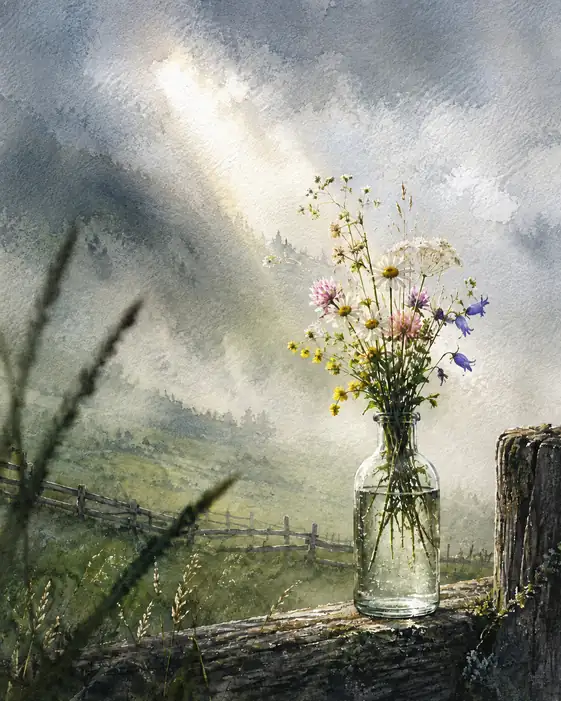 The Sky Opens for a Bottle of Meadow Flowers
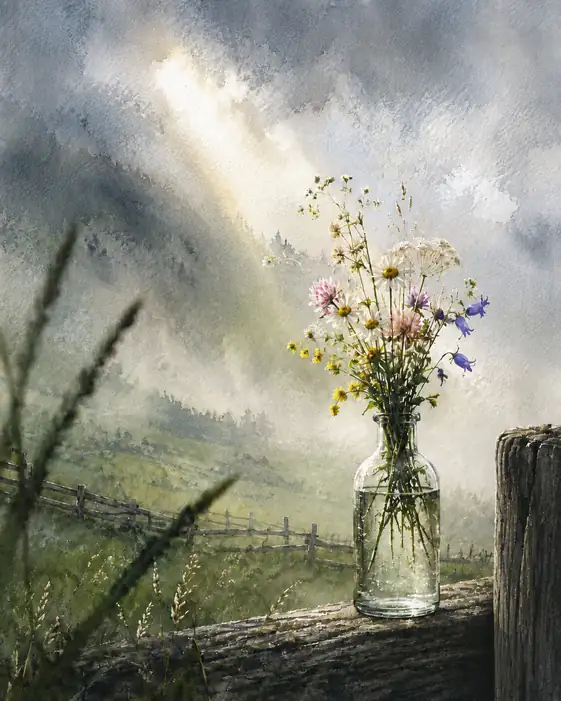 Wildflowers Holding Open the Storm