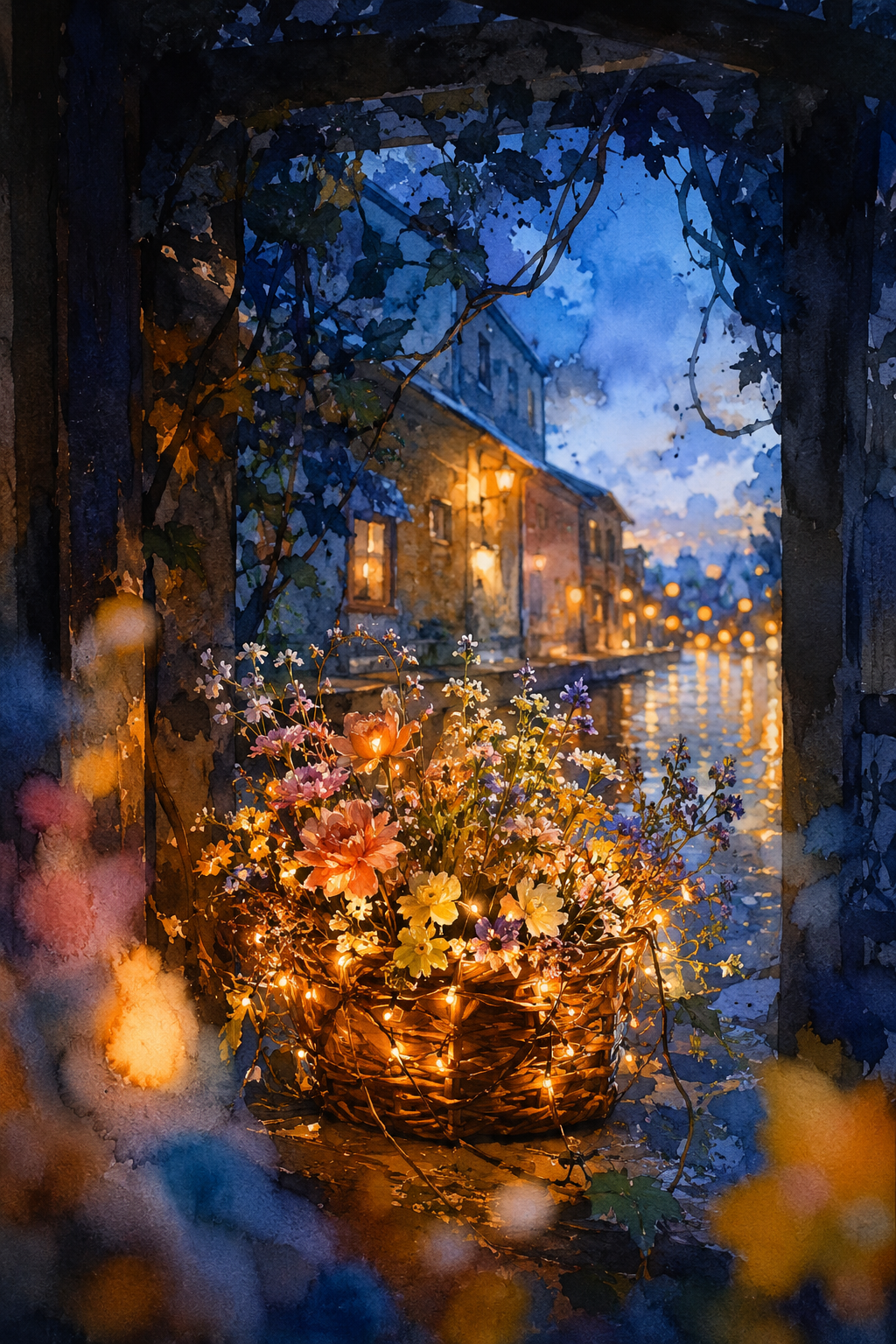
The Doorway Where Flowers Light the Blue Hour
Critique
Introduction This doorway scene frames a glowing wicker basket of mixed flowers against a blue canal street. Unlike an open promenade view, the dark post-and-vine enclosure makes the basket a threshold offering between interior shadow and public waterway. Description The low oval basket occupies the center foreground, filled with orange dahlias, yellow blooms, pink and lavender flowers, tiny white sprays, and trailing greenery. Warm fairy lights thread through the weave and foliage. Dark posts, beams, leaves, and hanging vines form a rectangular aperture around it. Beyond, old houses with amber lamps line a narrow canal or flooded lane, their lights reflected in vertical gold bands beneath clouded blue sky. Analysis The doorway creates a frame within the frame, concentrating attention on the basket before releasing it toward distance. Its low horizontal form counters the tall architecture and repeated reflections. Orange flowers align with the lamps, while violet blossoms mediate between warm bulbs and blue exterior. Foreground bokeh turns additional flowers and lights into soft colored disks, producing depth. Trailing stems cross the basket's edge and resist confinement. Interpretation and Evaluation Placed precisely at a threshold, the basket appears to welcome both those departing shelter and those approaching from the waterside. Its mixed flowers suggest abundance without hierarchy, and the woven lights make hospitality tangible after dusk. The dark enclosure does not threaten; it protects the near glow and intensifies the openness beyond. Repeated lamps show that this welcome belongs to a wider inhabited street. Conclusion The work turns framing into an ethical gesture: shadow preserves a space from which warmth can be offered outward. Basket, doorway, canal, and distant houses become successive containers of light. Intimacy expands rather than closes.
Same Subcategory
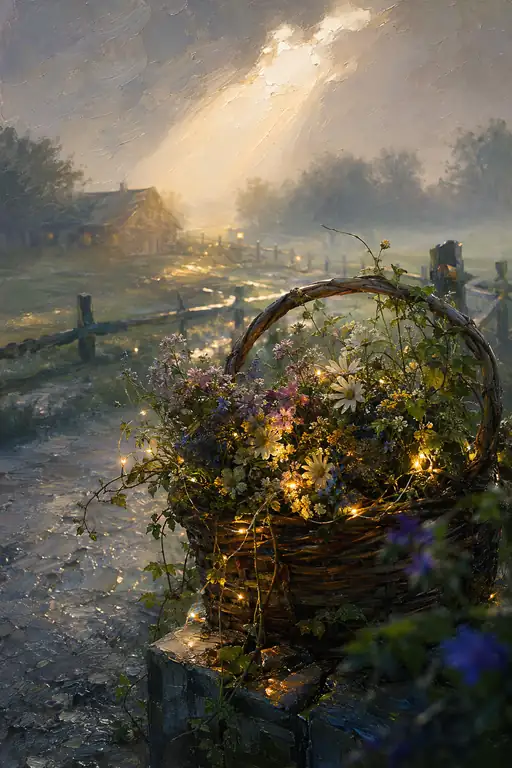 A Basket Woven with Flowers and Sunbeams
Similar Artworks
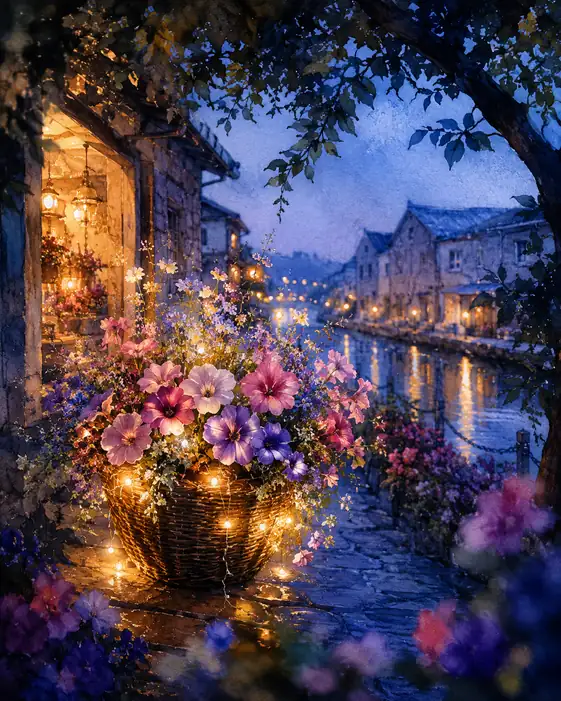 A Basket of Stars Beside the Sleeping Canal
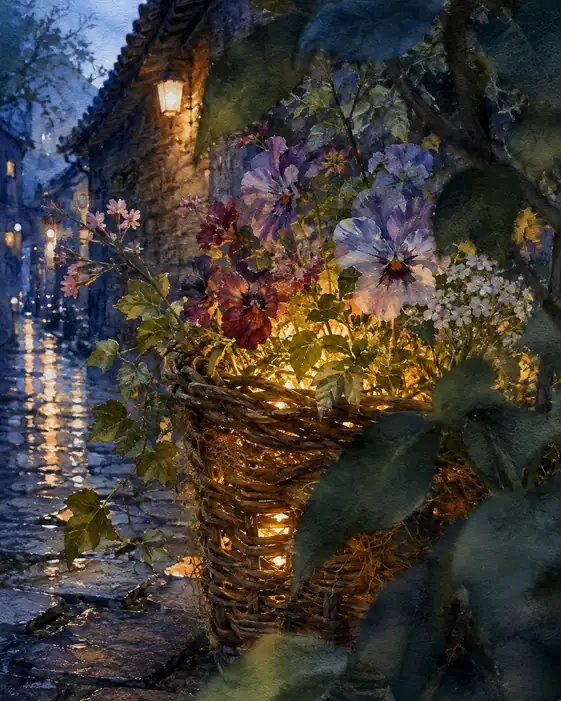 A Basket Glowing After the Rain
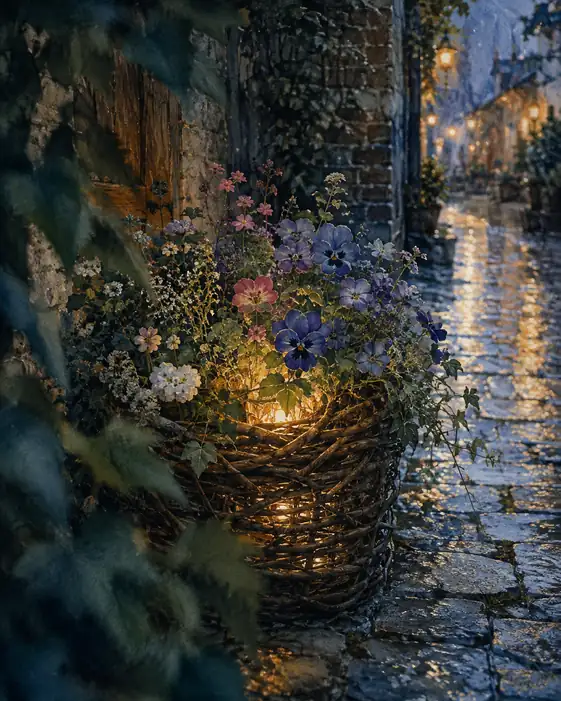 The Night Lamp Blooming in a Wicker Nest
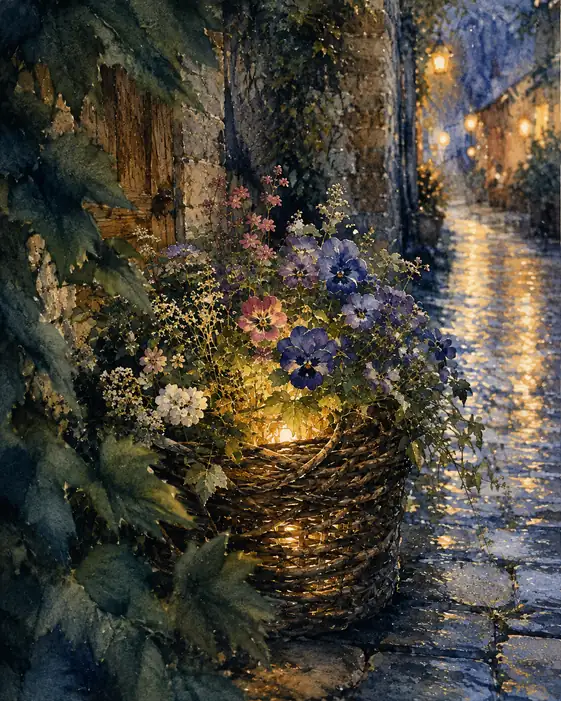 Where the Pansies Keep a Little Fire
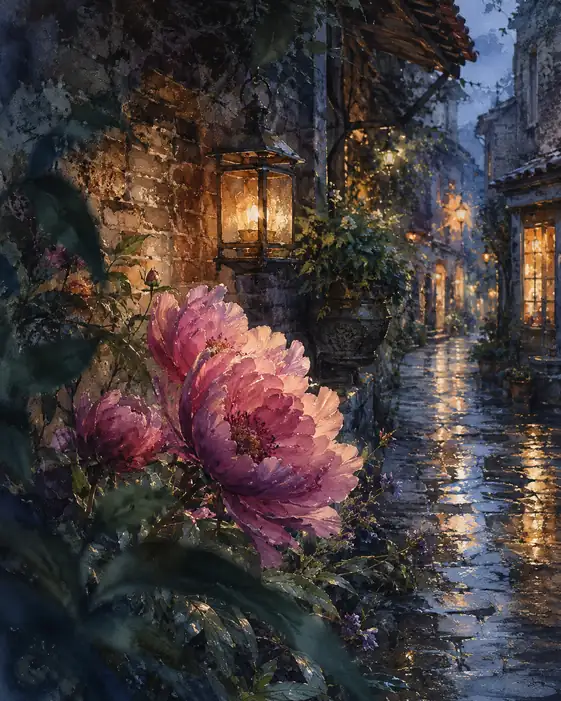 Peonies Keeping the Lantern's Secret
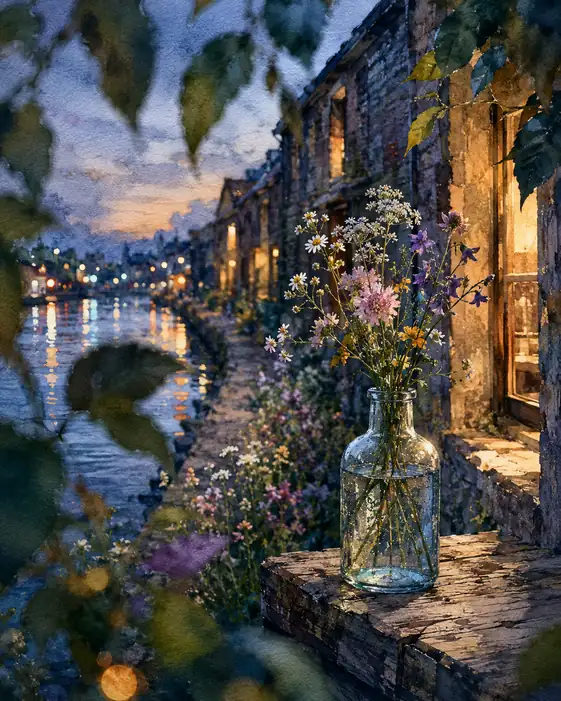 Wildflowers Waiting Beside the Blue Canal
 A Bottle Full of the Road's Last Light
 Wildflowers Borrow the Lantern's Gold
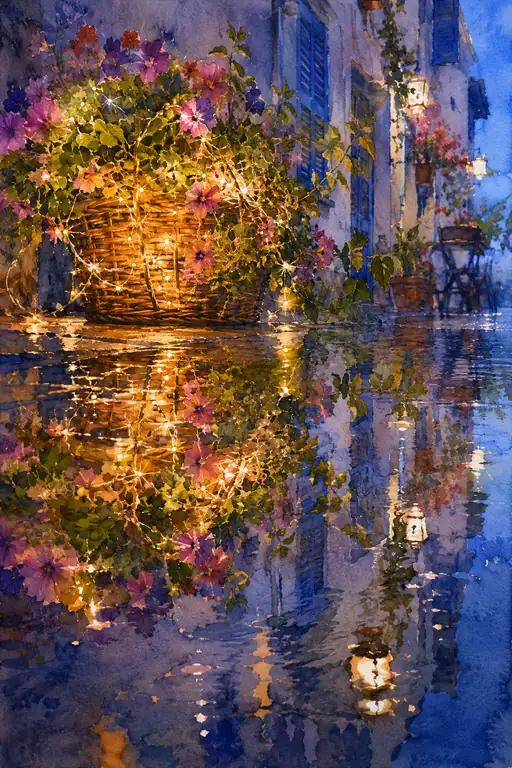 Fairy Lights Mirrored on Wet Cobblestones
 Twilight Poured into a Flower-Strewn Puddle