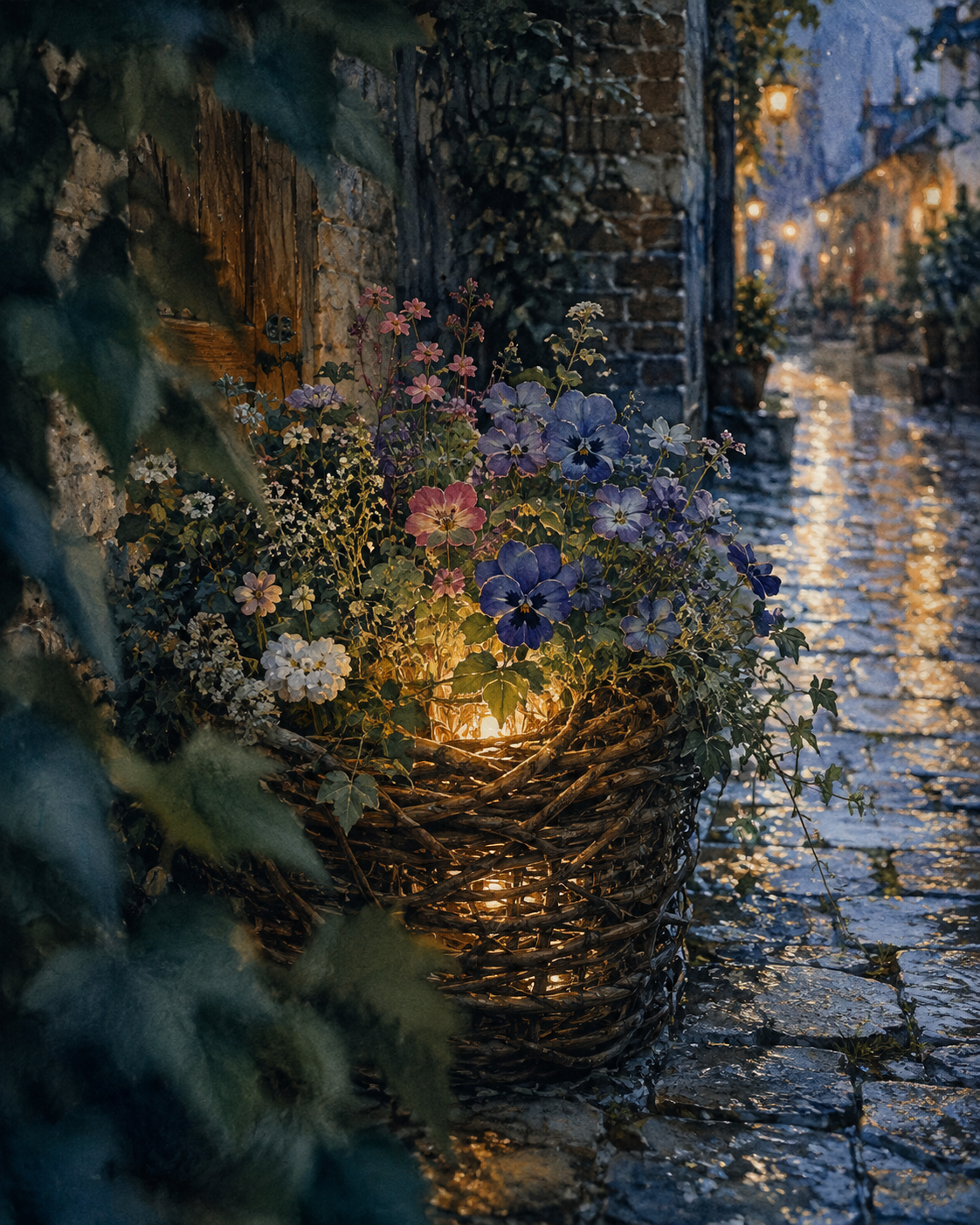
The Night Lamp Blooming in a Wicker Nest
Critique
Introduction This evening composition presents a luminous mixed-flower basket beside an old door, viewed through shadowed foliage. Compared with a conventional bouquet portrait, its off-center framing emphasizes discovery: beauty appears encountered along a rain-wet route. Description A broad wicker basket stands in the lower left-center, filled with blue and lavender pansies, a salmon-pink bloom, tiny white sprays, pink stems, and trailing ivy. Amber light glows from within the weave and foliage. A weathered wooden door and stone wall rise behind. At right, the wet lane climbs into soft focus past potted plants and successive lamps under deep blue sky. Analysis The basket's rounded body and dense bouquet contrast with the narrow vertical passage. A large dark branch veils the left foreground, creating strong depth and an irregular frame. Blue flowers visually belong to the street's cool atmosphere, while their warm-edged petals receive the hidden lamp. A salmon flower near center acts as a chromatic hinge. Gold reflections pull diagonally upward, balancing ivy that descends toward the paving. Interpretation and Evaluation The partly obstructed viewpoint gives the scene the intimacy of an unplanned glimpse. Internal light suggests care invested out of public view, while the closed door refuses a literal explanation. Diverse flowers coexist without hierarchy, offering a small image of community sustained by difference. The rain-polished route expands this private gesture outward by repeating its light toward distant homes. Conclusion The painting makes looking itself part of the subject. Shadowed leaves delay access, then the glowing basket rewards attention before the lane draws it onward. Discovery, shelter, and continuation are joined in one measured movement.
Same Subcategory
Similar Artworks
 Where the Pansies Keep a Little Fire
 A Basket Glowing After the Rain
 A Basket of Stars Beside the Sleeping Canal
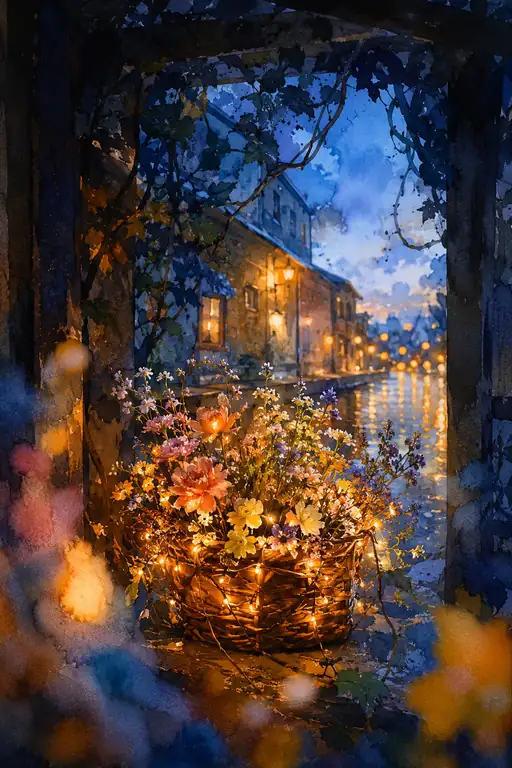 The Doorway Where Flowers Light the Blue Hour
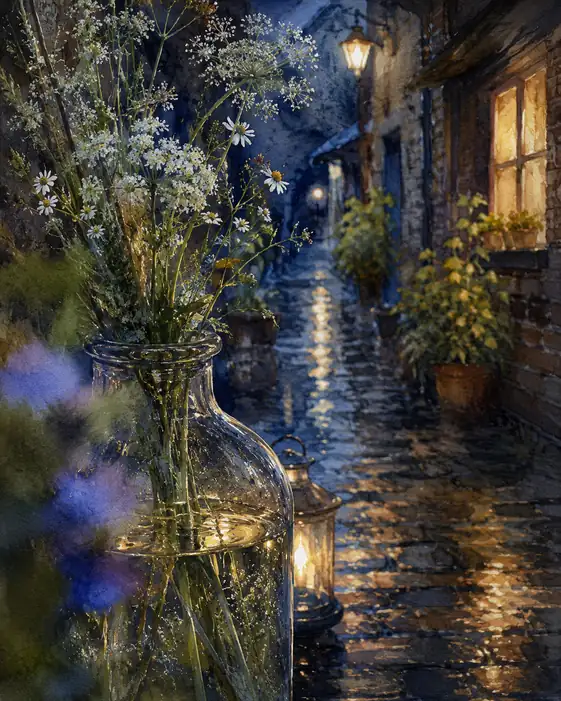 A Bottle Full of the Road's Last Light
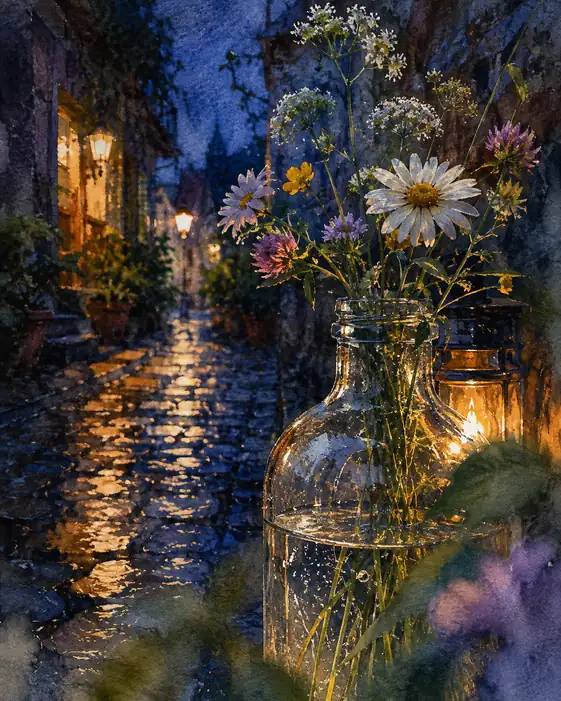 Wildflowers Borrow the Lantern's Gold
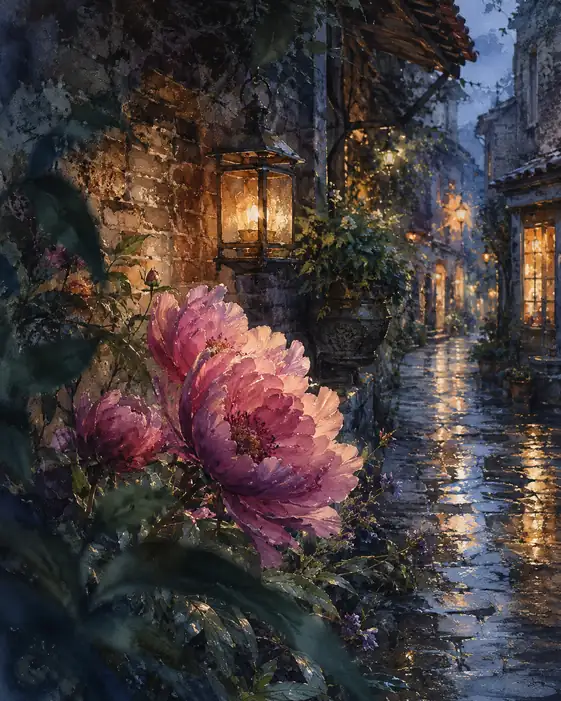 Peonies Keeping the Lantern's Secret
 Petunias Listening to the Rainlit Lane
 Fairy Lights Mirrored on Wet Cobblestones
 The Violet Hour Beaded with Rain