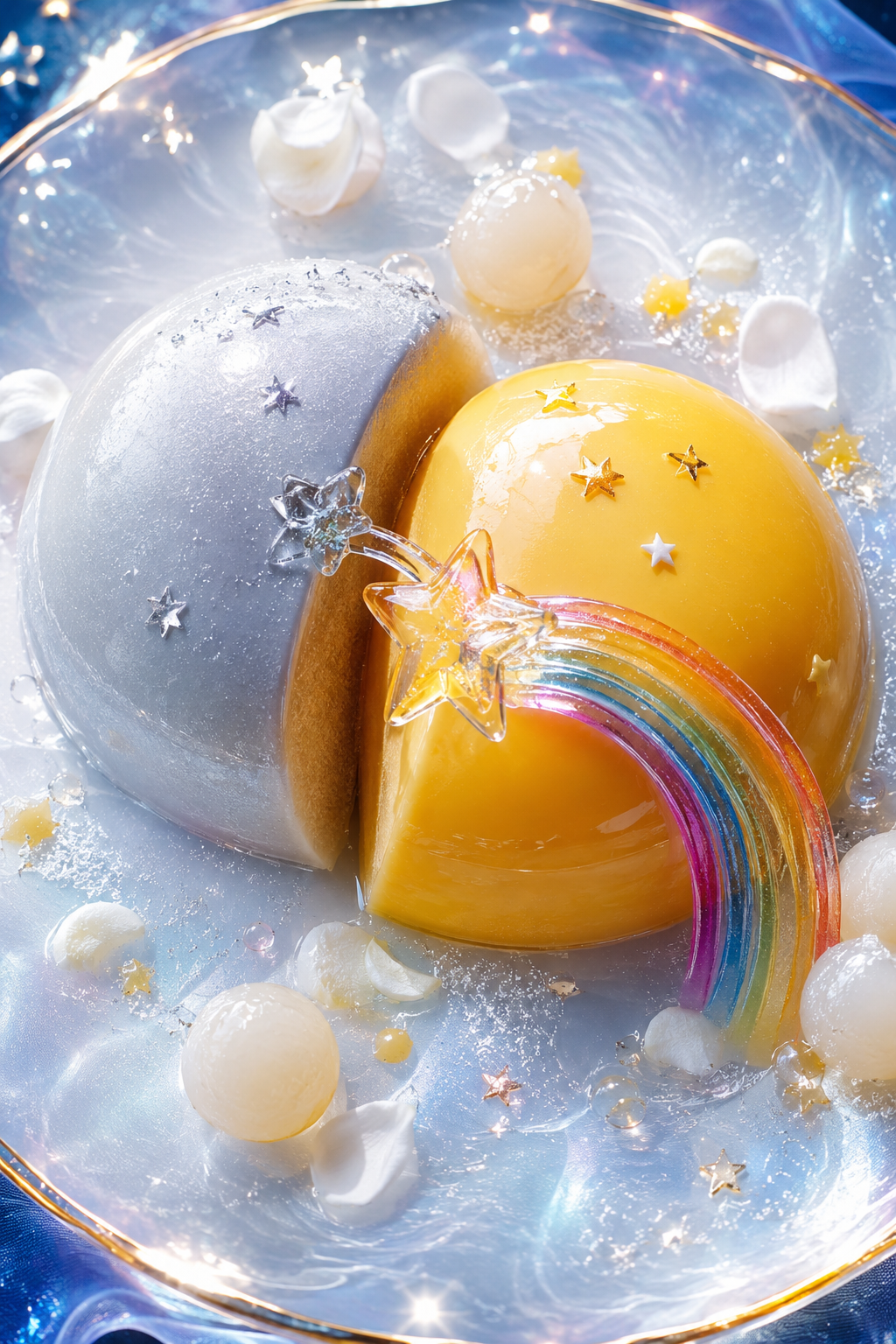
Where the Sun Sends a Star to the Moon
Critique
Introduction Silver and golden domes stand like moon and sun, joined by a transparent rainbow and stars. White spheres, petals, and metallic flecks surround them. Cosmic opposition becomes tactile and celebratory. Description The left dome is cool silver with gray stars; the right is yellow-orange with gold and white stars. A dark biscuit seam separates them. A clear shooting star bridges the pair, trailing rainbow bands toward the lower right. Pale spheres and curled petals scatter around a gold-edged plate reflecting blue, peach, and white. Analysis The paired hemispheres establish near symmetry, broken by the rainbow’s diagonal descent. Silver absorbs cool reflections while gold advances warmly, creating a balanced tonal opposition. The dark seam clarifies their boundary. Repeated spheres connect domes, fruit, droplets, and stars. Smooth glaze, powdered silver, transparent rainbow, matte biscuit, soft petals, and glass plate are distinctly modeled. Strong upper light produces broad highlights without erasing saturated color. Interpretation and Evaluation Sun and moon appear as companions rather than rivals, linked by a moving spectrum. The shooting star turns static duality into exchange, carrying color from their meeting point outward. Composition and color hierarchy are immediately clear. Scattered pale forms give the celestial symbols a domestic, edible scale. The restraint of the simple domes allows the transparent bridge to remain the imaginative focus. Conclusion At first glance, the image offers a bright celestial novelty. Closer viewing reveals a disciplined balance of paired mass, opposing temperature, diagonal connection, and repeated spheres. The rainbow transforms separation into relation. Its strength lies in presenting cosmic scale through simple, tactile forms and precise light.
Same Subcategory
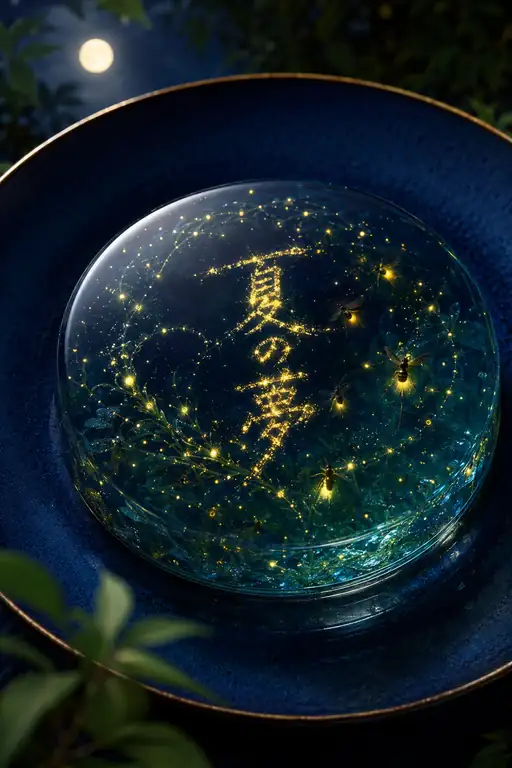 Fireflies Writing a Summer Dream
 The Chapel Sleeping Inside the Lantern
Similar Artworks
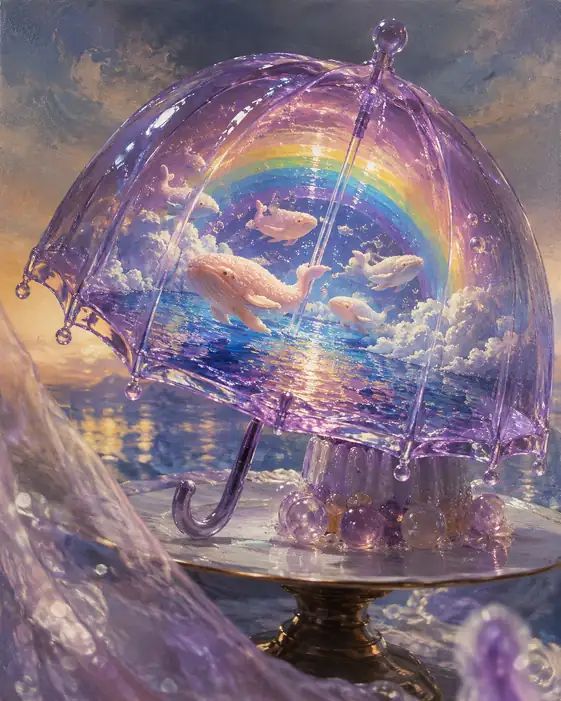 Whales Beneath the Rainbow Umbrella
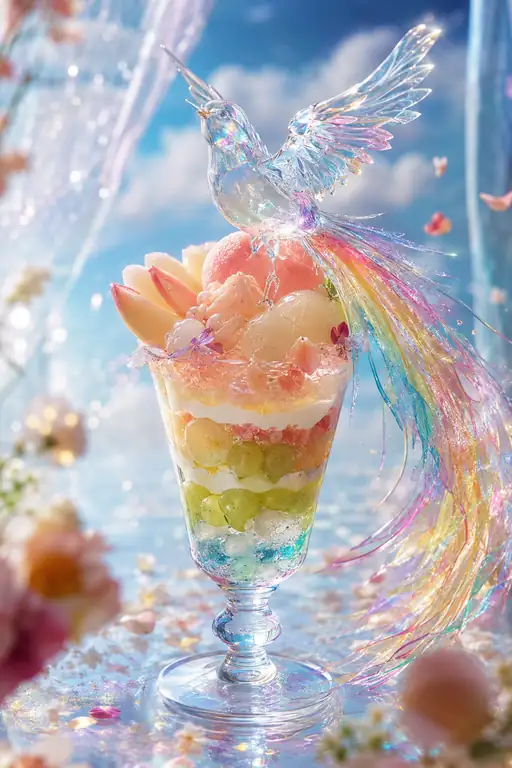 The Bird Who Brought Dawn in Its Tail
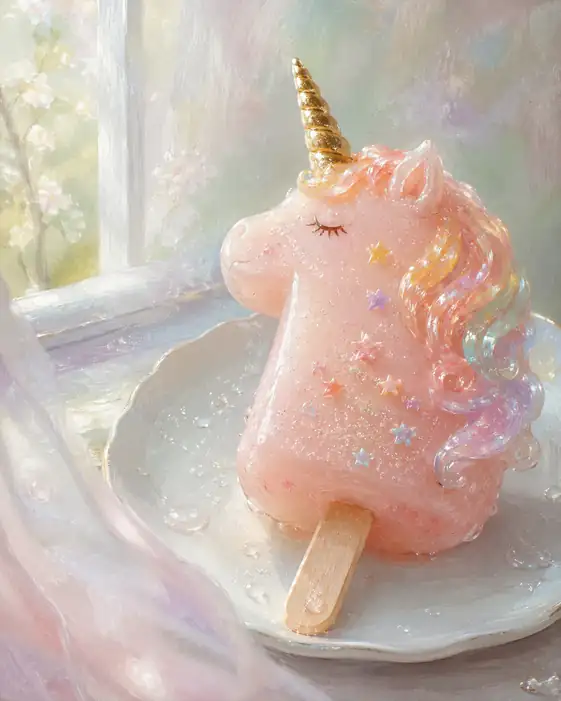 A Unicorn Dreaming Past the Window
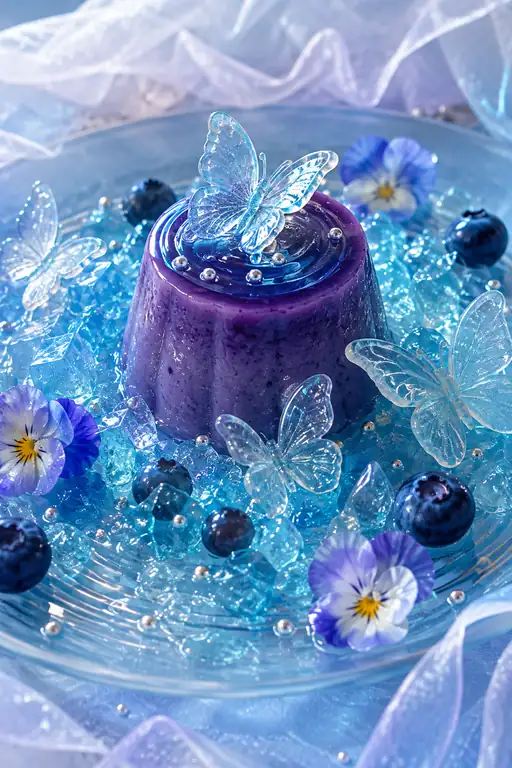 Butterflies Drink the Violet Silence
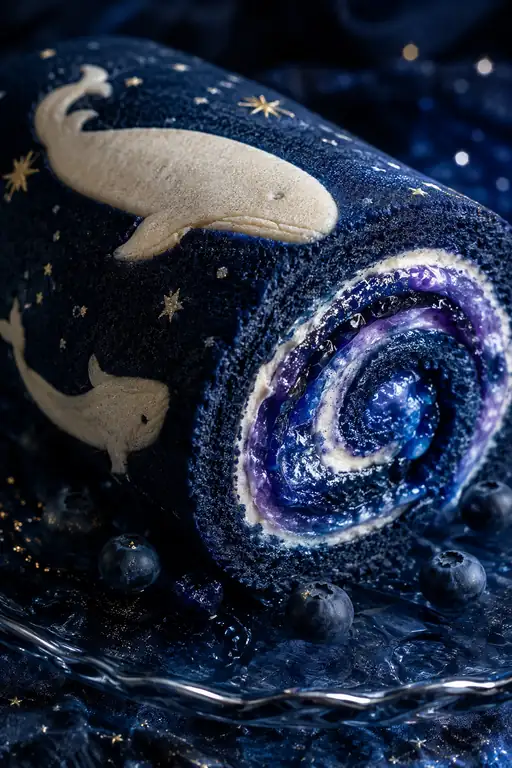 Whales Dream in the Spiral of Night
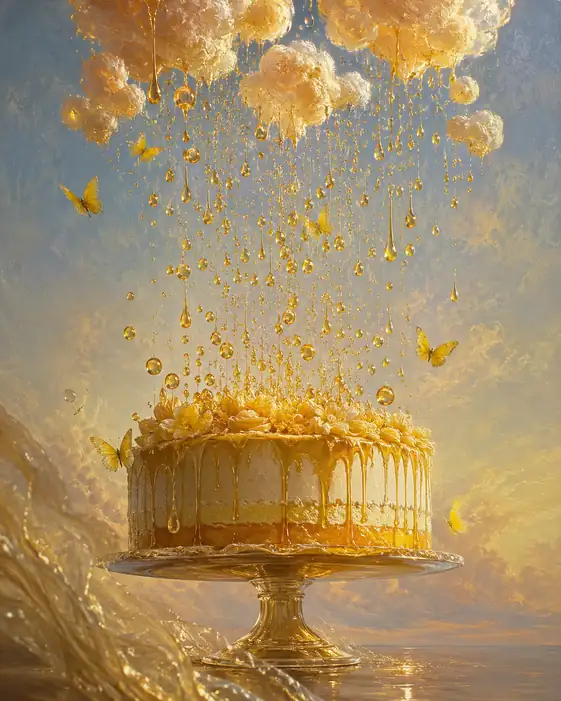 Honey Falls from Heaven's Garden
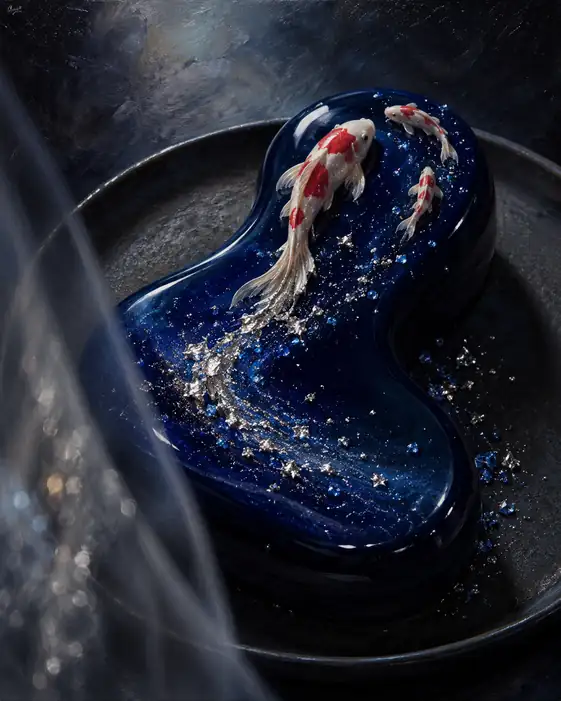 We Swam Beyond the Measure of Night
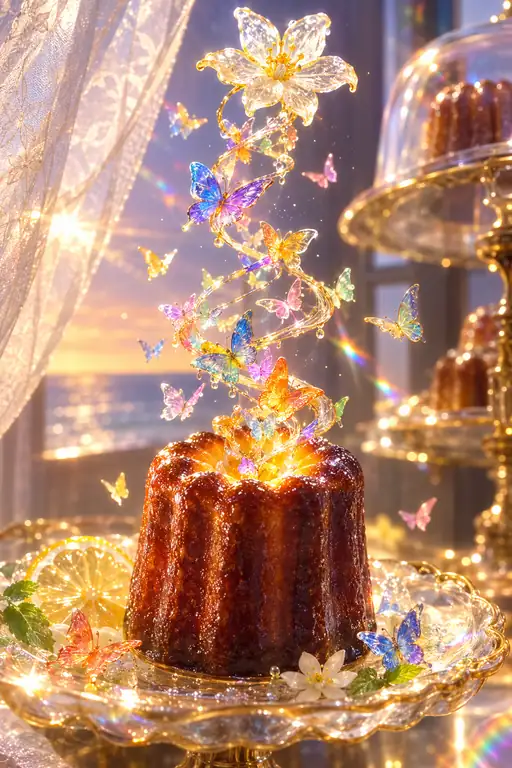 Butterflies Rise from the Golden Canele
 Silver Ripples Cross a Sea of Sleeping Light
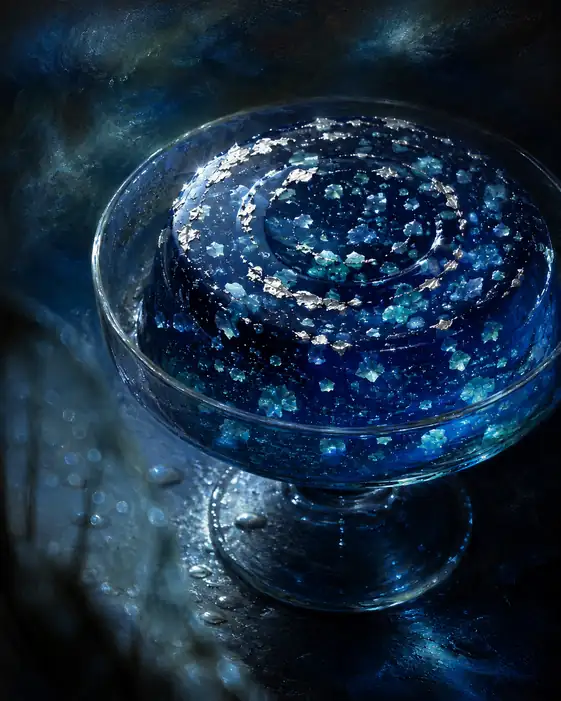 The Midnight Sea Remembers Every Star