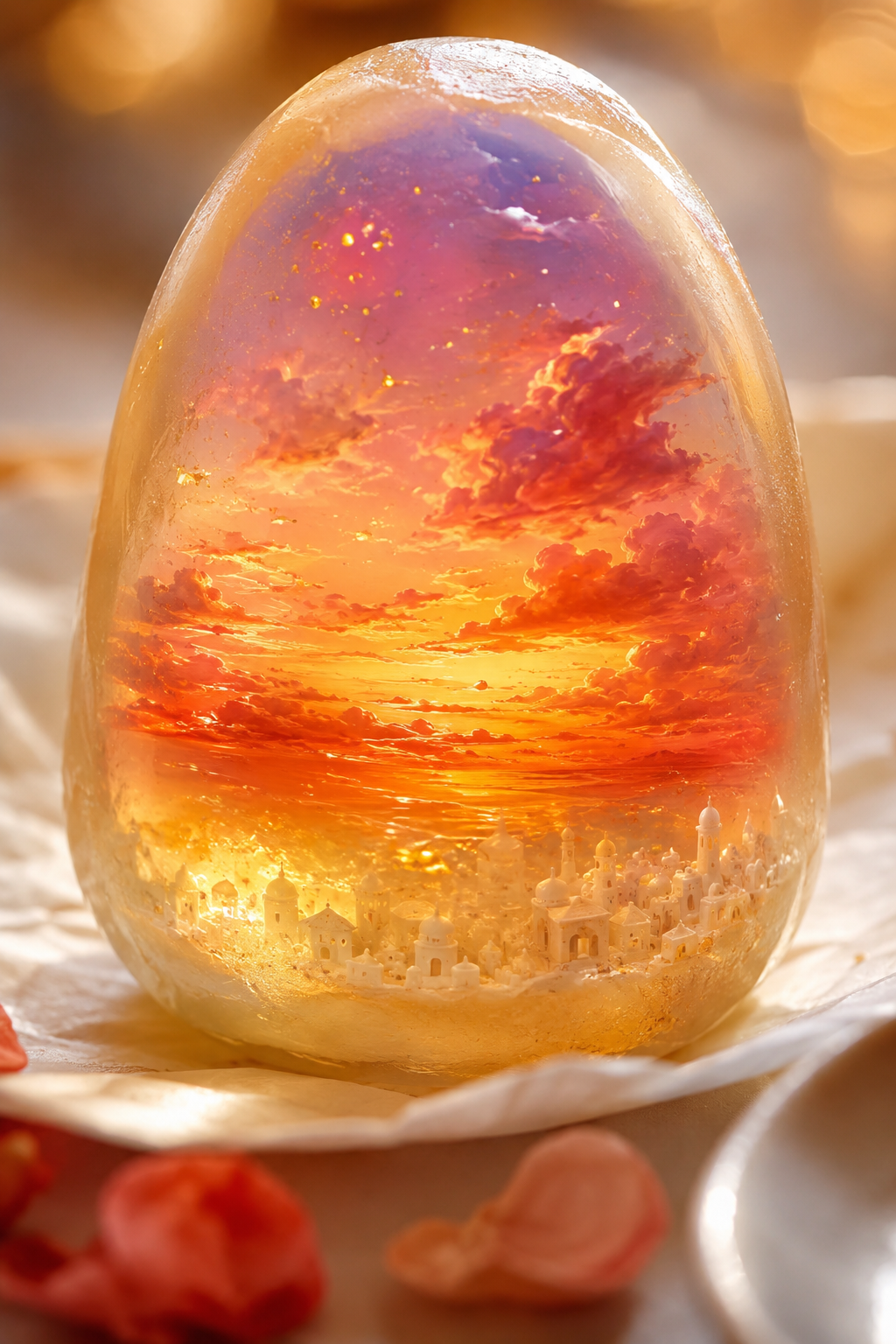
The City Waiting to Be Born
Critique
Introduction A translucent egg encloses a sunset and tiny city, compressing sky, sea, and architecture into a fragile world with a vast interior. Description The upright egg has a thick amber-clear shell with droplets and faint surface irregularities. Within it, violet and crimson clouds surround a brilliant orange horizon reflected across rippled water. A miniature city of domes, towers, arches, and clustered houses forms a pale band along the bottom. Gold flecks float through the upper atmosphere. Out-of-focus red and peach petals lie before the cloth-covered base. Analysis The oval boundary establishes strong symmetry, but asymmetric cloud masses keep the interior alive. Color descends from lavender through red and orange to creamy white, creating both atmospheric depth and a clear hierarchy. The luminous horizon becomes the focal axis, while the city supplies scale. Smooth shell, vaporous clouds, liquid reflection, granular buildings, cloth, and petals are carefully distinguished. Warm backlighting makes the shell act as lens, container, and source of radiance. Interpretation and Evaluation The egg suggests origin, protection, and potential, yet it contains a civilization already complete. This temporal contradiction allows the image to read as a memory of a city and as a world waiting to hatch. The low settlement faces a sky vastly larger than itself, expressing humility without menace. Miniaturization is handled convincingly, and the internal light remains coherent across different materials. The fusion of cosmic souvenir, landscape, and incubating life is imaginative. Conclusion The image begins as a glowing ornament and resolves into a meditation on how entire places survive inside memory. Its shell protects the view while also separating it from touch. Controlled color transitions, minute architecture, and the tension between fragile exterior and boundless interior give the work emotional weight.
Same Subcategory
 A Letter from the End of Winter
Similar Artworks
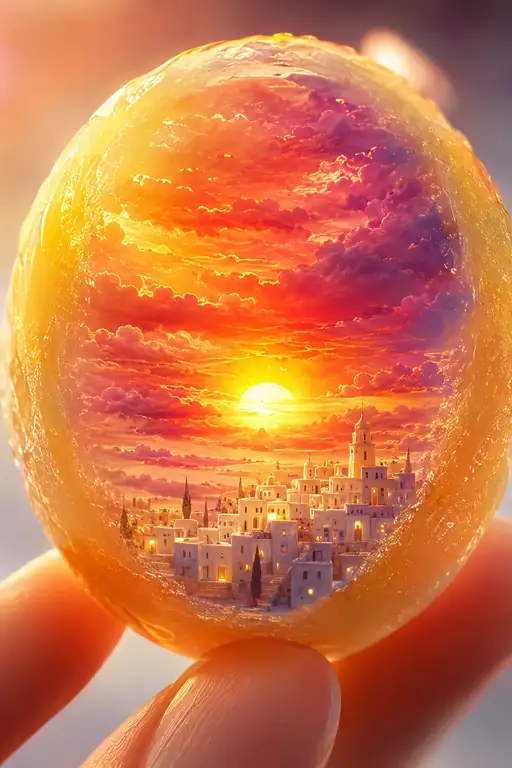 The Sunset I Could Hold
 The Ship Climbs from Sunset into Stars
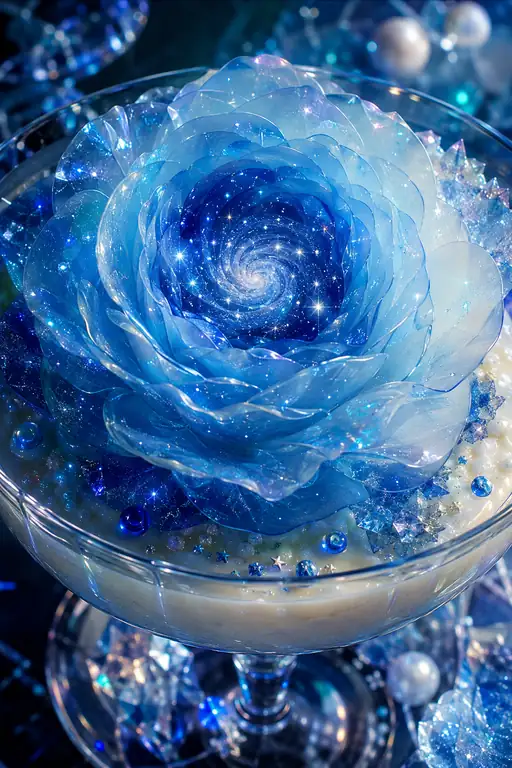 A Rose Blooming Beyond Infinity
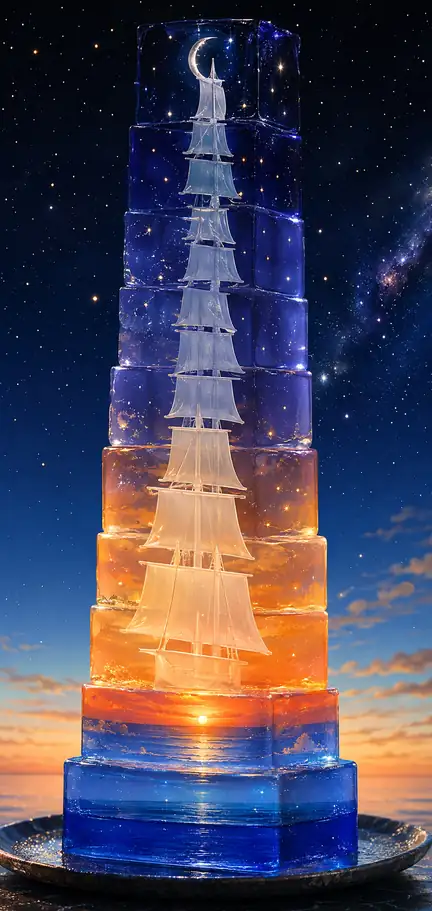 Sailing Upward Through Time
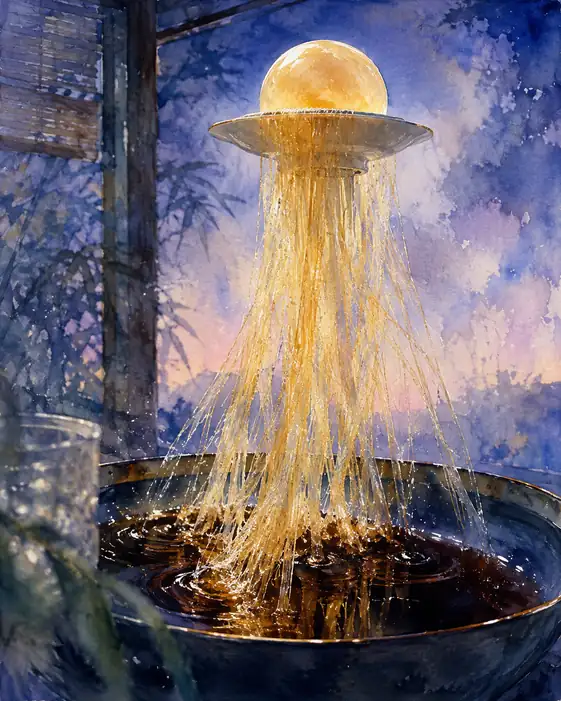 The Moon Rains Golden Threads
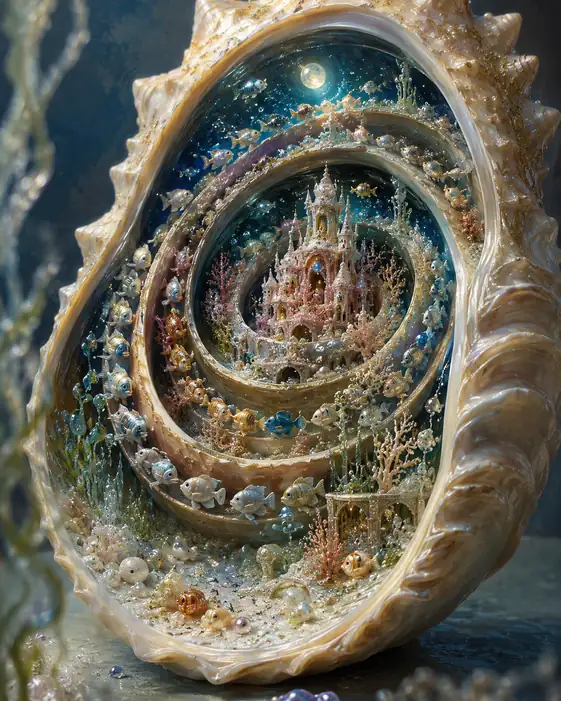 Where Every Tide Returns Home
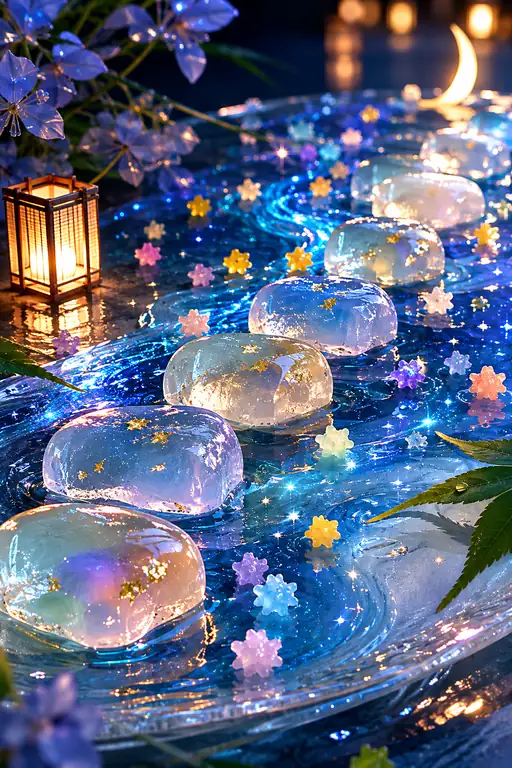 The Starry Floating Bridge from the Crescent Moon
 Infinity Blossoms Close to Me
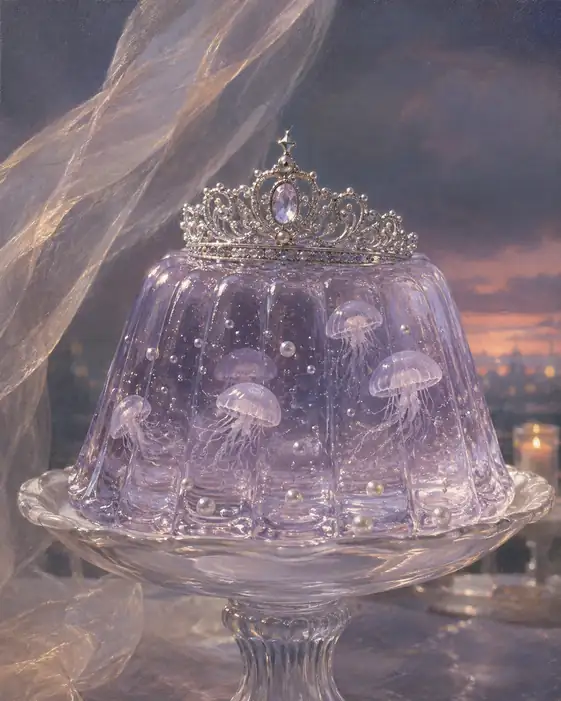 The Crown above the Unruled Sea
 Until My Light Reaches You