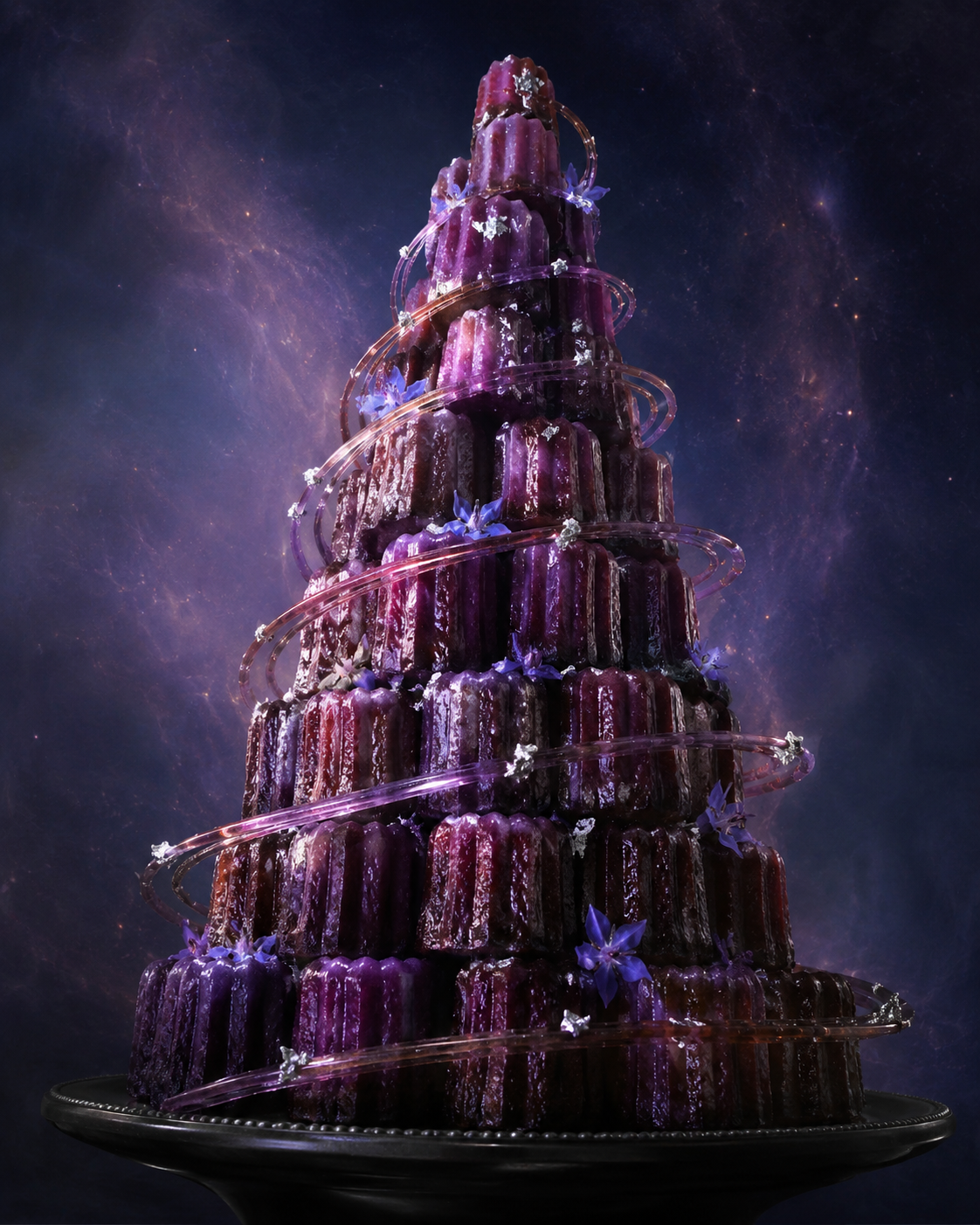
The Canele Tower Summons the Night
Critique
Introduction Dark violet fluted cakes rise into a cosmic tower. Transparent pink rings orbit its tiers, turning repeated pastry into monumental architecture. Description Glossy canelé-like cylinders stack in narrowing levels on a black pedestal. Colors range from burgundy and plum to near-black violet. Rose sugar tubes spiral around the tower, occasionally looping outward. Silver fragments and blue-purple flowers punctuate the mass. A starry indigo background enlarges the structure’s scale. Analysis Repetition supplies both texture and construction: each ribbed unit remains visible while contributing to the tapering whole. Horizontal tiers stabilize the steep vertical ascent, and orbiting tubes introduce diagonals and continuous motion. Narrow highlights reveal sticky glazed ridges against deep shadows. The limited purple palette unifies pastry, flowers, rings, and sky; silver flakes create brief high-value accents. Irregular loops keep the symmetrical pyramid from becoming rigid. Interpretation and Evaluation The tower resembles a mountain, temple, or civilization assembled from identical edible citizens. Its rings suggest that abundance has generated its own gravity. Cosmic staging may overstate the importance of modest pastries, yet that disproportion is also humorous and sublime. The stack’s practical stability is questionable near the narrow summit, but visible tiering provides credible structural logic. Sparse flowers humanize the otherwise industrial repetition. Conclusion At first scale and quantity dominate. Longer viewing alternates between individual ridged cakes and the single ascending silhouette they create. The work succeeds by transforming repetition into aspiration: a familiar pastry is not enlarged once, but made monumental through cooperation, while luminous orbits grant the collective form a universe of its own.
Same Subcategory
 A Flower Dreams beneath Violet Silk
 I Brought You Stars from the Shore
Similar Artworks
 The Night Ascends in Spirals
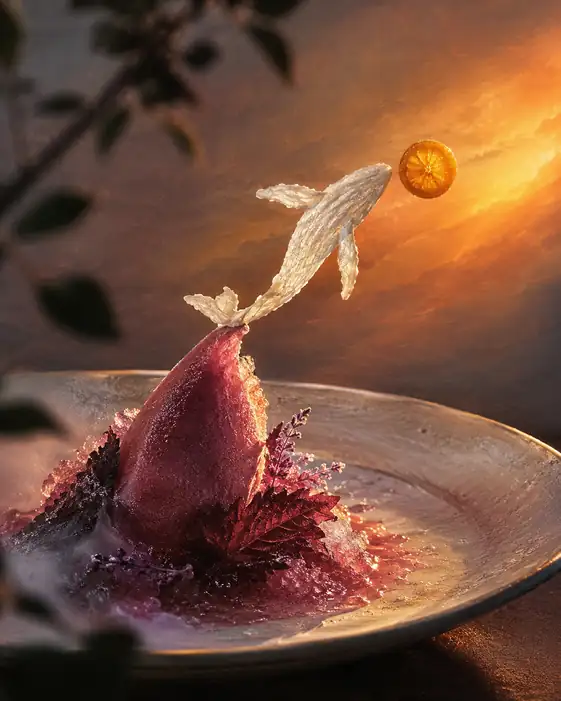 The Whale Who Chased the Last Light
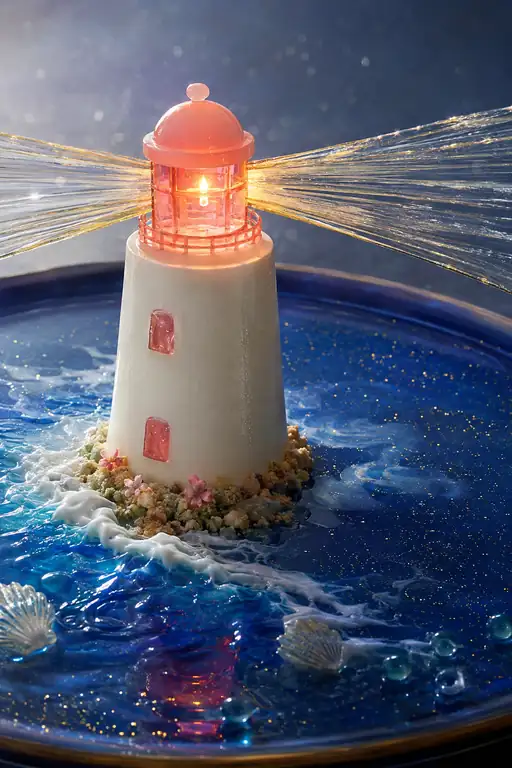 The Lighthouse Sends Sugar Light to Sea
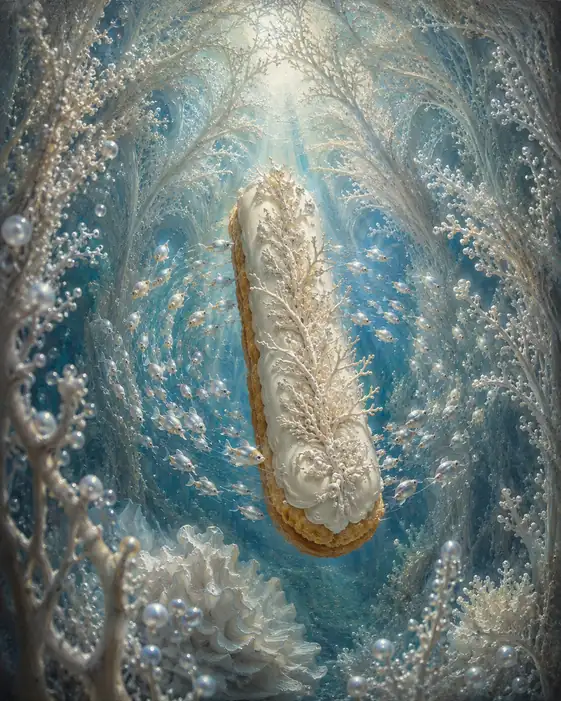 Where the Sea Learns Reverence
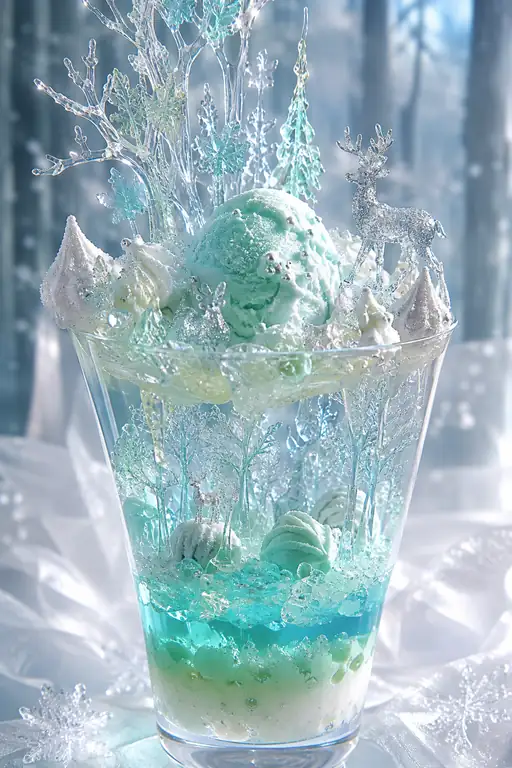 Winter Grows Beyond the Glass
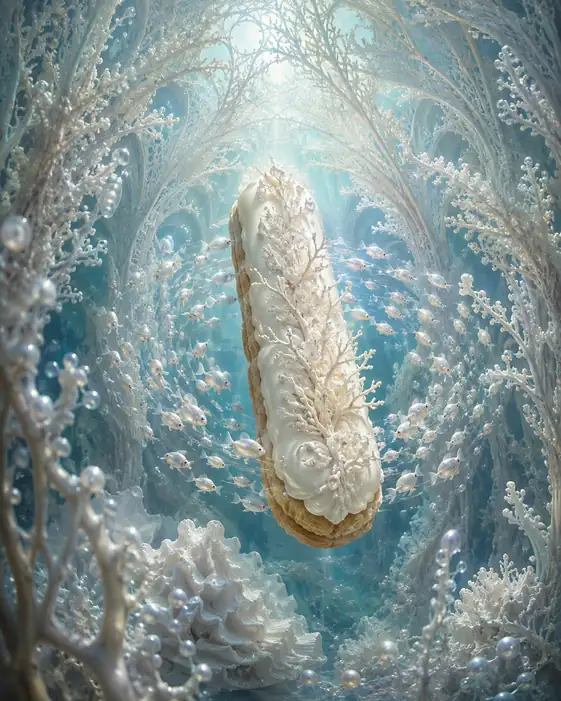 The Stillness All Lives Choose
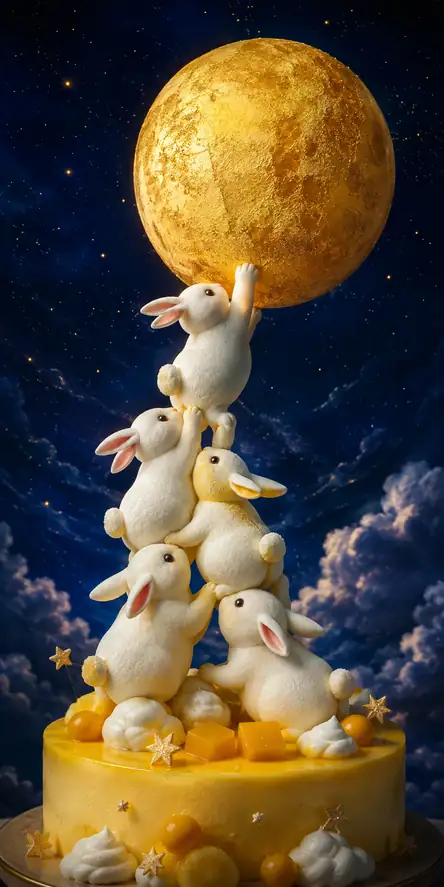 White Rabbits Build a Ladder to the Moon
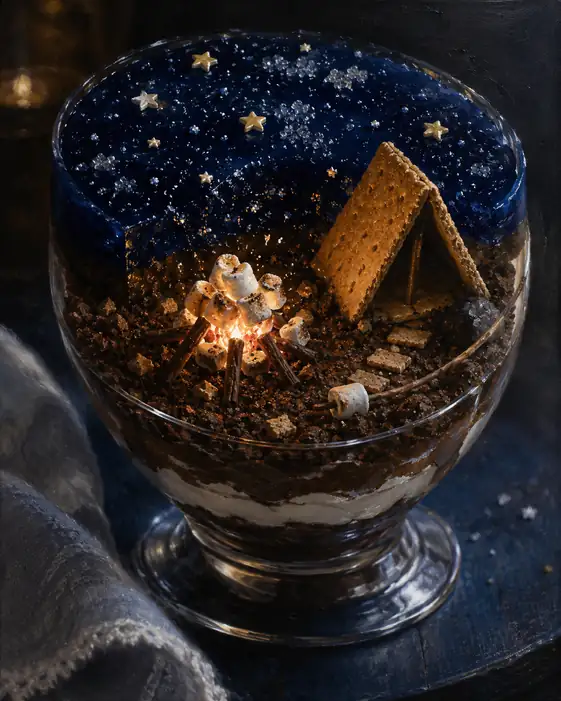 Under a Sky Small Enough to Taste
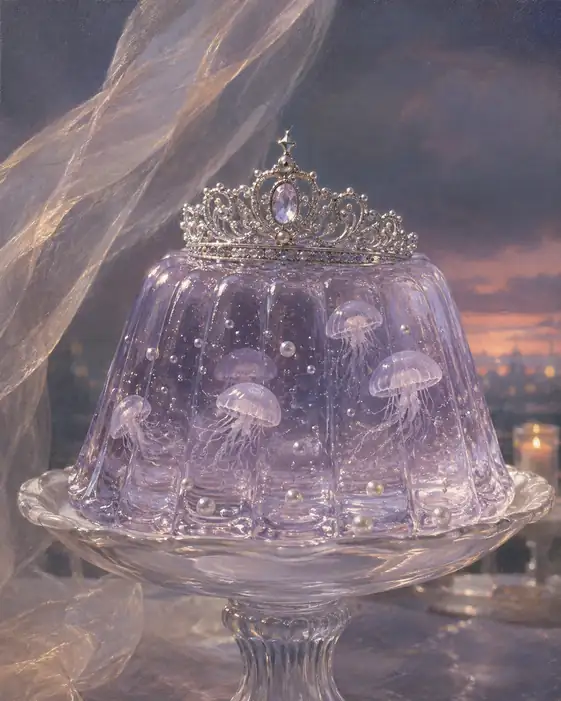 The Crown above the Unruled Sea
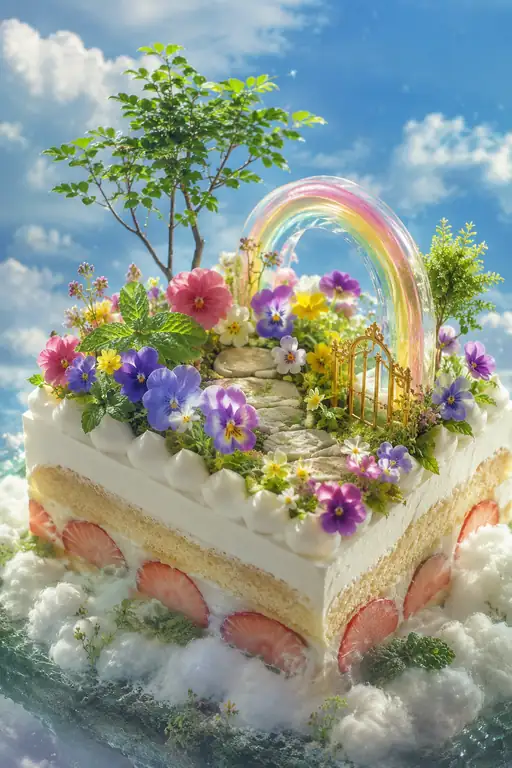 A Rainbow Garden Rises from the Cake