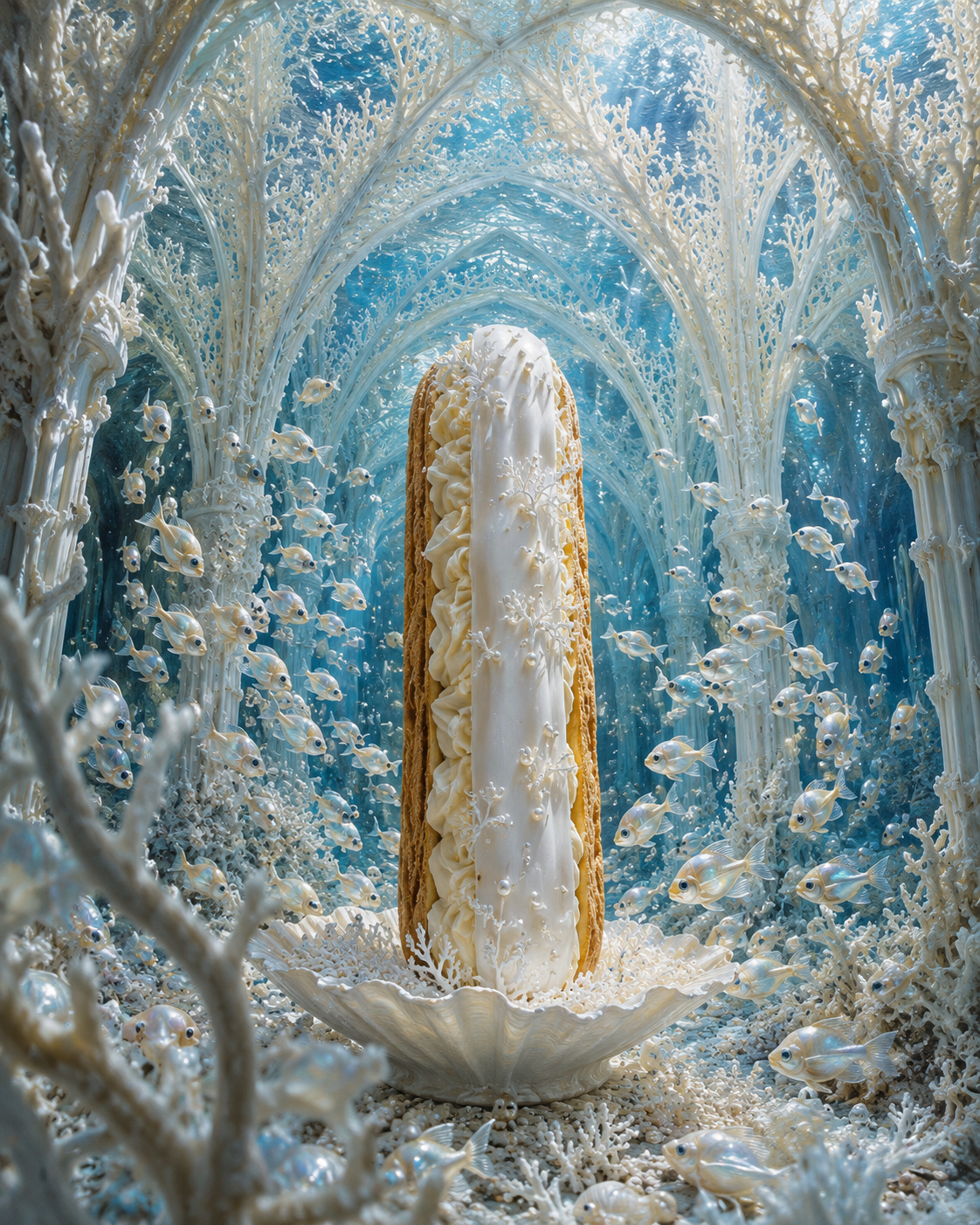
Where the Reef Learned to Pray
Critique
Introduction This tall white pastry stands within an underwater cathedral of coral arches. Pale fish swim through the blue interior as the confection rises from a shell base. The frontal composition combines food, sacred architecture, and marine life in a luminous sanctuary. Description The central object resembles a narrow eclair or upright shell, with brown pastry edges enclosing abundant folded white cream. Tiny coral branches and pearl beads decorate its smooth front. A broad white shell supports it at the seabed. Around it, pointed arches repeat into the distance, their columns formed from branching ivory coral. Schools of small silver-white fish move across both sides and behind the central form. Analysis The dominant vertical pastry aligns with the cathedral’s central aisle and repeated pointed vaults. Symmetry provides solemn stability, while differently directed fish introduce lateral motion. White and pale gold stand against luminous aqua, creating clarity without harsh contrast. Crisp pastry, soft cream, porous coral, smooth pearls, translucent fish, and granular seabed produce varied textures. Receding arches and smaller fish create deep perspective. Interpretation and Evaluation The image treats nourishment as an object of reverence. The pastry occupies the place of an altar or relic, yet surrounding fish keep the sanctuary alive rather than static. Architecture appears grown from marine material, joining construction with ecology. Precise repetition, controlled depth, and fine surface distinctions demonstrate technique, while the fusion of cathedral and reef offers ambitious originality. Conclusion What first appears to be elaborate underwater fantasy gradually becomes a study of devotion within a living environment. Central stillness is sustained by continuous movement around it. Geometry, restrained color, and the dialogue between edible softness and coral structure make the invented sanctuary coherent.
Same Subcategory
 The Lighthouse Built from a Thousand Layers
Similar Artworks
 Where the Sea Learns Reverence
 The Stillness All Lives Choose
 Where Every Tide Returns Home
 Tomorrow Glows on the Sweetest Shore
 Where Lantern Windows Cross the Abyss
 Until My Light Reaches You
 The Sea Remembers My Reflection
 A Bouquet from the Coral Moon
 Last Train Beneath the Sleeping Sea
 A Reef Gathered as a Gift