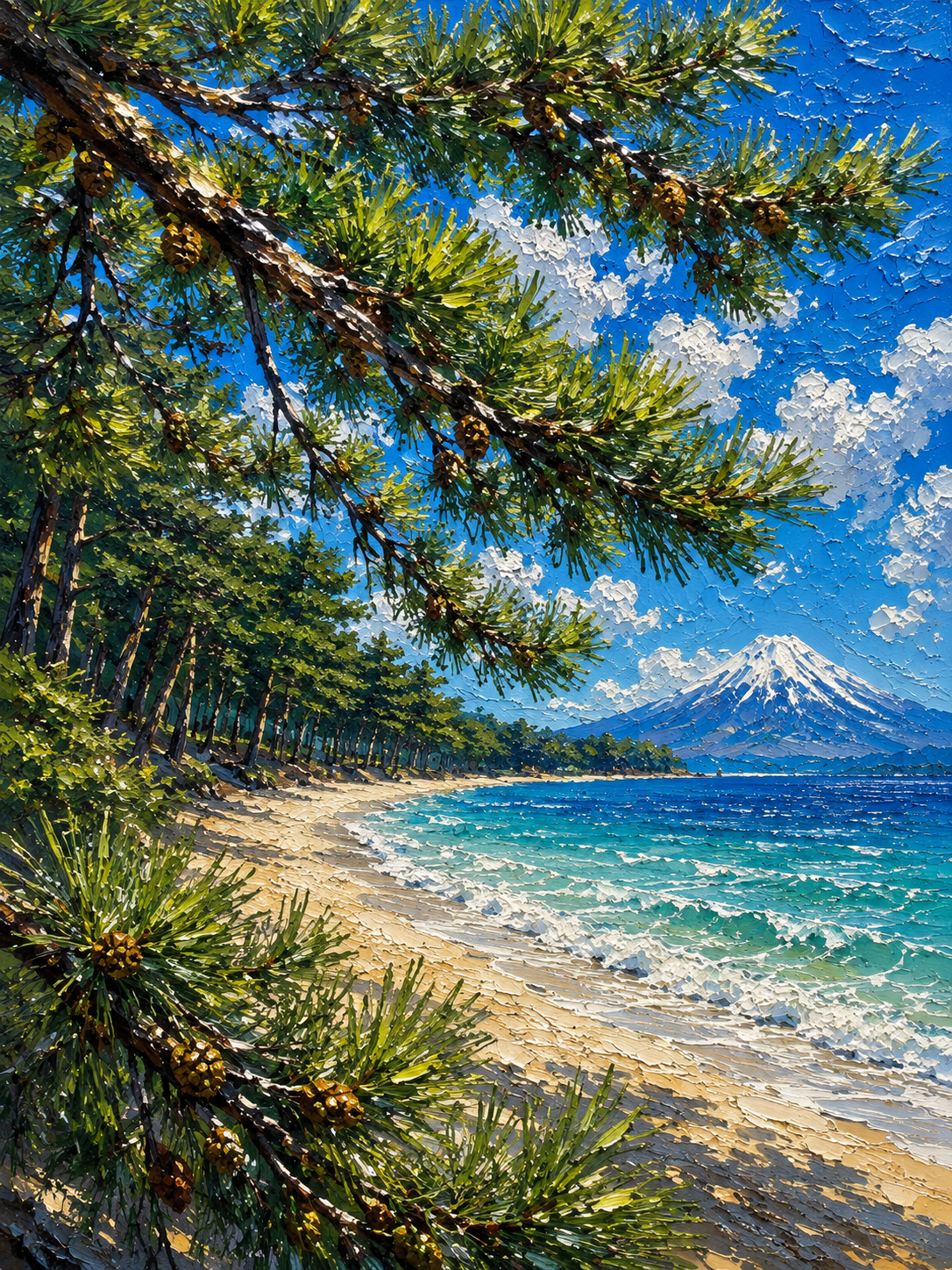
Beyond the Pines, Eternity Turns Blue
Critique
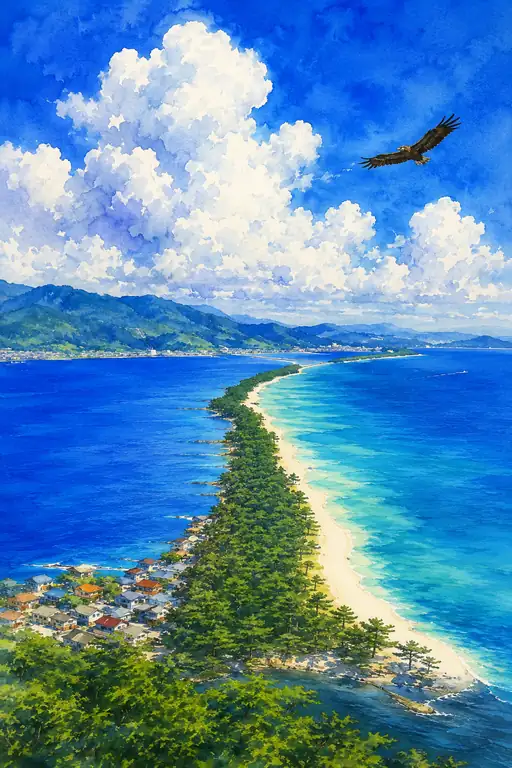
Introduction This work is a coastal landscape viewing snow-capped Mount Fuji through a frame of pine trees. Beach, blue sea, dark branches, and distant mountain are organized as a lucid panorama. Familiar elements of Japanese scenery are united around a sense of natural breadth and quiet, clear weather. Description Dark green needles and brown trunks fill the foreground, opening between them onto pale sand and luminous water. Waves approach the shore as repeated white lines, while the sea deepens in blue toward the horizon. Mount Fuji forms a calm focal point beneath drifting clouds, its white summit rising above a broad blue base. Analysis Pine branches along the upper and left edges act as a natural frame directing vision toward the open sea and mountain. Successive zones of dark green, bright blue, and pale blue-white create considerable depth. Short marks in the needles, rhythmic wave lines, and the mountain's stable triangle establish contrasting but balanced visual tempos. Interpretation and Evaluation The aged pine, continuously moving water, and seemingly motionless mountain suggest different scales of natural time. Descriptive skill appears in the needles and surf, while compositional strength comes from the boldly cropped foreground. A restrained blue-green palette remains clear, and visible painterly texture prevents the image from becoming photographically rigid. Originality lies in making a celebrated view feel like a private discovery through the branches. Conclusion Overall, the work arranges emblematic Japanese scenery into a measured progression from near detail to distant monument. Mount Fuji dominates at first, but sustained viewing shows that the pine frame and patterned waves create the panorama's depth. The contrast between open water and weighty branches communicates expansiveness and calm together. Composition, color, and technique quietly express familiarity with place and respect for nature.
Same Subcategory
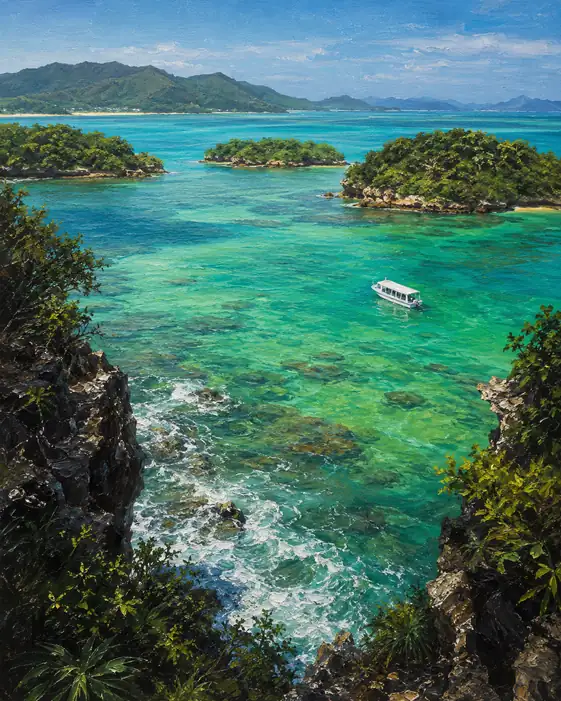 The Emerald Bay Holds Its Breath
Similar Artworks
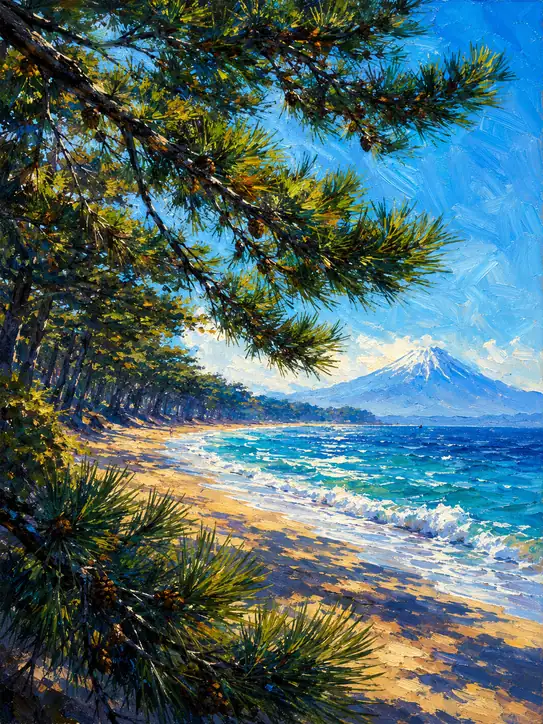 Pine Shadows Frame the Blue Road to Fuji
 Sentinels of the Ebbing Tide
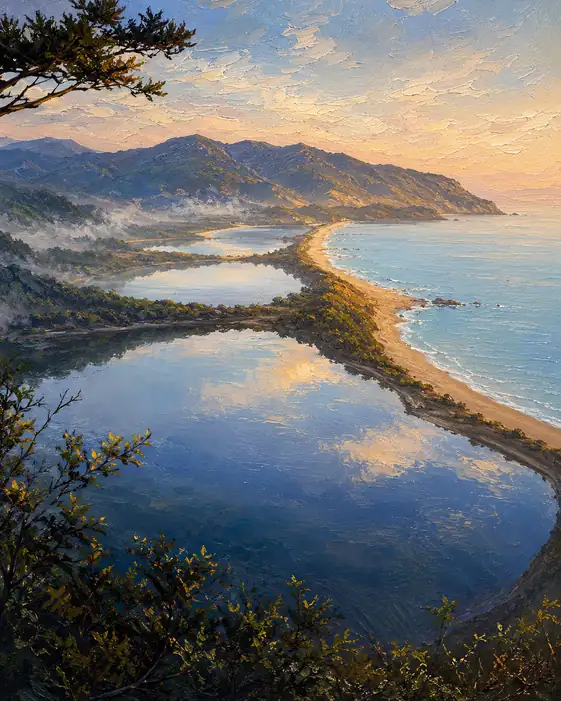 The Coast Draws a Line Between Two Dreams
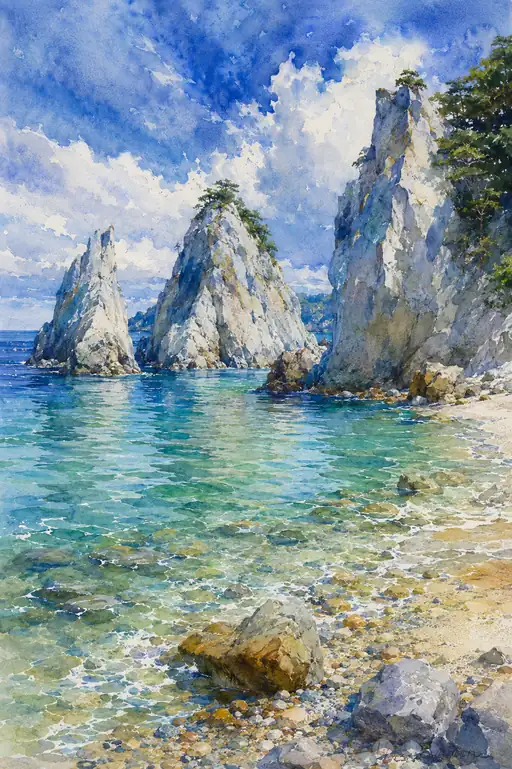 Where Time Stands Still on the Emerald Shore
 Sculpted by the Winds of Time
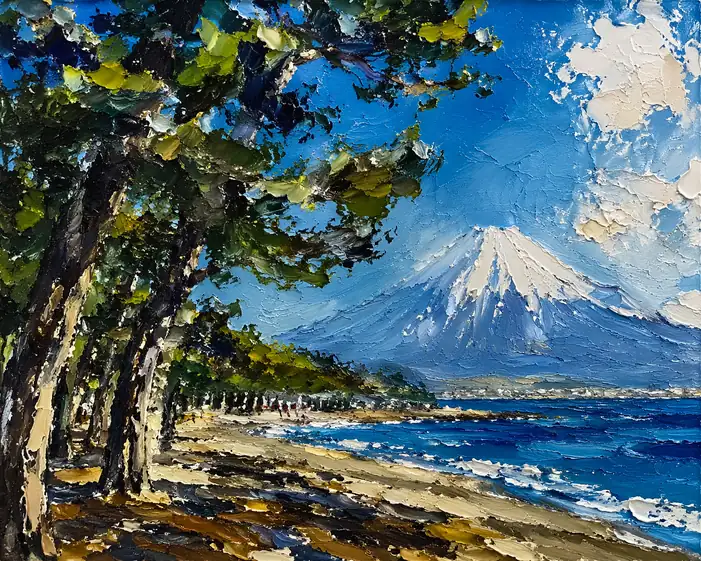 Majestic Shoreline Echoes
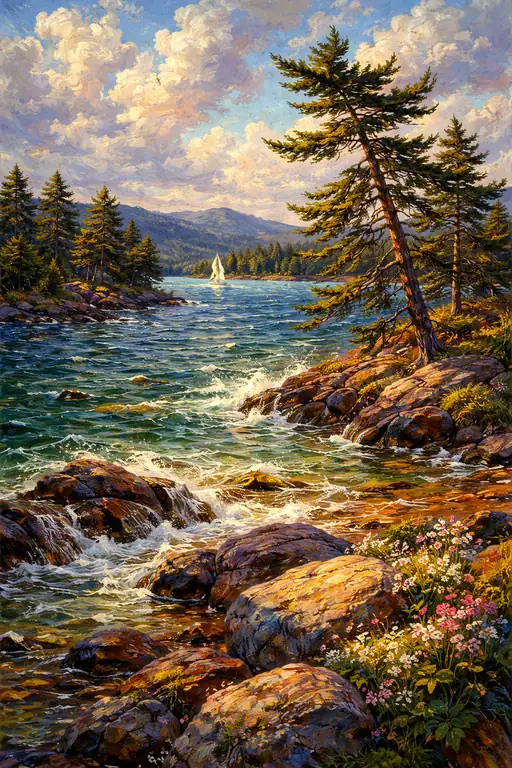 Whispers of the Windswept Shore
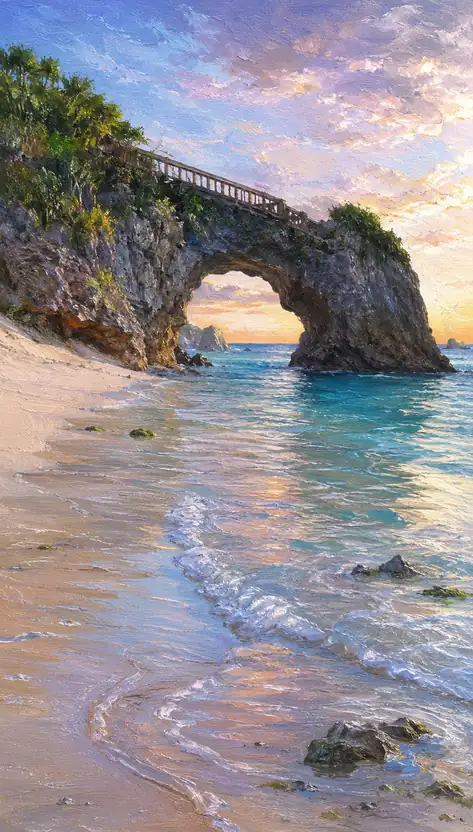 Evening Passes through the Stone Arch
 Sailing the Cobalt Summer Sky
 The Wind's Path Across the Blue