
The Sound That Became Light
Critique
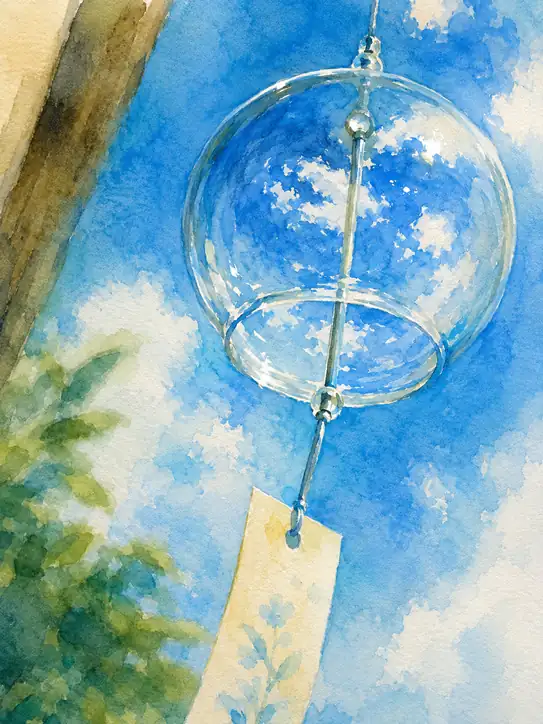
Introduction This painting presents a glass wind chime hanging beneath the eaves. The sphere above and its inverted reflection below establishes a clear focus, while transparent blue-green and pale gold conveys the time and atmosphere. The familiar motif invites both observation and reflection. Description Foreground forms are precise, while distant areas soften into atmosphere. Thin color used for glass refraction and moving water determines the surface character and clarifies changes of distance. Open areas prevent the detail from becoming crowded. Analysis The composition depends on the sphere above and its inverted reflection below, producing stability without sacrificing movement. The palette is organized around transparent blue-green and pale gold, and light-dark contrasts emphasize the focal area. Descriptive skill appears in the distinction between illuminated and shadowed surfaces, while thin color used for glass refraction and moving water adds rhythm to the space. Interpretation and Evaluation The scene can be interpreted as a meditation on an attempt to translate the suggestion of sound into vision. Although the imagery remains concrete, light, scale, and distance give it an imaginative dimension. The composition supports the subject, while the chosen viewpoint gives the work an individual character. Its value lies in joining observation with personal interpretation. Conclusion The work succeeds through the coordination of drawing, composition, color, and technique. Rich detail never obscures the main structure, so distant impact and close discovery remain in balance. An initial impression of visual beauty gradually develops into an awareness of an attempt to translate the suggestion of sound into vision. The result is a poised image that offers immediate pleasure as well as sustained reflection.
Same Subcategory
 Three Suns Wait Inside Amber
Similar Artworks
 Wind Chimes Ring the Visible Light
 The Wind Chime Borrows the Stream's Cool Breath
 The Wind Chime Writes Sunlight on the Path
 The Wind Chime Carries Wisteria into Morning
 One Raindrop Changes the Whole Forest
 The Basin Where Autumn Offers Flowers
 Two Swimmers in the Summer Sky
 Singing with the Blue Sky's Wind
 Whispers in Glass and Summer Breeze
 The Wind Chime Rings the Sunset into the Room