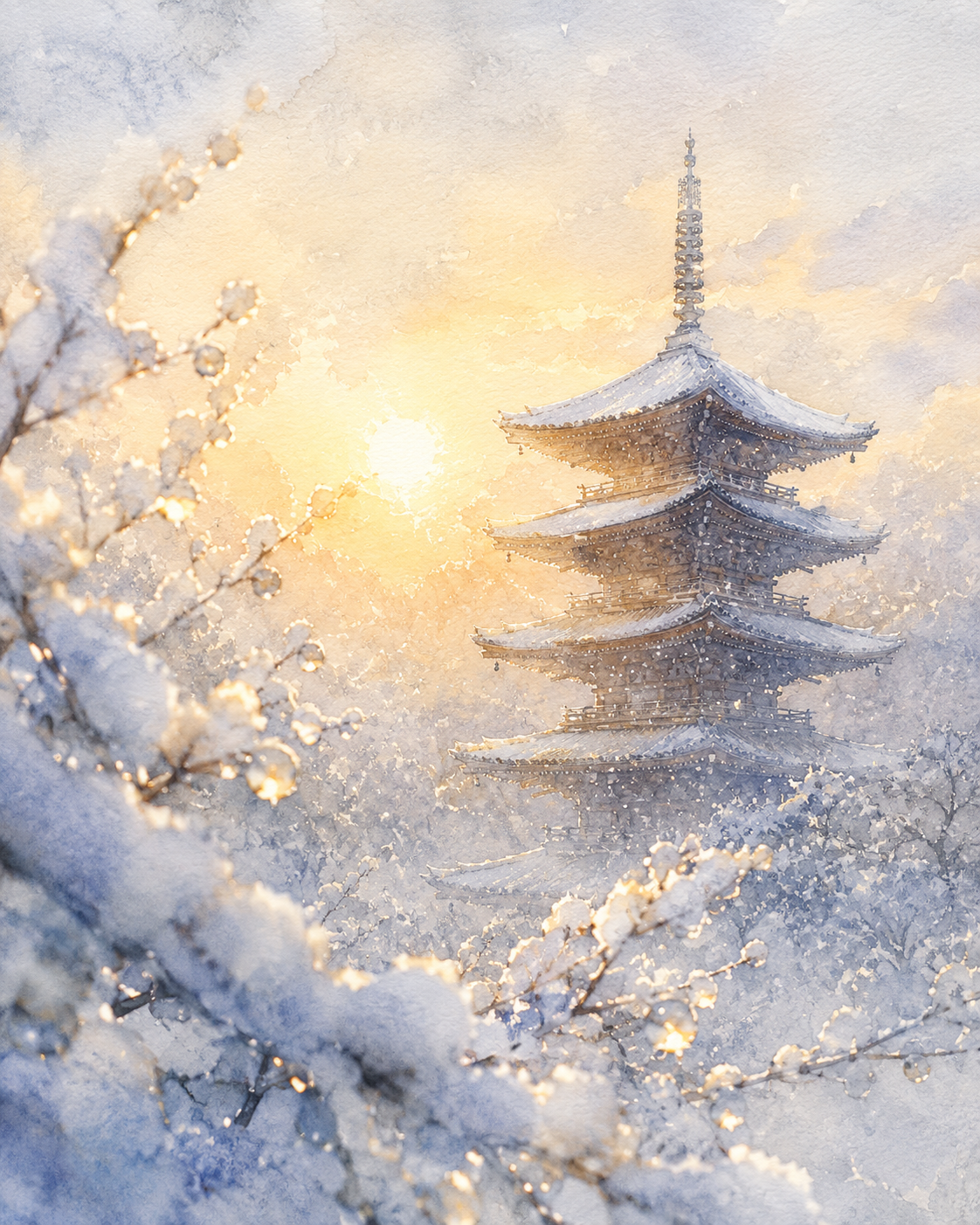
The Pagoda Dissolves into Snowlight
Critique
Introduction This view sets a pagoda against sun, framed by snow. Architecture and weather share a palette, making the building emerge from atmosphere. Warm light tempers winter. Description The pagoda occupies the right center, its stacked roofs covered in snow and crowned by a slender finial. The sun glows to its left behind cream and gray clouds. Thick snow coats branches sweeping across the left foreground and lower edge; small rounded forms resemble white blossoms and carry translucent drops. Fine flakes fill the air, while distant trees dissolve into blue-gray mist. Analysis The pagoda’s strong vertical ascent is articulated by repeated horizontal roofs, producing a measured rhythm against irregular branches. The foreground bough creates a broad diagonal that partially screens the building and deepens space. Cool blue shadows describe snow volume, while gold rim light marks roof edges, buds, and airborne flakes. Soft washes merge distant vegetation with sky; sharper architectural lines preserve the pagoda’s structure without making it rigid. Repetition connects stacked eaves with layered branches. Interpretation and Evaluation The enduring architecture and transient snow naturally invite reflection on permanence and change. Yet the pagoda is not represented as untouched by time: snow covers it, mist obscures its base, and light continuously alters its surfaces. The foreground forms resemble spring blossoms, allowing winter to carry a visual promise of renewal. This resemblance is romanticized, but the heavy snow and muted blues prevent easy sentimentality. Conclusion At first the pagoda appears as a stable monument within a radiant winter scene. Longer viewing reveals how thoroughly it participates in weather, light, and obscurity. The painting finds continuity not in resisting change, but in remaining recognizable while every surface is temporarily transformed.
Same Subcategory
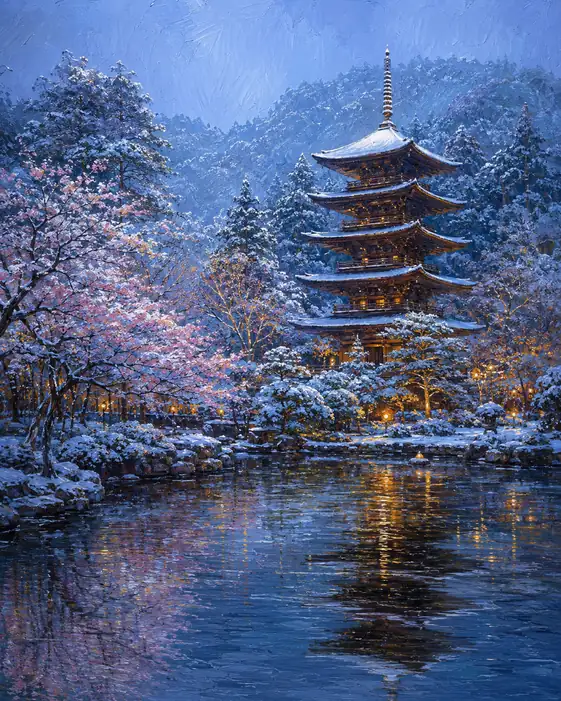 Winter Blossoms Around the Golden Pagoda
Similar Artworks
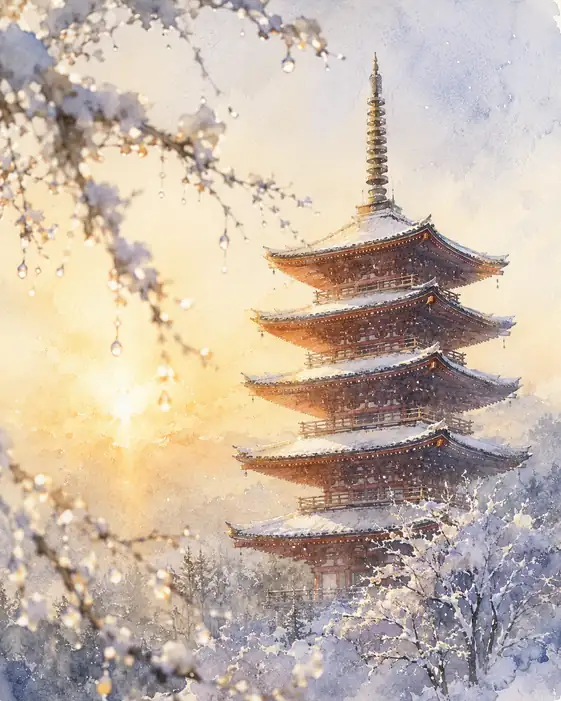 Five Stories of Winter Light
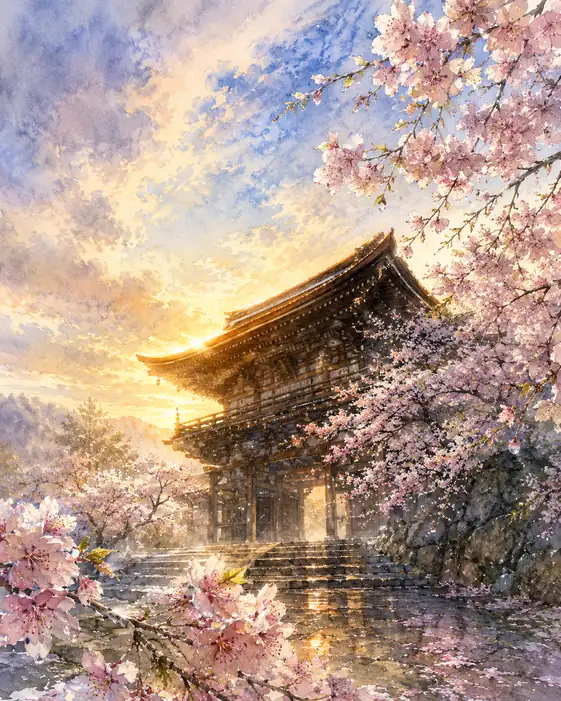 Spring Knocks on the Ancient Gate
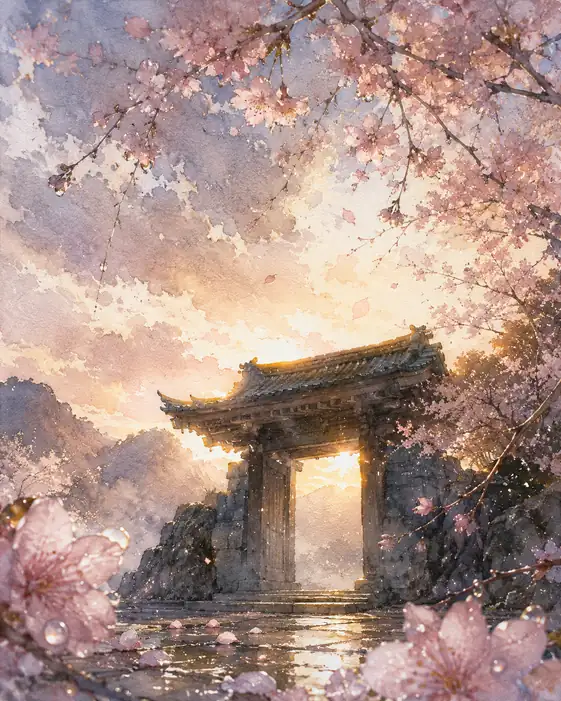 The Gate Opens into Cherry Mist
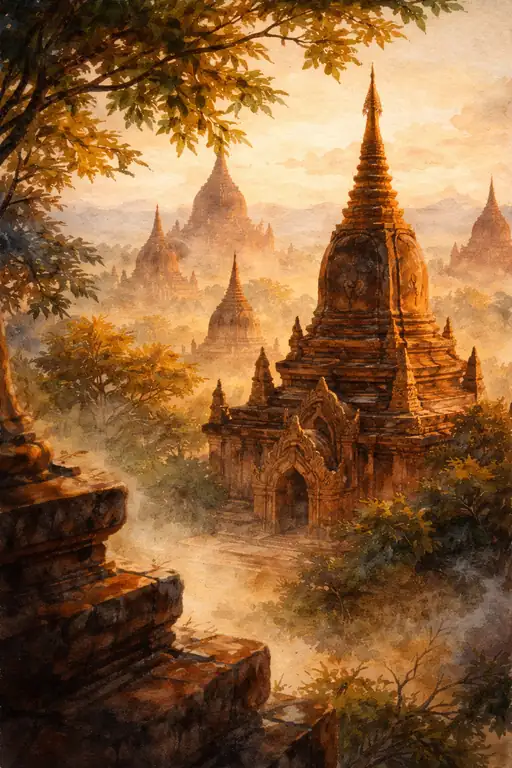 Golden Echoes of Bagan's Heritage
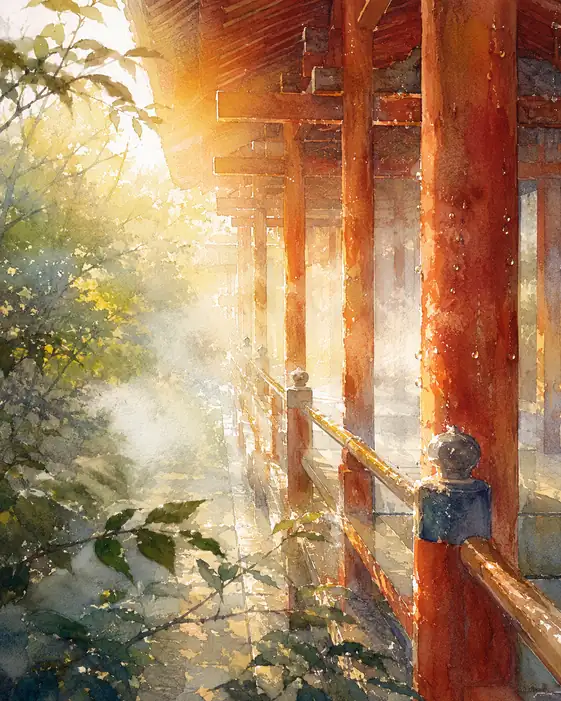 Morning Walks the Empty Corridor
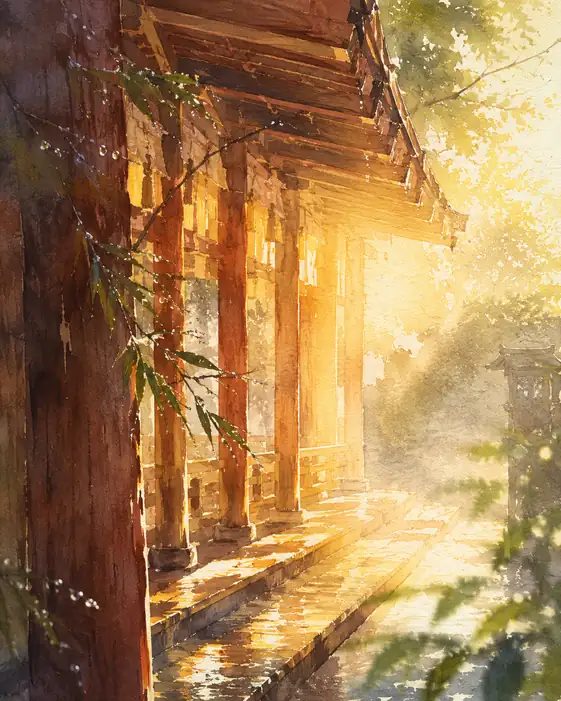 Morning Walks the Temple Corridor
 The Temple Morning Beyond the Rain
 Rain Writes the Old Town Quietly
 Snow and Flowers Guard the Five Stories
 Aurora Dancing over the Frozen Peak