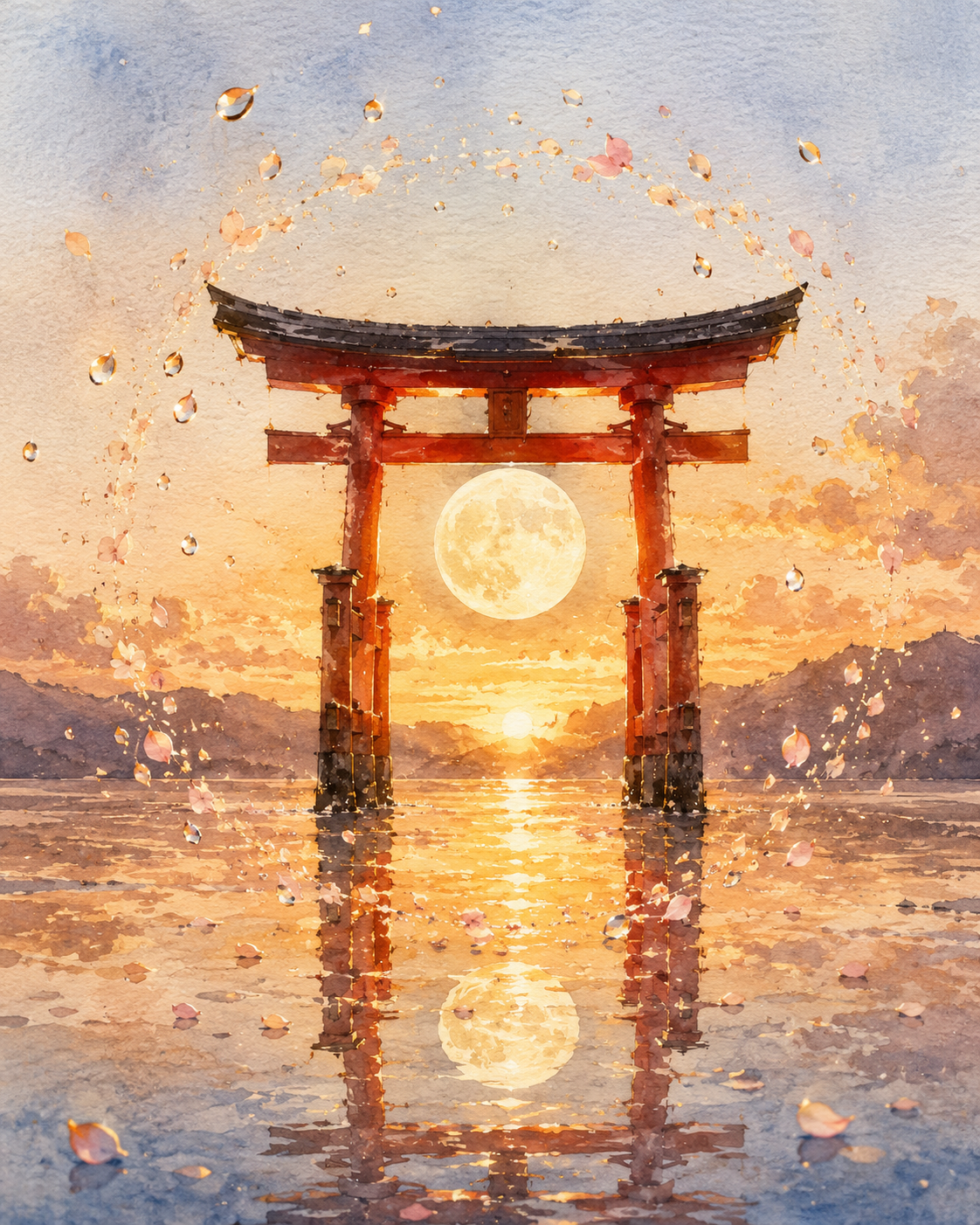
The Moon Passes through the Sacred Gate
Critique
Introduction This waterscape aligns gate, moon, sun, and reflections. Petals and droplets arc around the architecture. Impossible in ordinary time, its symmetry imagines a threshold between states of light. Description A red gate rises from shallow water at center, backed by distant purple mountains. A large pale moon hangs within its opening, while a smaller sun touches the horizon below. Both appear again in the reflective foreground together with the gate’s dark uprights. Pink petals and clear drops sweep overhead and descend along both sides, completing a loose ring. Analysis Near-perfect bilateral symmetry grants the image ritual stillness. The gate’s columns establish strong verticals; roof beams and horizon provide horizontal counterweights. Circular moon, sun, droplets, and petal arc soften this rectilinear structure. Warm orange dominates sky and reflection, while gray roof tiles and violet mountains control saturation. The reflected gate lengthens the central axis and turns water into a second, inverted realm. Irregular floating petals keep the symmetry from becoming mechanical. Interpretation and Evaluation As a threshold, the gate naturally suggests passage between earthly and sacred, past and future, or day and night. The enlarged moon and simultaneous sunset make the scene allegorical rather than observational. Its visual logic remains coherent because every element participates in alignment and reflection. Symbolic density is high, yet water’s broken surface and the fragile petals introduce impermanence into the monumental frame. Conclusion At first the spectacle appears governed by perfect cosmic order. Longer viewing reveals instability within that order: petals fall, drops descend, and reflections tremble. The work becomes most engaging when the enduring gate is understood not as a fixed destination, but as a frame through which changing light continually passes.
Same Subcategory
 A Pilgrim Steps Beyond the Stone Dark
Similar Artworks
 Where the Moon Waits Inside Spring
 The Sun Waits inside the Torii
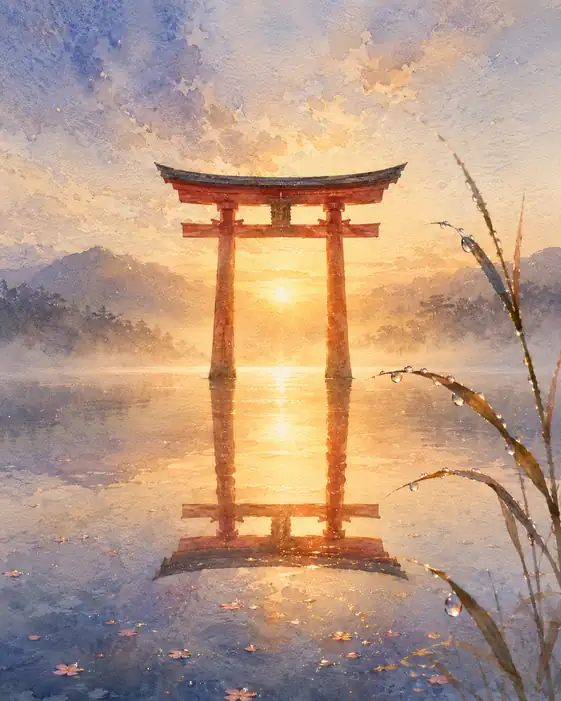 The Gate Between This Morning and the Next
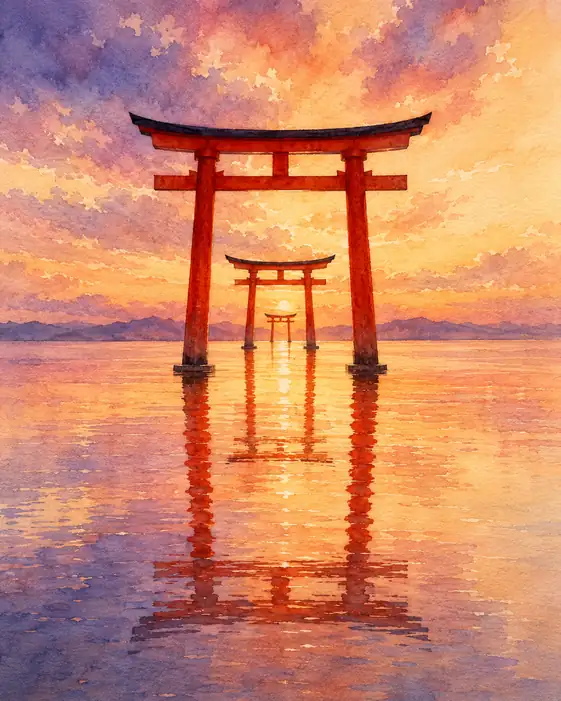 Gates to the Sunken Sun
 The Light Through Which I Pray
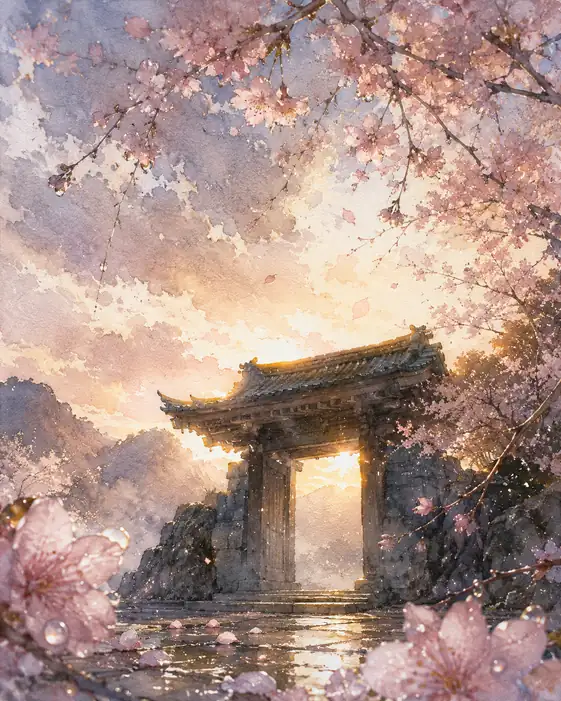 The Gate Opens into Cherry Mist
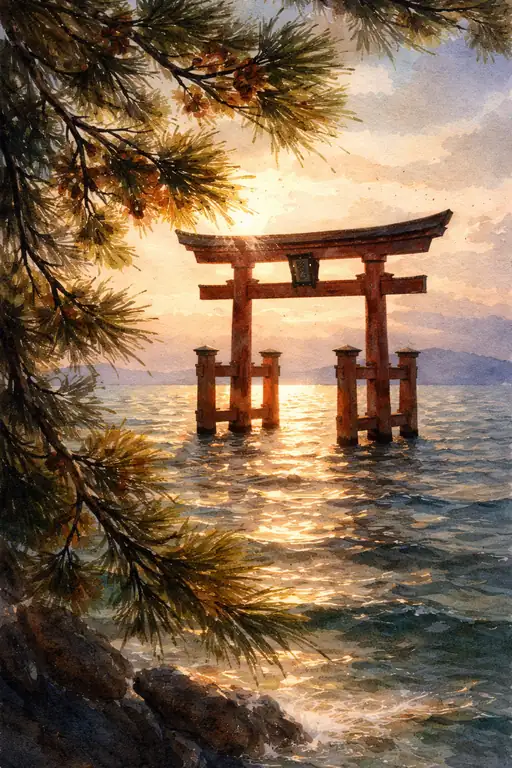 Whispers of the Golden Twilight
 Spring Knocks on the Ancient Gate
 Petals Turn the Morning into a Circle
 Two Prayers at the Edge of Winter