
The Wave Catches the Rising Sun
Critique
Introduction This seascape pairs a vast sun with a rising wave, making water and sky equally luminous. Its strongest quality is structural: wave curve, solar disk, and reflected path create a precise exchange between motion and stillness. Description A turquoise wave lifts across the lower half, its crest scattering suspended droplets against the horizon. Deep blue folds run through its face, interrupted by green light and white foam. A large pale sun rests low behind horizontal orange and violet clouds. Its reflection travels toward the viewer in broken gold strokes across darker water. Analysis The wave forms a broad diagonal arc from lower left toward center right, countering the sun’s stable circle and the horizon’s horizontal bands. The crest partially overlaps the reflected path, weaving foreground motion into distant light. Saturated cyan and ultramarine oppose orange and yellow, producing a vivid complementary tension. Small circular droplets echo the solar disk at miniature scale. Layered dark strokes describe water volume, while reserved highlights distinguish surface glitter from the translucent light within the wave. Interpretation and Evaluation The painting stages a meeting of duration and instant. Sunset appears measured, while the wave exists briefly before collapse. Their shared luminosity suggests permanence and transience are different scales of change. The turquoise glow approaches fantasy, yet the trough’s weight, irregular foam, and horizontal swells preserve credibility. Conclusion At first the brilliant wave competes with the enormous sun for attention. Longer viewing reveals cooperation rather than rivalry: each gives the other shape, color, and scale. The work transforms a familiar sunset into an energetic meditation on recurring change, where every ending is carried forward by another movement.
Same Subcategory
Similar Artworks
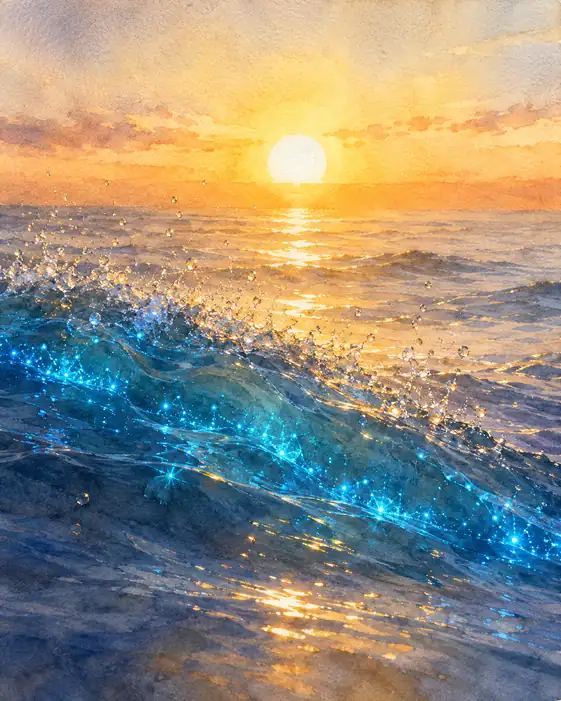 The Wave That Stole a Piece of Night
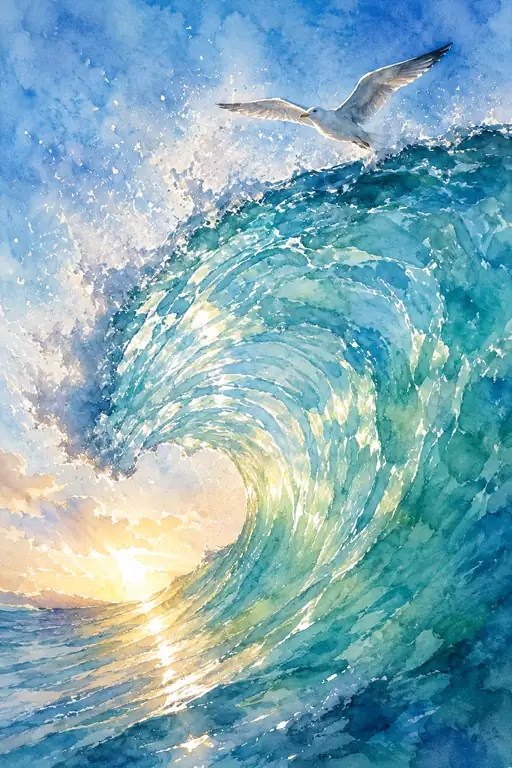 Wings over the Golden Crest
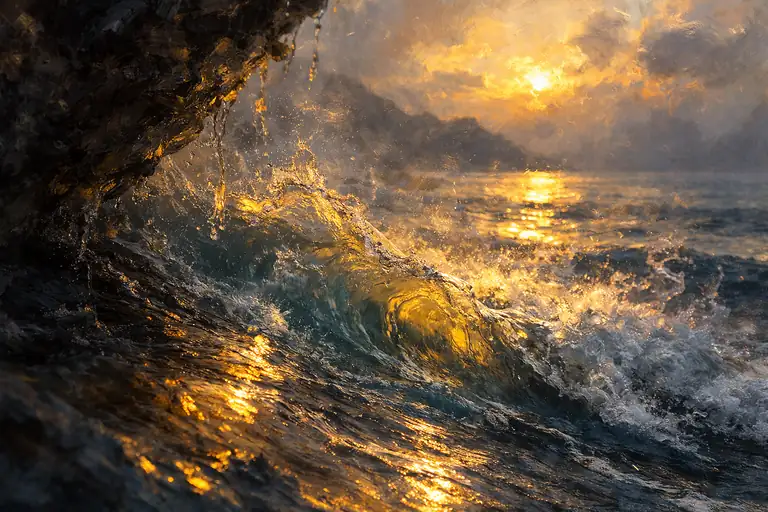 Crashing Waves at Golden Hour
 The Shell That Remembered the Rainbow
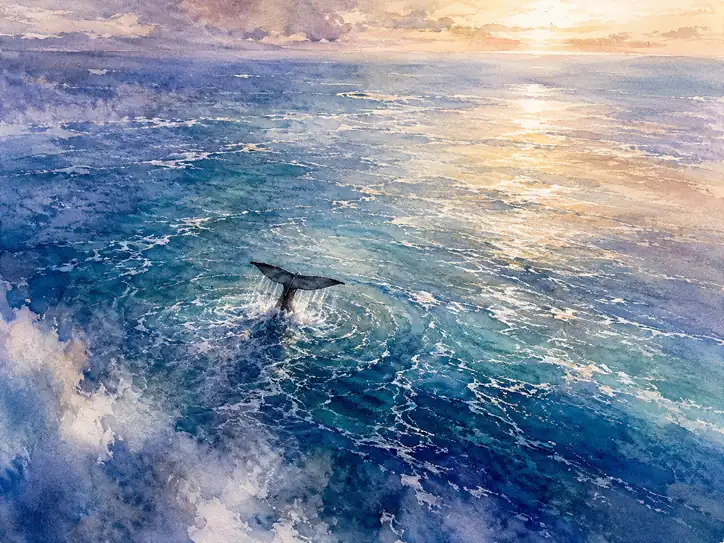 Farewell to the Evening Light
 Shattered Waves, Unbroken Light
 Gilded Crests of the Surging Deep
 Sunlight Dancing on the Splintered Turquoise Tides
 The Golden Wrath of the Sea
 Symphony of Sea Glass