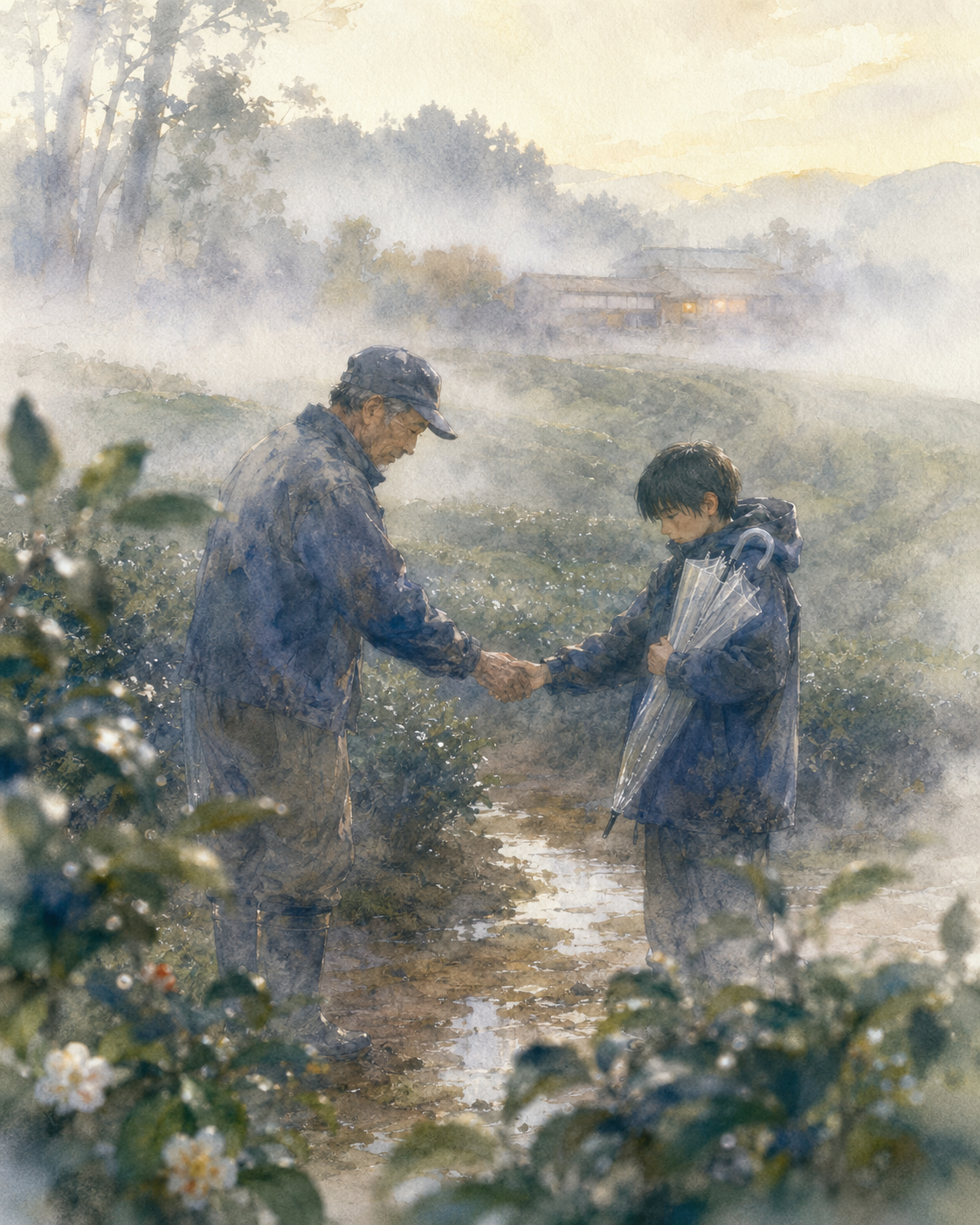
Hands Meet in the Tea Morning
Critique
Introduction This rural scene centers on a handshake between an older worker and younger visitor after rain. Their relationship is unexplained; meaning develops through posture, setting, and weather. A small contact occurs within a landscape shaped by patient labor. Description Two figures stand on a muddy path between low cultivated rows. The older figure at left wears a cap, work clothes, and tall boots; the younger figure at right holds a transparent umbrella against a dark jacket. Their right hands meet near the center, and both look downward. Mist veils trees, mountains, and a farmhouse whose windows glow faintly in the distance. Analysis The joined hands form the compositional hinge between two separately weighted bodies. Curving crop rows and the reflective path guide the eye from this gesture toward the house. Blurred foliage in the lower corners creates a close frame, while progressively softer washes establish recession. Muted blue, gray, and earth colors unify clothing with wet soil; the small warm windows offer a measured counterpoint. Reflections in puddles repeat the pale sky and bring light into the lower half. Interpretation and Evaluation The handshake might mark greeting, gratitude, agreement, or transferred responsibility. Its ambiguity is productive: bowed heads and practical clothing emphasize respect rather than ceremony. The umbrella suggests arrival, while mud-stained garments embed the older figure in the field. This remains suggestive, not absolute. Cool color and wet conditions control sentiment. Conclusion Initially the human exchange appears to dominate the scene. Longer viewing reveals that rain, furrows, house, and path all participate in its meaning, connecting the gesture to work and continuity. The painting dignifies cooperation by presenting it as ordinary, quiet, and rooted in place.
Same Subcategory
 The Path That Only Summer Knows
 Song of the Autumn Orchard
Similar Artworks
 Reflections of Early Summer
 The Ancient Green Awakens
 Melody of the Golden Fields
 Waiting for the Ripple of Time
 Morning Symphony of the Emerald Hills
 Hymn of the Sun-Kissed Earth
 Bountiful Hill of Scarlet and Gold
 Forest Voyage Across a Mirror of Rain
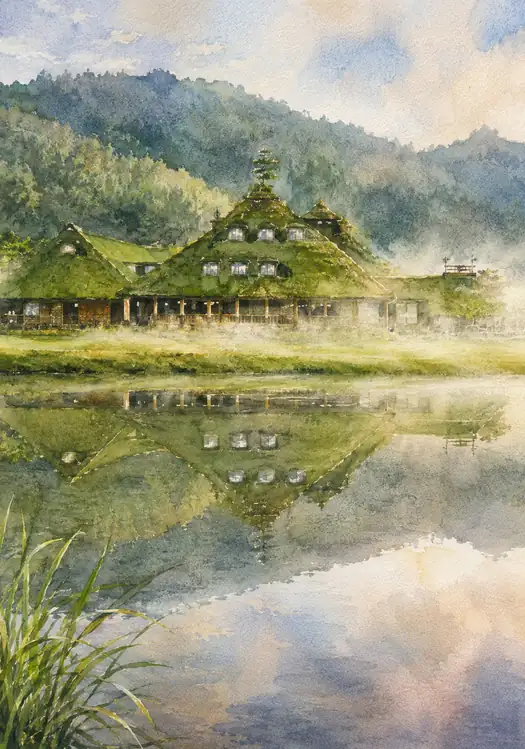 A House Dreams Twice in the Mist
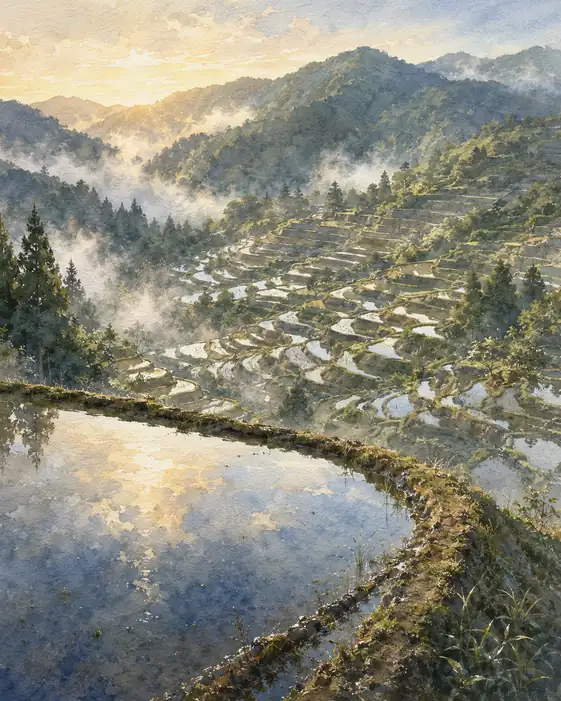 A Thousand Skies Sown on the Mountain