
Fuji Rises from a Sea of Dreams
Critique
Introduction This mountain view stages a meeting between night and dawn above clouds. The snowy peak provides a clear center, but the picture’s energy comes from the exchange between blue shadow and golden light. Description A broad conical mountain rises above layered clouds, its upper slopes streaked with snow. Warm light enters from the right, catching the summit and turning cloud edges peach and gold. The upper left remains deep blue and holds a slender crescent moon with scattered stars. Dark twigs, grasses, and leaves cross the lower foreground, each carrying bright droplets. Analysis The mountain’s stable triangle anchors a vertically layered composition of vegetation, clouds, peak, and sky. Light sweeps diagonally from lower right toward the summit, opposed by the cool blue field at upper left. This chromatic diagonal makes the time of day visually legible. Fine foreground branches create scale through contrast with the massive distant form. Repeated droplets echo stars and bright cloud breaks, joining near and far through points of light. Granulated washes give the clouds volume without hardening their edges. Interpretation and Evaluation The crescent moon and sunrise evoke a threshold when distinct times overlap. The peak appears enduring, while clouds, dew, and changing color register transience. This suggests continuity within change rather than conquest. Though the palette is idealized, cool shadows and irregular vegetation prevent a simple emblem. Foreground moisture translates cosmic transition into touchable detail. Conclusion At first the mountain seems to dominate as a sublime icon. Gradually, the eye recognizes a network of smaller correspondences: moon and droplet, snow and cloud, starlight and dawn. The work’s lasting appeal lies in this exchange of scales, where grandeur and delicacy illuminate one another.
Same Subcategory
 Where Gold Meets the Sky
Similar Artworks
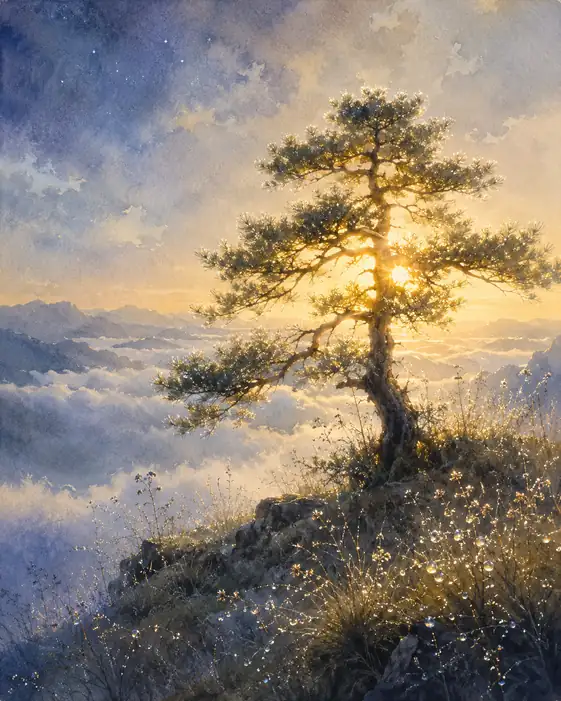 The Pine That Kept the Dawn
 Transcendence at Dawn: The Radiant Crown of the Peak
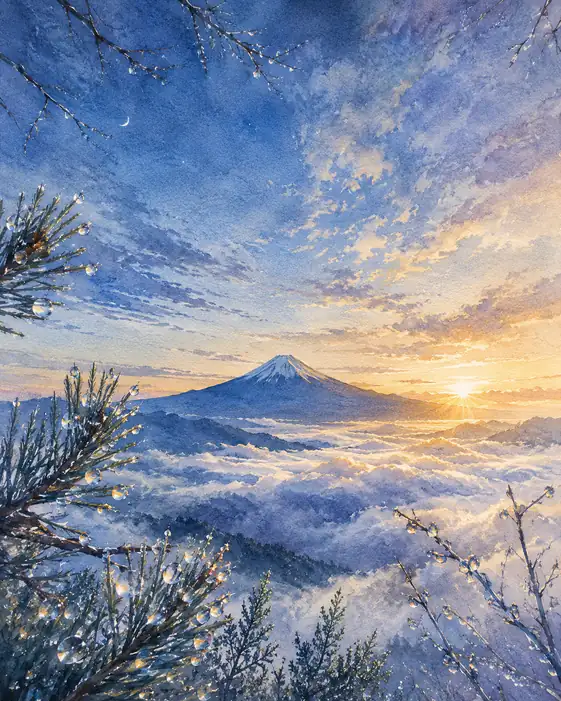 Reign of Light Above the Cloud Sea
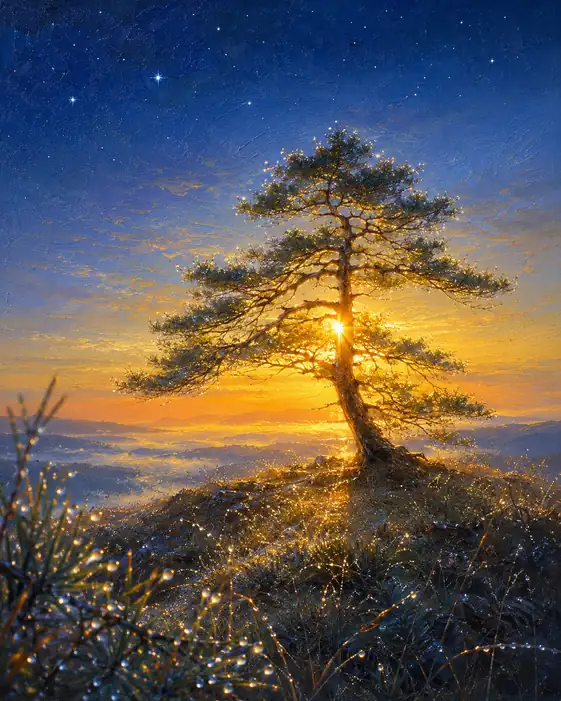 The Lone Pine Carries the Dawn
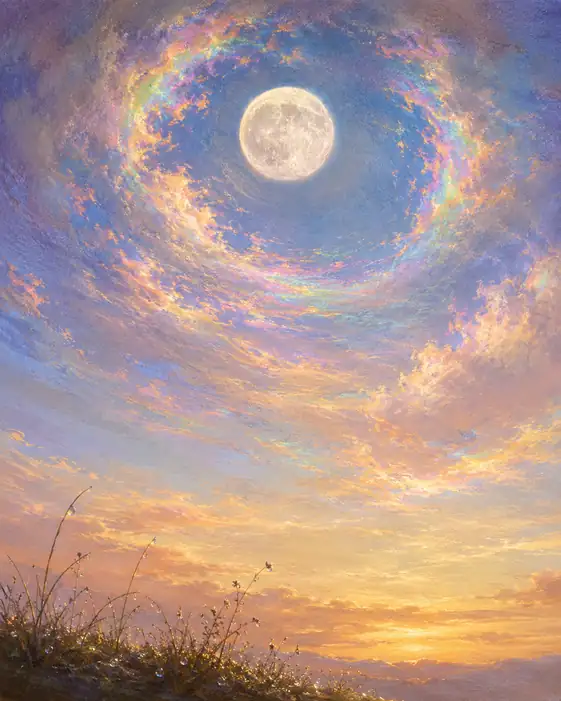 Full Moon Piercing the Iridescent Cloud Ring
 Dawn of the Serene Peaks
 The Crater Lake Receives the Evening
 Lunar Halo Intersecting the Twilight Sky
 The Burning Crown of the Alps
 The Gate Between This Morning and the Next