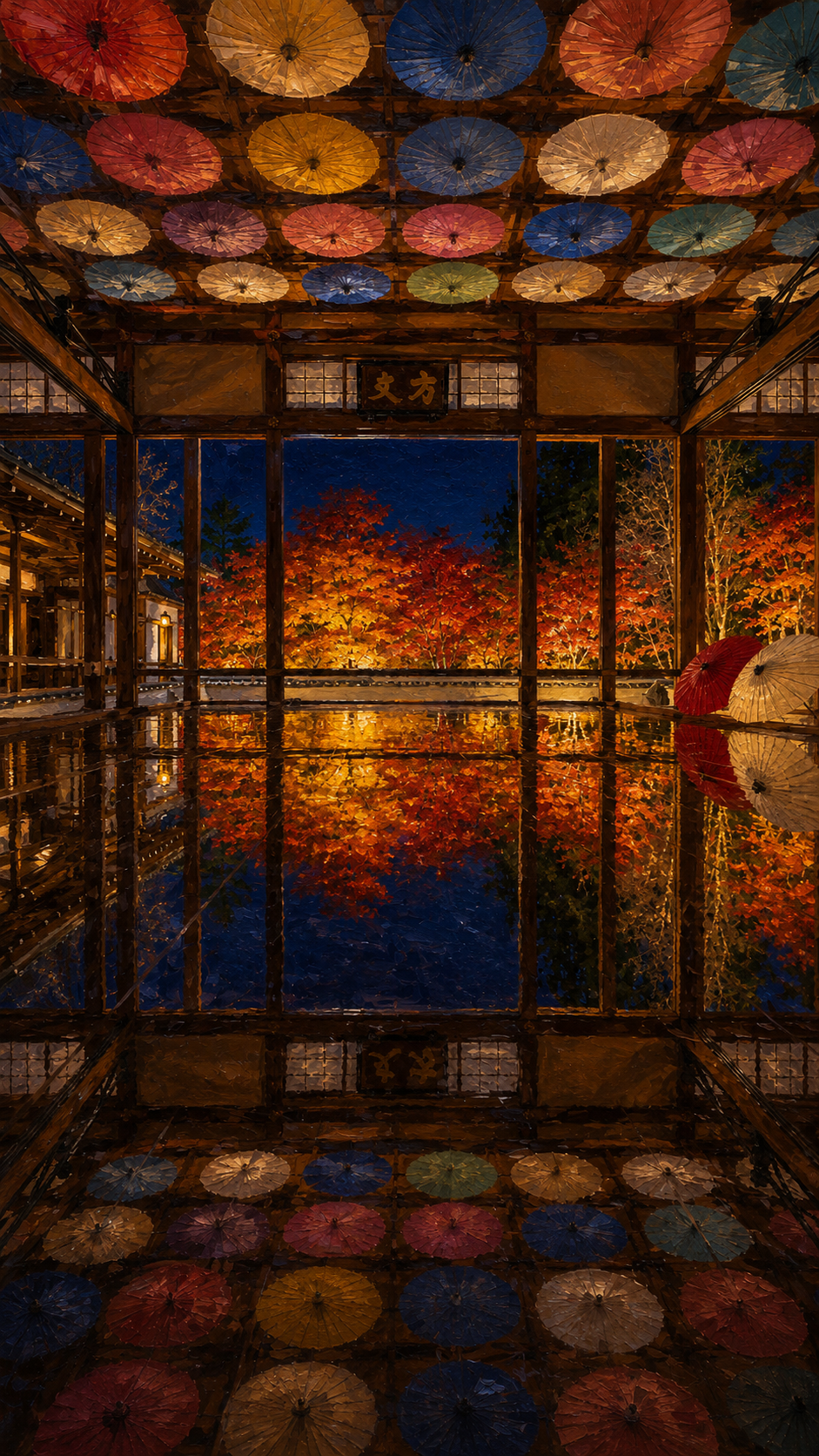
Night Arrives beneath the Painted Eaves
Critique
Introduction This painting presents a temple room opening onto autumn maples, beneath a ceiling densely patterned with colorful paper umbrellas. Its immediately legible setting is developed through a controlled painterly surface, inviting attention to both recognizable detail and atmospheric sensation. The work treats the scene as a sustained study of place, light, and visual memory. Description The palette is organized around scarlet, cobalt, gold, and dark timber brown. Near and distant elements are separated through shifts of scale, edge, and saturation, while small accents guide the gaze across the image. Reflections, foliage, masonry, water, or sky are described according to their position without losing the unity of the whole. Analysis The composition is governed by the gridded room framing a central outdoor view while circular umbrellas press overhead. This structure gives the scene depth and stability, yet asymmetrical details prevent it from becoming static. The technique is especially effective in repeated radial patterns, polished reflections, and crisp wooden divisions; passages of sharper definition alternate with softened areas, allowing light to function as both illumination and a means of spatial organization. Interpretation and Evaluation The scene balances observation with imaginative concentration. Its descriptive skill is evident in the separation of materials, while the color design establishes mood without excessive exaggeration. The composition is clear, the handling is varied, and the selective transformation of ordinary appearances gives the image a distinct, quietly original character. Conclusion What first appears to be a direct view gradually reveals a carefully ordered meditation on distance, atmosphere, and attention. Through disciplined color, coherent structure, and responsive brushwork, the painting turns a specific visible scene into an experience that rewards prolonged looking.
Same Subcategory
Similar Artworks
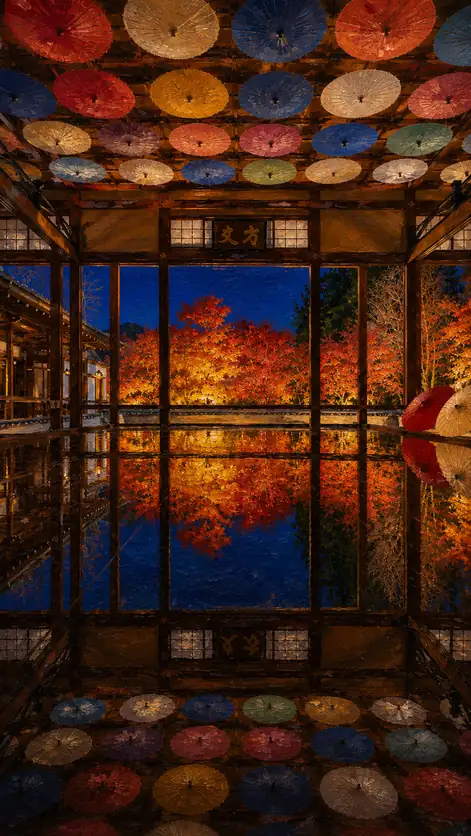 Red Leaves Wait beyond the Glass
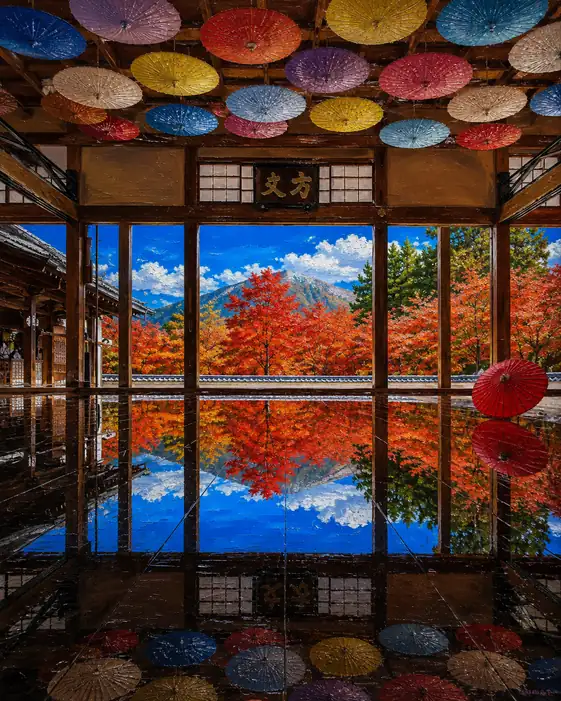 Where the Temple Stands Guard, Autumn Blooms Twice
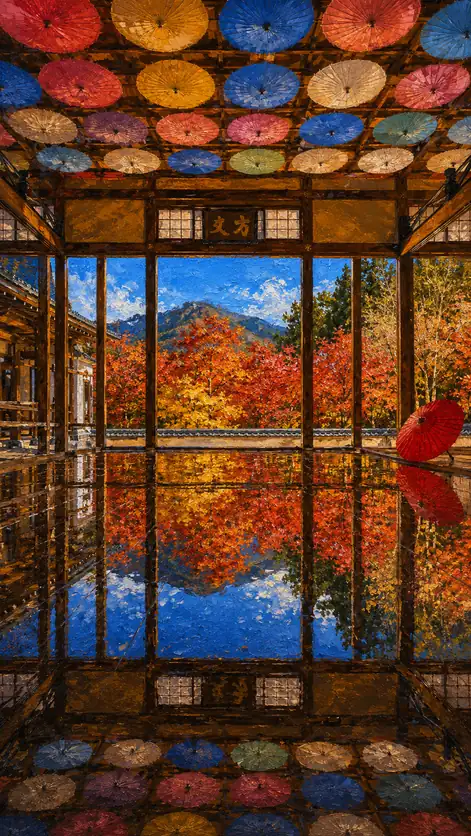 Autumn Reflected Twice
 The Room Where Evening Turns Gold
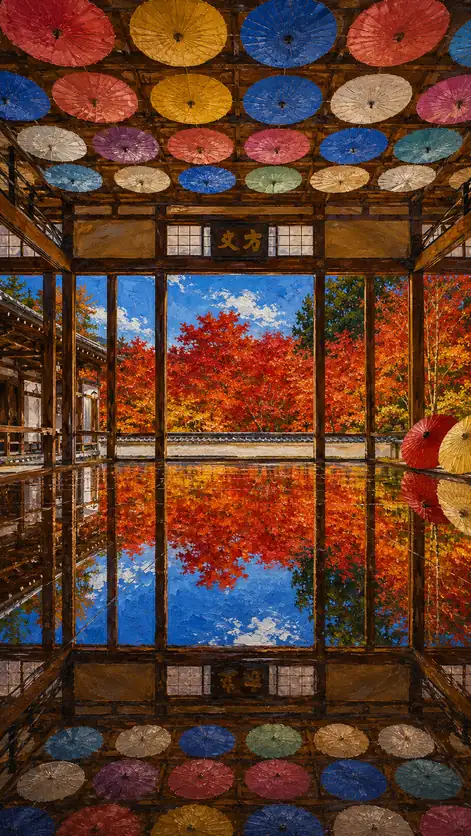 A Thousand Circles above the Crimson Lake
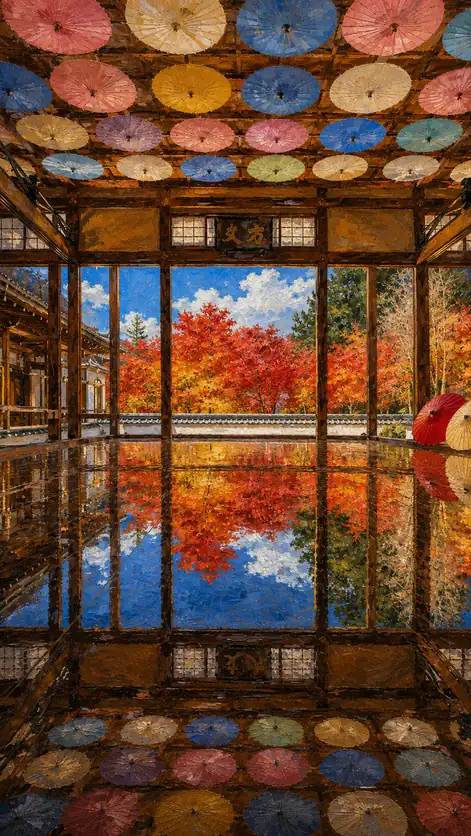 The Painted Ceiling Holds the Sunset
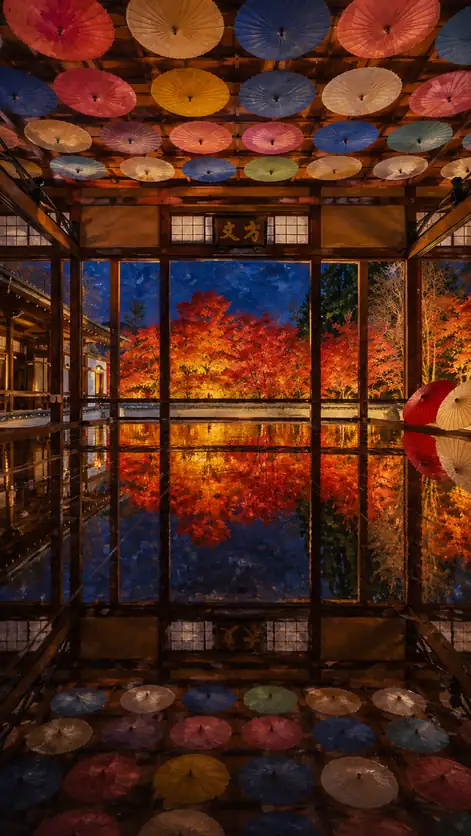 Umbrellas Gather the Autumn Evening
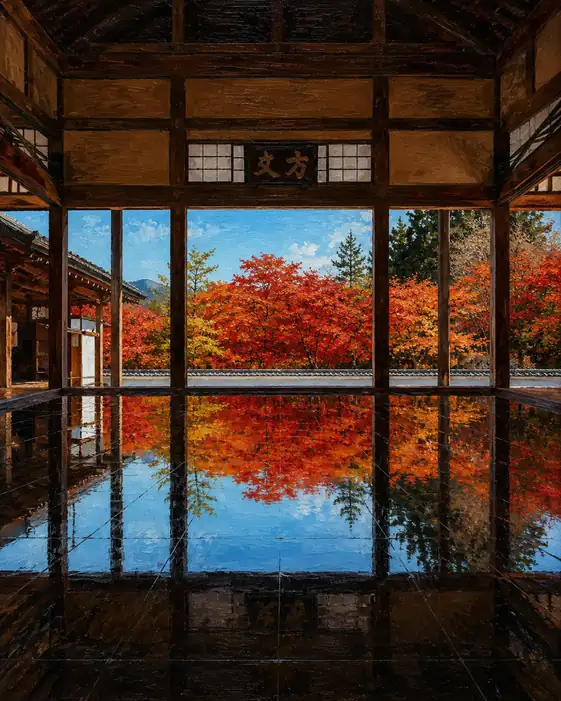 Autumn Enters through the Open Hall
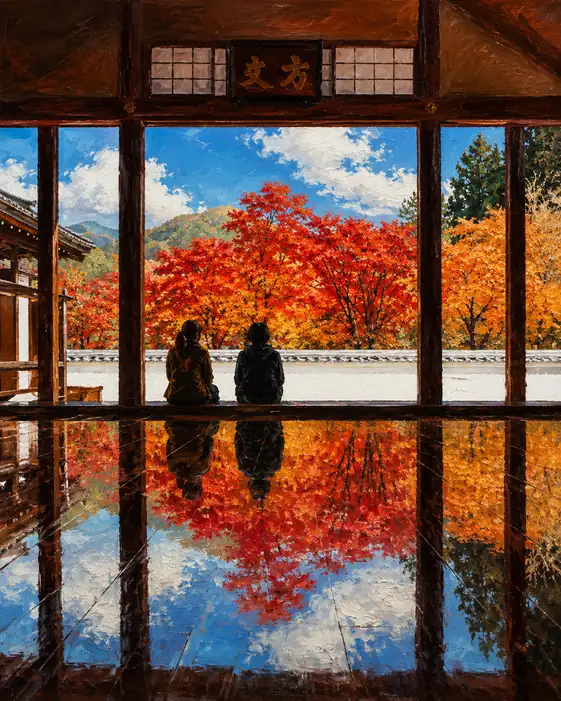 Two Silhouettes inside the Crimson Mirror
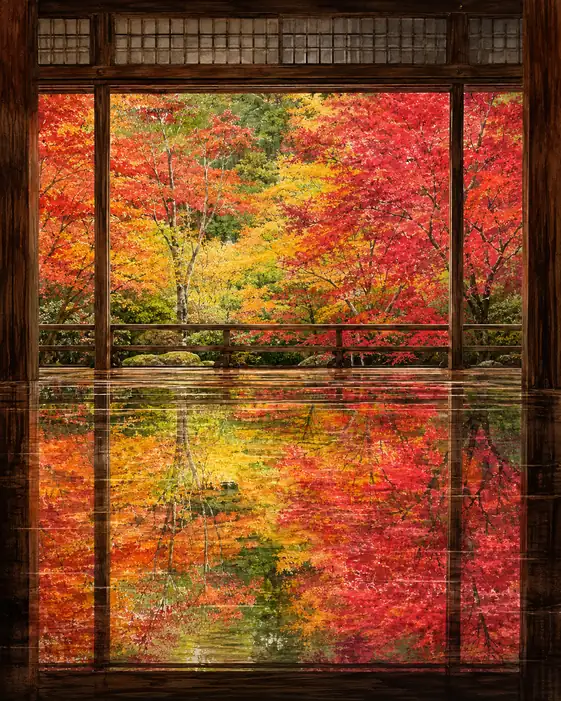 Autumn Waits behind the Quiet Frame