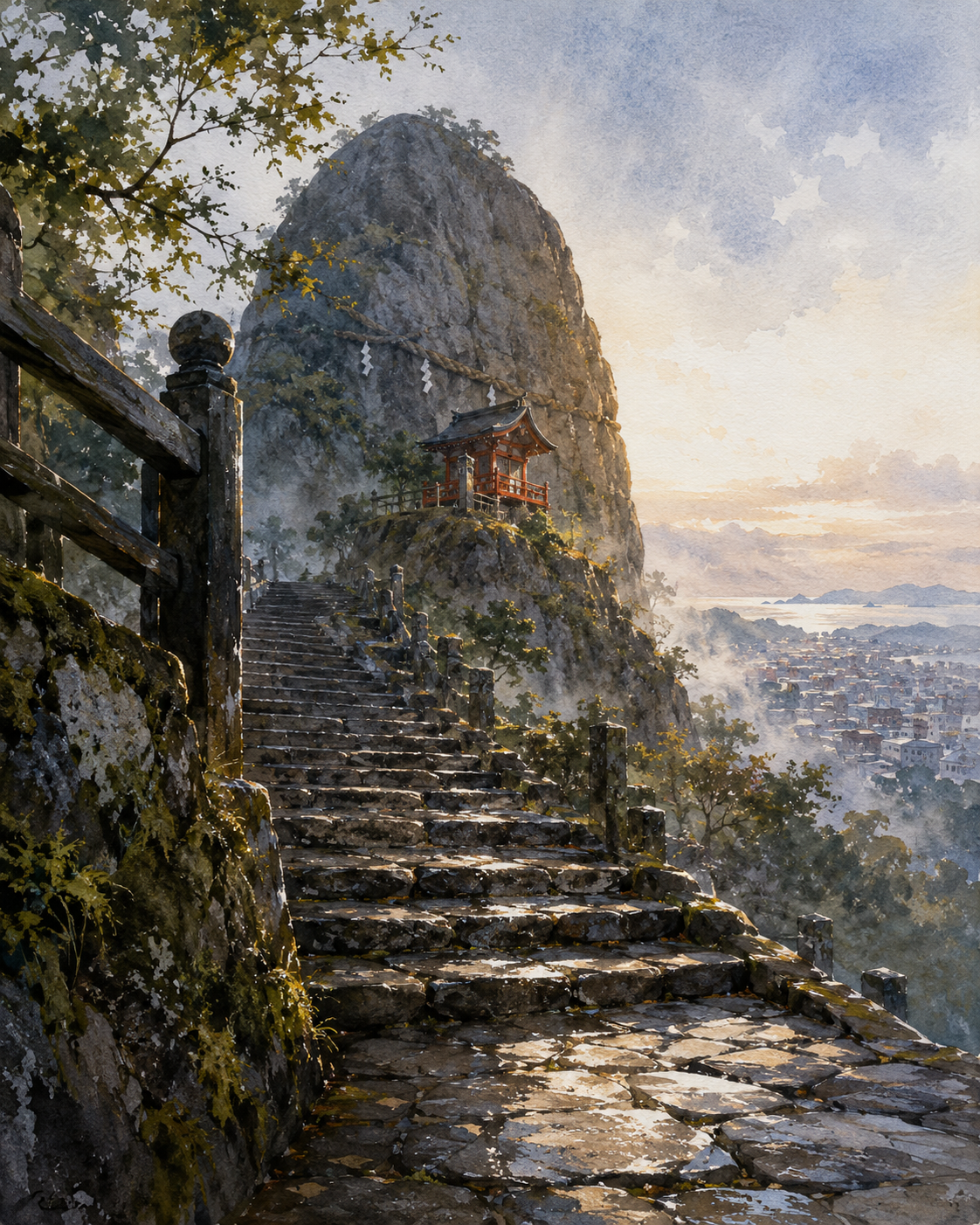
Prayer Clings to the Mountain's Heart
Critique
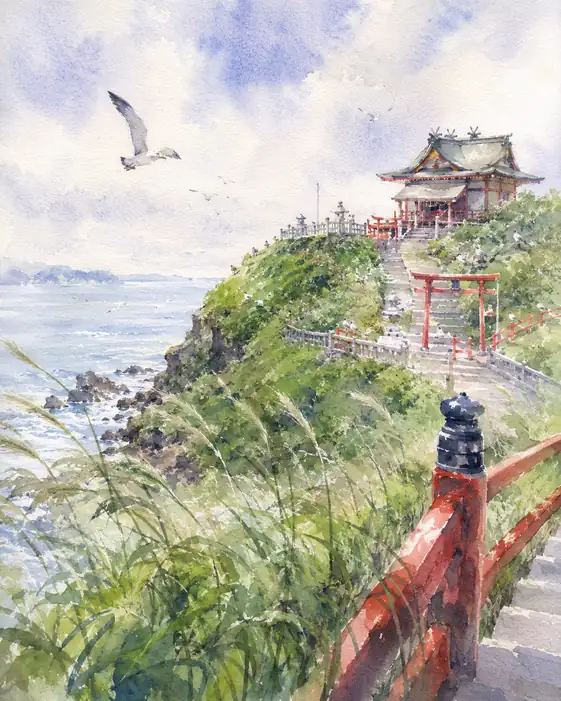
Introduction This painting presents a steep sacred approach where human construction, exposed rock, and a distant coastal settlement share continuous space. Its immediate focus is the small vermilion shrine set against the monumental stone outcrop, but the ascending path gives the scene its narrative force. Description Broad, irregular steps rise from the lower edge and turn toward the shrine at mid-height. A heavy wooden railing and mossed rocks occupy the shadowed left side, while the right side opens across misty roofs, water, and low islands. The palette combines charcoal gray, muted green, warm brown, pale blue, and restrained touches of vermilion. Analysis The stairway establishes a strong diagonal that carries the eye upward before the large rock redirects it vertically. Differences in scale make the shrine appear delicate without diminishing its authority. Dark foreground masses balance the luminous sky, and the distant town is softened through atmospheric perspective. Broken washes and dry, granular marks distinguish wet stone, foliage, timber, and cloud while preserving unity across the surface. Interpretation and Evaluation The image can be read as an encounter between effort, devotion, and expansive vision. The convincing drawing of the steps supports physical credibility, while the composition transforms ascent into a measured psychological progression. Color is controlled rather than decorative, and the selective brightness around the shrine gives the familiar motif an individual emphasis. The technique effectively joins precise structure with an open, breathable atmosphere. Conclusion At first glance the work appears to celebrate a dramatic mountain sanctuary, but sustained viewing reveals that the path is equally important as the destination. Its strongest achievement is the balance between weight and openness, allowing a specific landscape to suggest reflection, endurance, and release.
Same Subcategory
 The Stairway Winter Cannot Silence
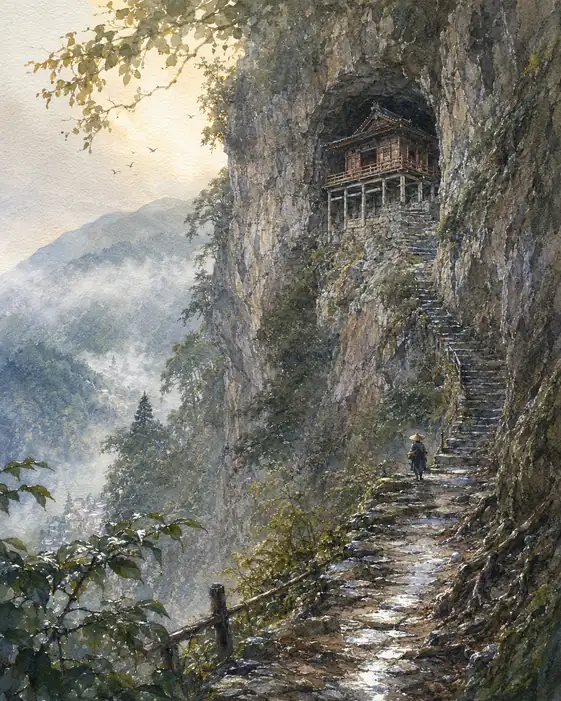 One Step Closer to Heaven
Similar Artworks
 Lanterns Climb Through Winter
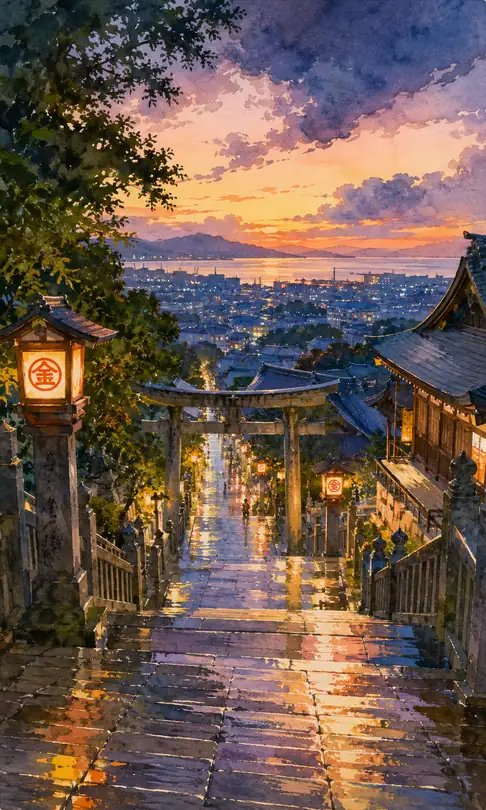 Evening Pours Down the Steps
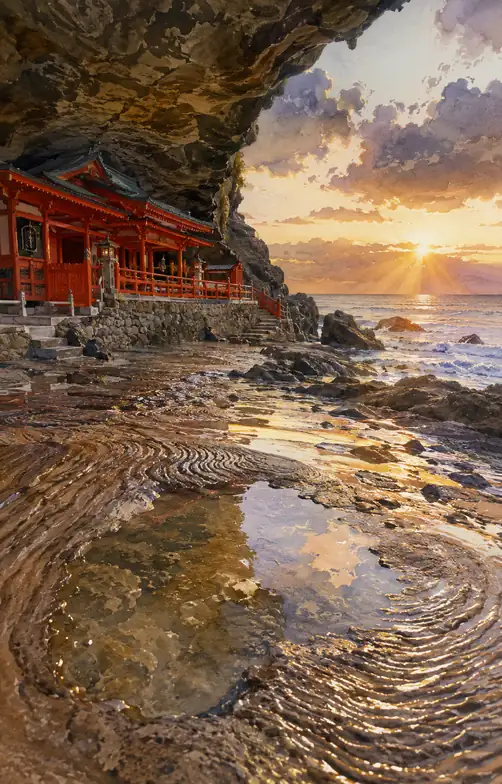 The Cave Keeps a Shrine for the Setting Sun
 Every Step Holds the Evening
 Ascending the Vermilion Silence
 Path of the Sea Breeze and Sacred Vermilion
 Where the Ocean Prays: The Temple in the Spray
 The Stairway between Two Silences
 Steps Rising through Cedar Silence
 A Small Gate Beneath the Infinite Blue