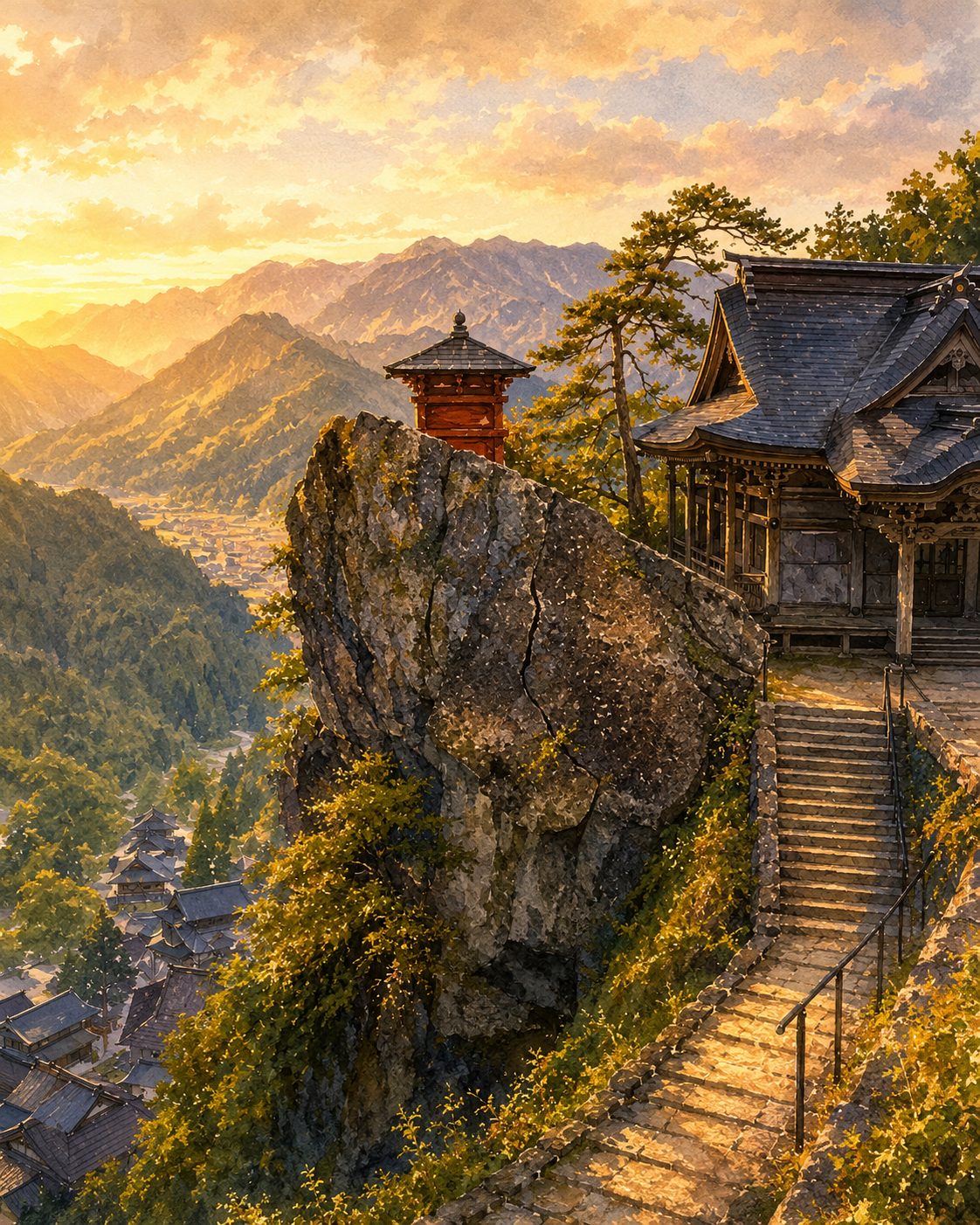
A Lone Vermilion Glow on Yamadera's Cliff Edge
Critique
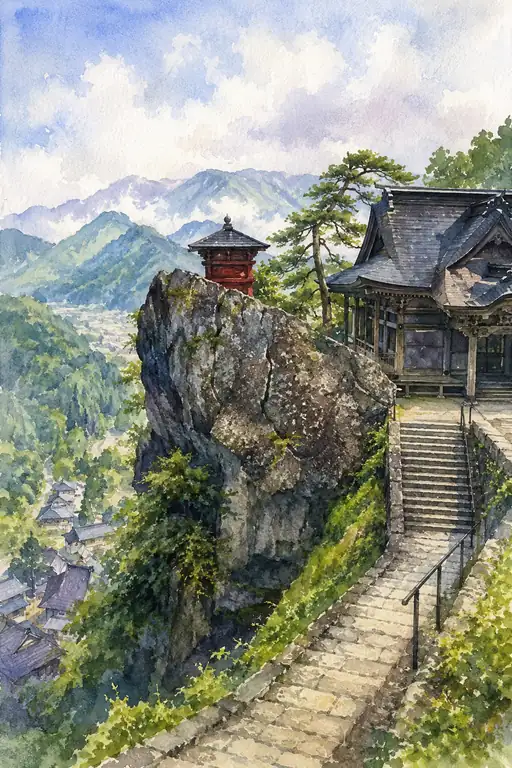
Introduction Golden sunset covers a mountain temple, monolith, and valley. Hall, stairs, red shrine, and village are joined by strong diagonal light, as if evening blessing enters difficult terrain. Description The central rock carries dark gray-brown planes, fissures, moss, and shrubs touched by gold. A red shrine rises behind it. At upper right, deep eaves and timberwork glow along their edges. Wet steps reflect narrow strips of light. Temple and village roofs overlap in the valley before green and violet mountains. The sky shifts from white-gold through orange and pink beneath luminous cloud. Analysis Light flows diagonally across mountain, rock, architecture, and stairs, unifying their values. The dark monolith is balanced by bright sky left and illuminated steps right. Red echoes the warm atmosphere while retaining clear focus. Fine marks describe rock and timber; broad fields describe sky and distance. Rim light makes complex forms legible, and the settlement measures height. Interpretation and Evaluation Sunset marks ending, yet light on the sanctuary suggests relief after ascent. Stable rock is temporarily transformed by passing illumination. Buildings share that light with nature and enter the same daily cycle. Because gold also reaches the village, sacred height is not uniquely chosen; prayer and ordinary life remain one world. Conclusion Evening transforms familiar structures and makes time itself a subject. Light along the stairs invites ascent, while open sky releases vision beyond the valley. Deep shadow makes gold feel like brief grace rather than decoration. Shrine, hall, and settlement occupy different heights but express continuity between devotion and life. Severity, quiet, and exhilaration meet convincingly.
Same Subcategory
Similar Artworks
 Under the Cloud, the Sacred Door
 The Stone Remembers Every Ascent
 A Shrine Held Between Clouds
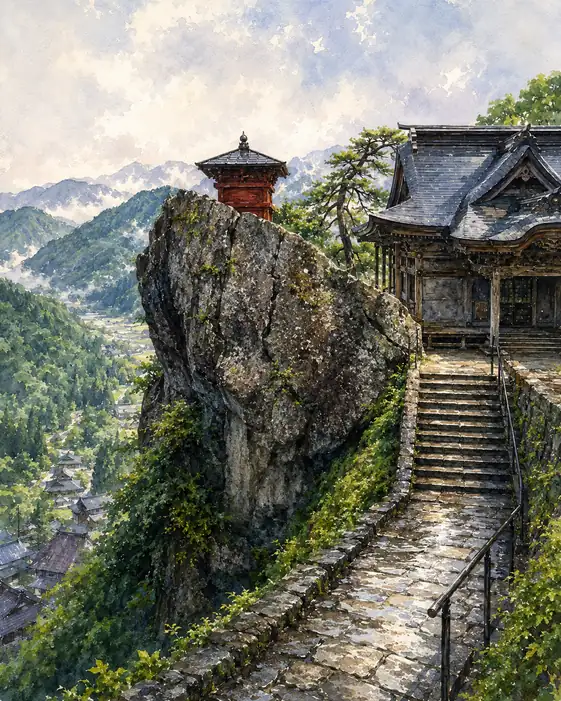 The Mountain Grants a Narrow Path
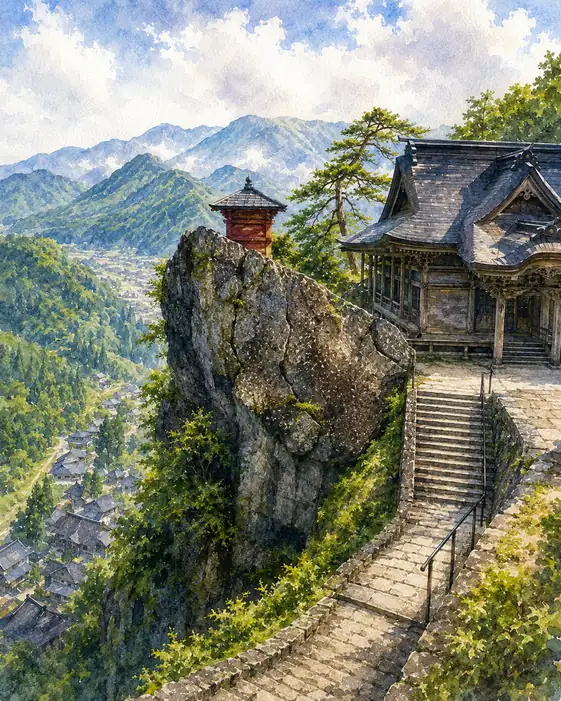 Where the Valley Learns to Pray
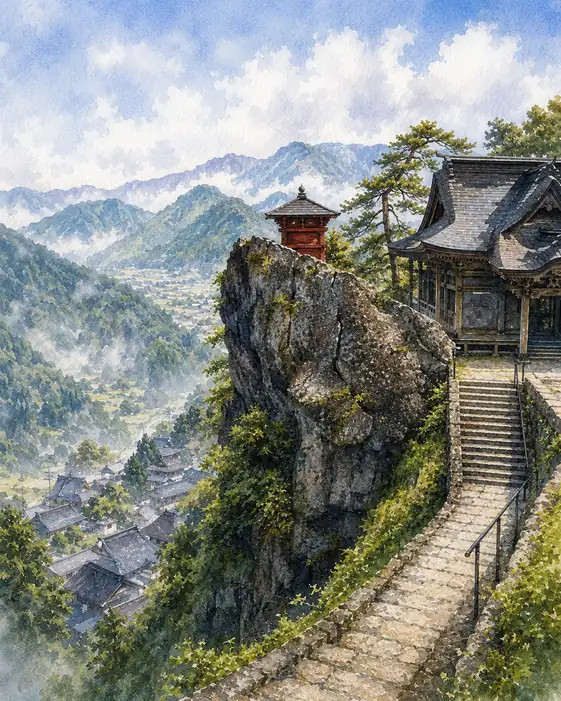 Where Prayer Rests on Stone
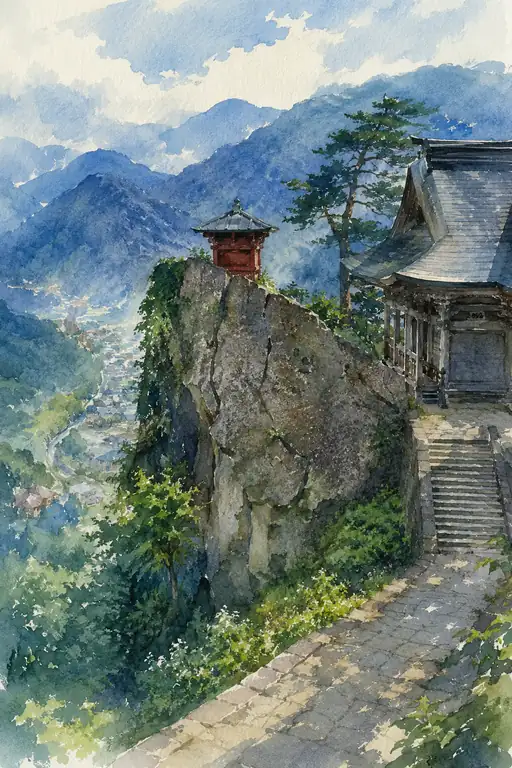 At the Edge Where Prayer Dwells
 The Mountain Leaves No Easy Prayer
 Every Roof Is Another Prayer
 Faith Finds a Foothold in Stone