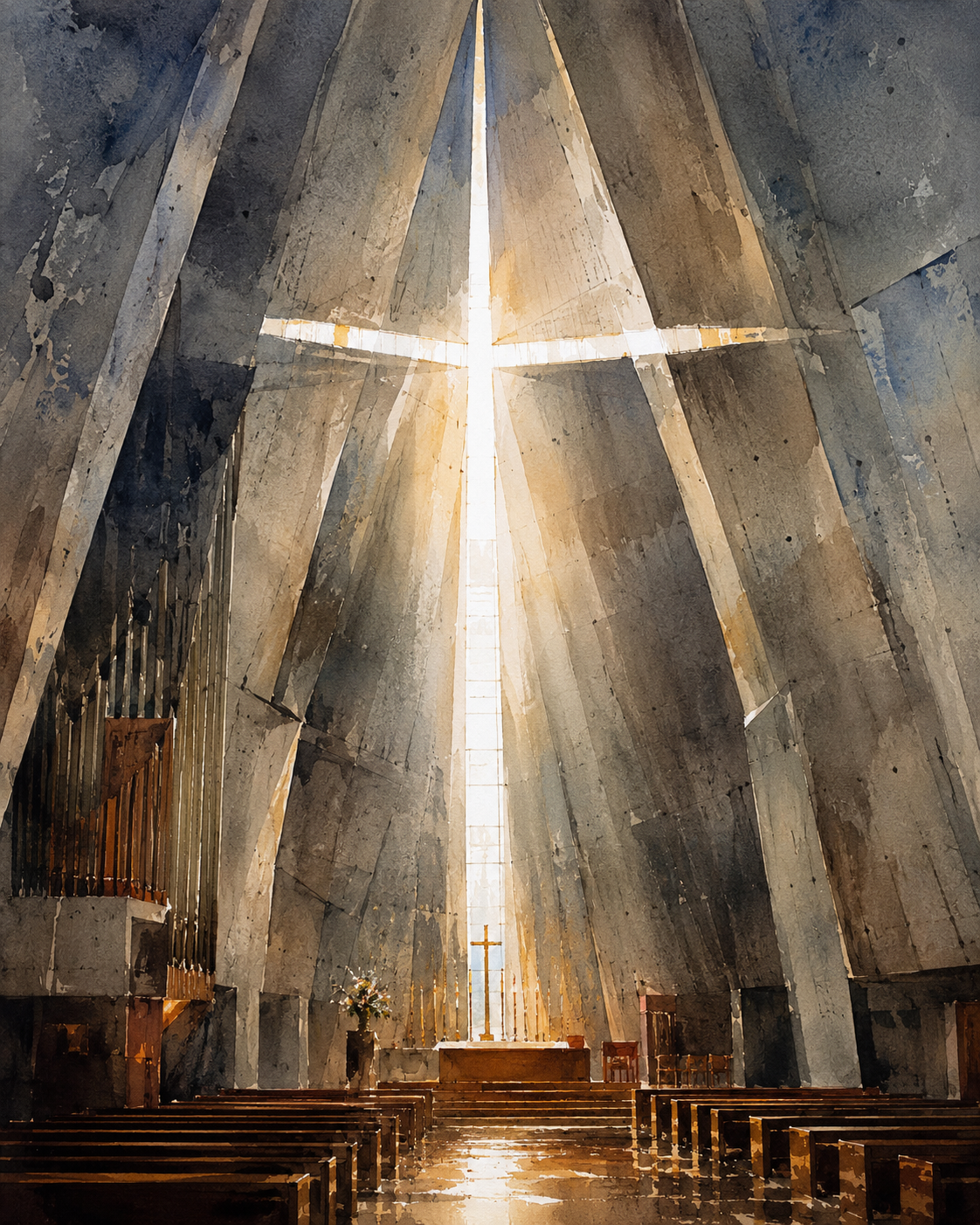
A Cross Cut from Silence
Critique
Introduction This vertical watercolor presents a cathedral interior organized around concrete planes and a luminous cross-shaped opening. Human presence is absent, allowing architecture and directed light to become the primary subjects. A gray palette is interrupted by warm illumination above the altar. Description A narrow vertical window rises through the center and meets a horizontal opening high above, forming a radiant cross. Sloping walls converge toward a small altar and crucifix, while ranks of wooden pews occupy the lower foreground. Dark organ pipes stand at left, and the polished floor carries broken reflections of white and amber light. Analysis The composition approaches symmetry, although the dense organ and the more open right side introduce a useful imbalance. Repeated diagonals in the walls intensify the upward movement and make the central axis appear still taller. Transparent washes, granular blooms, and dry marks distinguish rough concrete from metal pipes, wooden furniture, and the reflective floor. Tonal contrast is carefully controlled, with the brightest area reserved for the architectural cross. Interpretation and Evaluation The cross is not applied ornament but light cutting through the building itself. The modest altar establishes a human measure within an immense structure. The painting demonstrates compositional discipline, economical color, and convincing material description. Its originality lies in turning a severe modern interior into an experience of quiet attention without figures or decorative excess. Conclusion At first the towering walls dominate the encounter, but sustained viewing reveals that every plane serves as a vessel for the central light. The preserved darkness prevents the illumination from becoming theatrical. Architectural precision and watercolor irregularity are held in productive balance, giving the scene both solemn clarity and atmospheric life.
Same Subcategory
 The Watcher Beyond the Tide
 Lamps Lead Toward the Temple
Similar Artworks
 A Spire Gathering the Rainlight
 The Stairway Inside a Shattered Rainbow
 Sunset Enters the Fissure
 We Stood Where the Sun Became Water
 The Red Span Beyond the Mist
 Two Figures at the Edge of Gold
 Arches Where Trains Became Echoes
 Daylight Finds the Underworld
 One Umbrella Above the Current
 The World Begins Beyond the Clouds