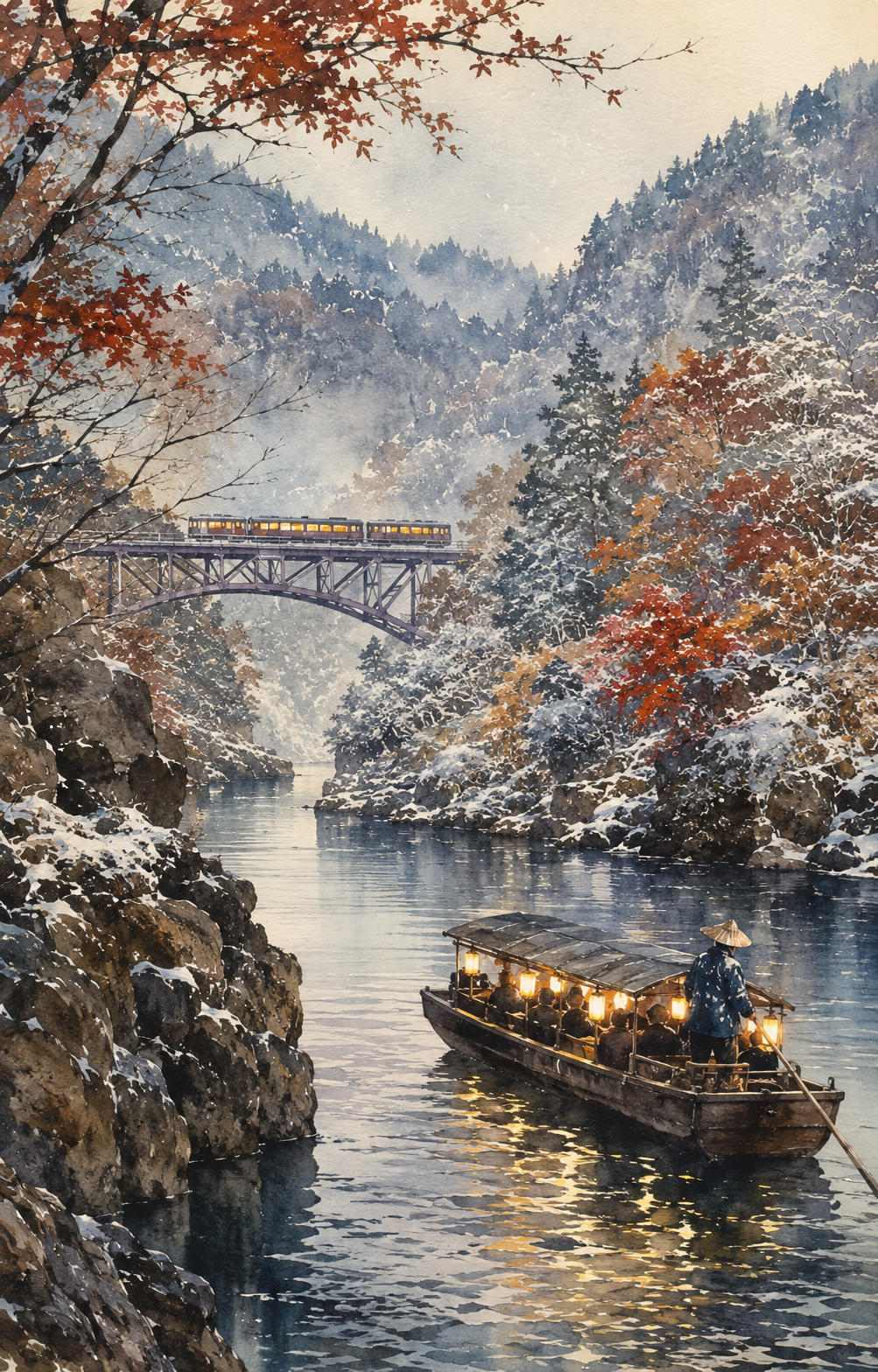
Two Journeys Through the First Snow
Critique
Introduction This painting joins a snowy gorge, autumn color, a railway bridge, and a lantern-lit boat. Train and vessel cross the valley at different heights and speeds. Against blue-gray snow, orange lights make human travel visible within severe nature. Description A steel arch bridge crosses the upper center, carrying a short train with yellow windows. Below, a narrow river flows toward the viewer. At lower right, passengers sit beneath the roof of a boat while a standing operator handles a pole. Snow covers rocks and conifers, although rust-red leaves remain. Mist and flakes soften distant mountains, and lanterns reflect across the water. Analysis The bridge's horizontal, the river's recession, and the boat's diagonal provide three strong axes. Train and boat occupy separate scales and levels, revealing both height and distance. Watercolor diffusion dissolves snow and mist, while rocks and metal keep firmer contours. Warm lights remain limited in area and therefore function as precise focal notes against white snow and blue water. Interpretation and Evaluation The train follows a modern timetable; the boat follows current and bodily labor. Their coexistence layers different historical experiences of moving through one landscape. Remaining leaves and new snow create a parallel threshold between seasons. Figures stay small enough to preserve nature's scale, yet repeated lights ensure that human life remains present. The organization of several temporal contrasts is especially effective. Conclusion The boat commands attention, but the distant train supports the gorge's scale and narrative. Lantern reflections visualize irregular water, unlike straight railway windows. A dark left rock anchors the brilliant bank. Distinctions among flakes, fog, and foliage turn differing travel speeds and seasonal transition into restrained lyricism.
Same Subcategory
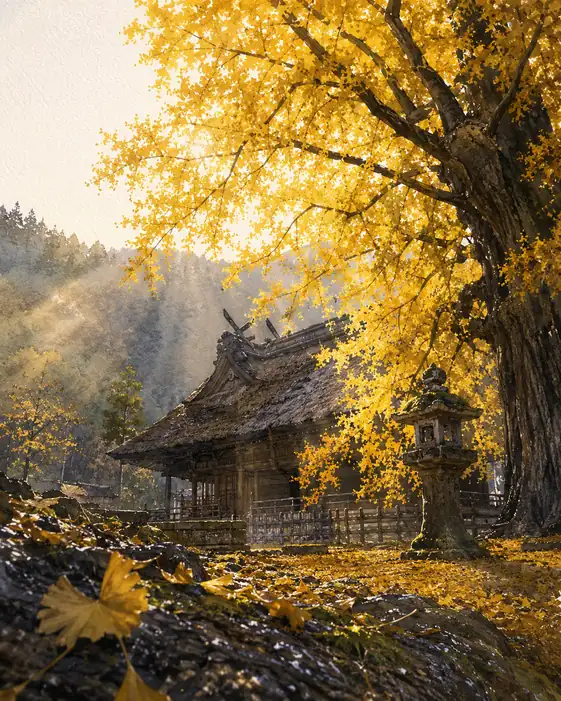 Beneath the Golden Guardian
Similar Artworks
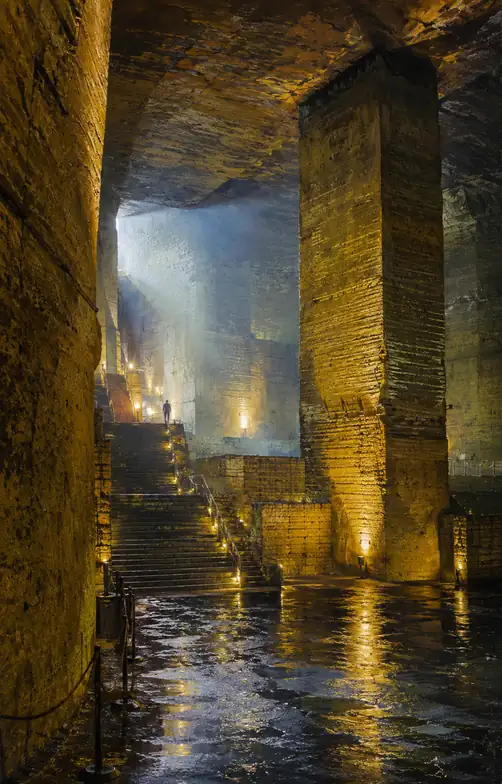 Cathedral of the Quarry
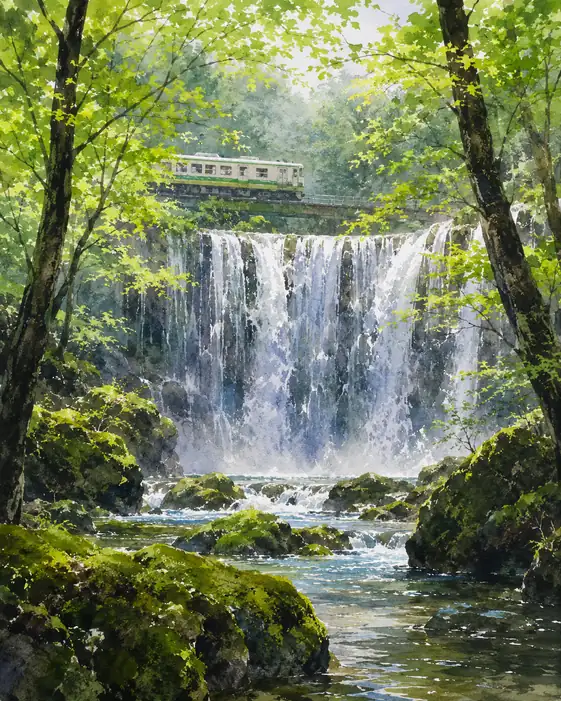 A Wind of Seven Blessings over Ryumon Falls
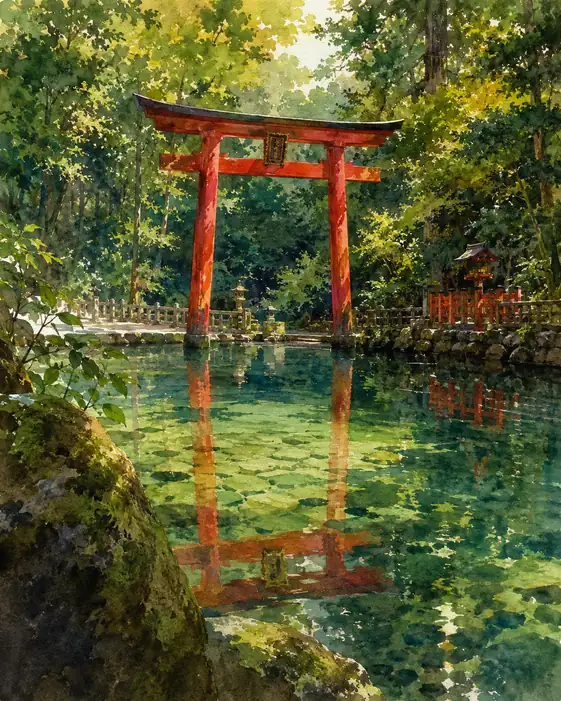 A Gate Reflected Inward
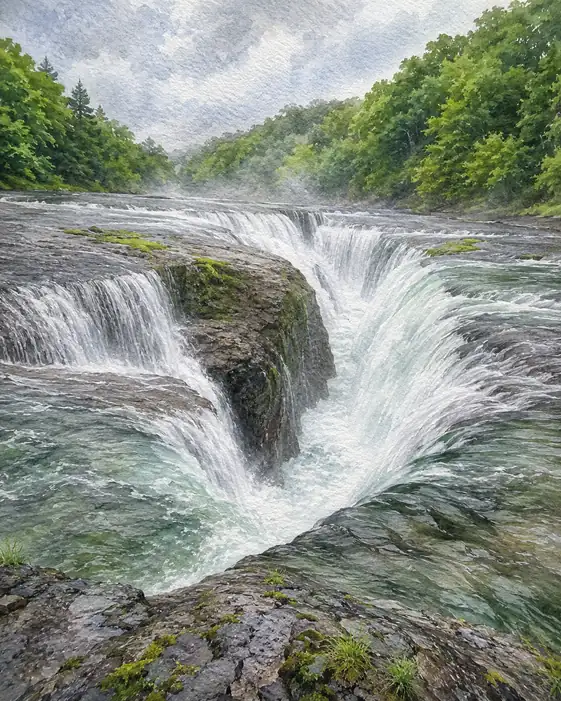 Where Water Carves Its Own Name
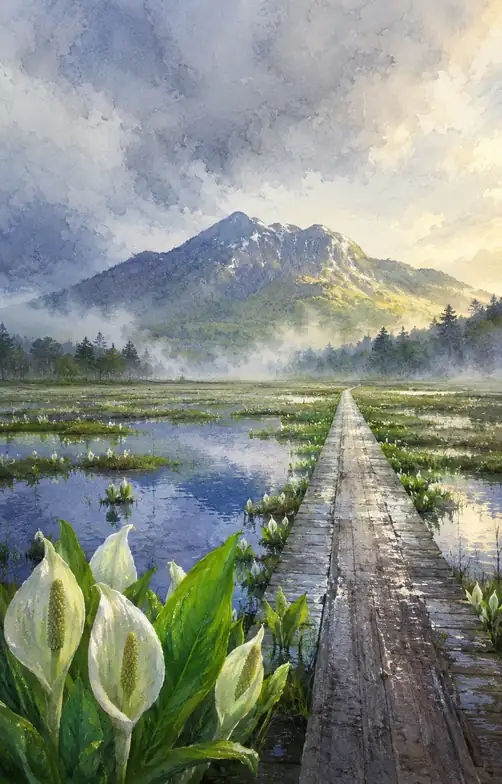 The White Flowers Guide My Steps
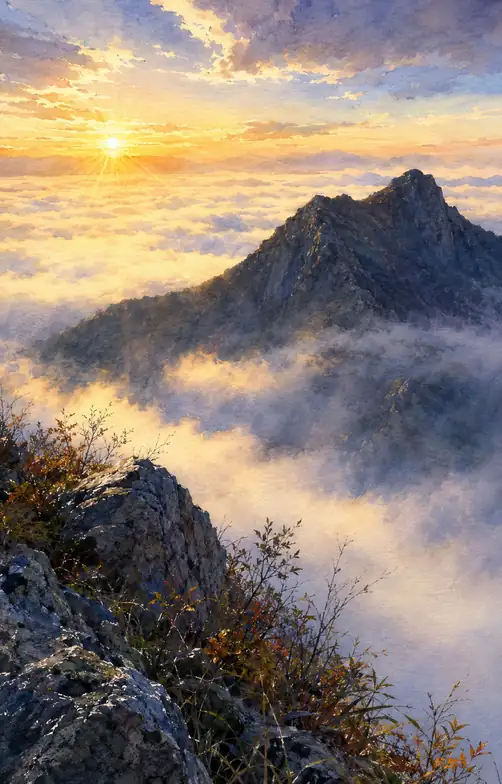 Morning Poured Across the Clouds
 Beyond the Reach of My Small Light
 The Stone Hall Keeps Its Silence
 The Gate Beneath the Water
 The Float Passes Through Rain